History of (tagg)Art...
HomeNatureIdentityRenaissanceBaroque

Nature

  • All Nature artworks
  • Landscape or Seascape in 2D
  • Animals in 2D or 3D
  • The Elements (Fire, Water, Wind or Earth) in 2D or 3D
  • +3 more topics

Identity

  • All Identity artworks
  • The Divine in 2D or 3D Works
  • Portraits in 2D Works
  • Portraits in 3D Works
  • +3 more topics

Renaissance

  • All Renaissance artworks
  • Religious Painting
  • Religious Sculpture
  • Mythological in 2D or 3D
  • +3 more topics

Baroque

  • All Baroque artworks
  • Religious Painting
  • Religious Sculpture
  • Mythological Painting
  • +6 more topics

About

A comprehensive study resource for Pearson Edexcel History of Art A-Level.

NatureIdentityRenaissanceBaroque

History of (tagg)Art... - A-Level Study Resource

Pearson Edexcel Specification

Admin
  1. Home
  2. Identity
  3. How Does a Girl Like You get to Be a Girl Like You?

How Does a Girl Like You get to Be a Girl Like You?

Yinka Shonibare, 1995
IdentityEthnic Identity in 2D or 3D WorksPost-1850
How Does a Girl Like You get to Be a Girl Like You? by Yinka Shonibare
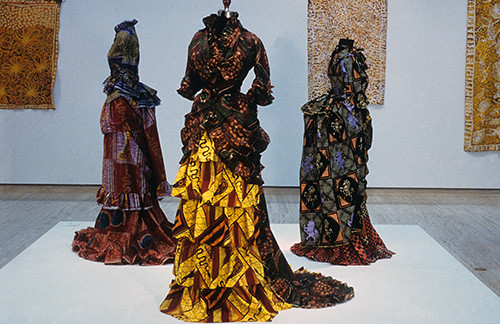
How Does a Girl Like You Get to Be a Girl Like You?, Yinka Shonibare CBE, 1995, fiberglass mannequins, Dutch wax print cotton, Museum of Modern Art, New York

Overview

About This Work

How Does a Girl Like You Get to Be a Girl Like You? (1995) is a seminal sculptural installation by British-Nigerian artist Yinka Shonibare CBE (b. 1962). The work consists of three life-size, headless fiberglass mannequins dressed in opulent 19th-century Victorian gowns constructed entirely from Dutch wax print fabric. Housed in the Museum of Modern Art, New York (among other major collections), this early work established Shonibare's signature aesthetic and introduced the conceptual frameworks that would dominate his practice: the interrogation of authenticity, the complexity of post-colonial identity, the deconstruction of fixed cultural categories, and the strategic use of hybridity as artistic and political strategy. The title is drawn from Alfred Hitchcock's 1959 spy thriller North by Northwest, invoking the figure of the femme fatale—a woman whose agency and identity are perpetually questioned, performed, and contested. The work functions simultaneously as sculpture, fashion statement, historical critique, and philosophical meditation on how identity is constructed through clothing, visibility, and the body.

Visual Analysis

Composition

The Headless Figures: The absence of heads is the defining formal feature. The mannequins are decapitated, a visual reference to the French Revolution and the guillotine (1793). Shonibare has stated this was partly "a joke"—a dark humour about the violent erasure of aristocratic privilege. More conceptually, the missing heads remove individual personality, emotion, and facial identity, leaving only the dressed body. This emphasizes that identity is constructed through costume and display, not through innate or psychological essence. The Three Figures: Unlike a single-figure portrait, Shonibare presents a trio. They are arranged in loose spatial relationship—one turns toward the group, another faces out to the right, the third to the left. This creates compositional interest and suggests a narrative moment (a conversation, a social gathering) without any actual narrative content. Scale and Presence: Life-size mannequins create an uncanny, theatrical presence. They occupy the gallery space at human height, forcing the viewer to engage with them as quasi-human presences, yet their blankness (missing heads, fiberglass skin) creates psychological distance and artificiality.

Colour & Light

Vibrant Saturation: The colours are deliberately vivid and eye-catching, violating the subtle restraint typically associated with "serious" contemporary art. This gaiety and opulence resist the austere minimalism that dominated 1990s conceptual art, asserting decorative beauty as a legitimate artistic value. Pattern Repetition: The textiles are mass-produced fabrics with repeating patterns. This mechanized repetition and accessibility (the fabric is available in Brixton market where Shonibare sourced it) contrasts with the exclusivity and hand-craftsmanship traditionally associated with high art. It challenges the boundary between "art" and "craft," between the elite and the vernacular.

Materials & Technique

Dutch Wax Print Fabric: The entire dress of each figure is constructed from vibrant, patterned Dutch wax print textiles (also called Ankara or African print). These fabrics feature bold geometric patterns, rich colour combinations (deep blues, jewel greens, reds, golds), and eye-catching designs. The Historical Irony: While these fabrics are culturally associated with African and Afro-diasporic identity, they are not authentically African. They were invented in Indonesia, manufactured industrially by the Dutch and English in the 19th century, and exported to West Africa (and later the broader African continent) as part of the colonial and post-colonial economy. Africans adopted them as symbols of identity, agency, and post-colonial pride. Thus, the fabric itself embodies colonial violence, economic exploitation, and cultural reclamation simultaneously. The Victorian Silhouette: The dress cut is strictly 19th-century European—a full-skirted, cinched-waist Victorian gown with elaborate draping and corseted structure. This juxtaposition (European silhouette + non-European fabric) creates a visual hybridity that mirrors Shonibare's own identity as someone who is neither "purely" British nor "purely" Nigerian, but irreducibly both/neither.

Historical Context

Context

Shonibare's Biography: Shonibare was born in London (1962) but grew up in Lagos, Nigeria (1966–1975), where he spoke Yoruba at home and attended British schools. His family then returned to London when he was 12. This migration and cultural liminality are fundamental to understanding his artistic practice. He is neither an "African artist" nor a "British artist," but a post-colonial subject shaped by both cultures' contradictions. The "Sensation" Exhibition (1997): Although How Does a Girl Like You was created in 1995, it gained international prominence when included in the controversial "Sensation" exhibition at the Royal Academy, London (1997). Organized by Charles Saatchi, the exhibition showcased Young British Art (YBA) and sparked tabloid outrage over "conceptual" rather than "skilled" art. Shonibare's work, with its decorative beauty and conceptual sophistication, stood out as intellectually rigorous amid the shock-value sensationalism of other pieces. Post-Colonial Theory Context: The 1990s saw the emergence of critical post-colonial theory (Gayatri Spivak, Homi Bhabha, Stuart Hall). Bhabha's concept of "hybridity" as a strategic space of resistance and negotiation deeply influenced Shonibare's artistic thinking. He was articulating, through visual form, theories about identity that academic critics were simultaneously theorizing in writing. Fashion and Identity Politics: The 1990s also witnessed growing interest in how clothing constructs identity, particularly in feminist and post-colonial frameworks. Shonibare was part of a broader turn toward fashion, textiles, and the "decorative" arts as serious sites of political meaning-making.

Key Themes

Identities and Hybridity

Radical Hybridity: The work does not resolve into a clear position. It is neither celebrating African identity nor critiquing Western fashion. Instead, it holds both in productive tension, asserting that contemporary identity cannot be "pure" or fixed to a single nation, culture, or aesthetic tradition. The Constructed Nature of Identity: By replacing a "real person" with a mannequin, Shonibare emphasizes that identity is performance and costume, not an essential, unchanging core. The Victorian dress code creates a "character" or social role; the wearer becomes legible as a particular type of person (wealthy, European, leisured). Yet the non-European fabric disrupts this legibility, refusing easy categorization. The Female Body and Visibility: The figures are female bodies (the mannequins have female proportions). Victorian dress codes controlled female bodies through corseting and restriction. Yet by rendering them headless, Shonibare paradoxically liberates them from the gaze that seeks to know and classify them. They are visible but unknowable; present but absent. Fashion, Power, and Colonialism: Textiles as Colonial Archive: The Dutch wax print fabric carries colonial history within its material form. By using it to make European fashion, Shonibare makes visible the hidden colonial networks that undergird everyday aesthetics. It is a way of writing colonial history onto the body.

Exam Focus Points

Critical Perspectives

The Title's Significance: The title is borrowed from North by Northwest, a film about mistaken identity, spies, and the gap between appearance and reality. It suggests that the question "How does a girl like you get to be a girl like you?" is unanswerable—identity is not something one "gets to be," but something one performs and is read as by others. The question is intentionally irresolvable. Headlessness as Strategy: Unlike headlessness in other contexts (violence, death, the grotesque), Shonibare's heads are absent as a conceptual move. It removes individualizing features and opens the space to multiple readings. The figures could be anyone; this is the point. It resists the portrait tradition's investment in capturing a unique individual soul. The Brixton Market Context: Shonibare sourced these fabrics from Brixton market in London—a site of post-colonial, Black British, and diaspora commerce. By choosing affordable, available fabrics rather than rare/precious ones, he resists the elitism of high art. He is saying: high art can be made from the vernacular, the popular, the quotidian. Comparison to Haute Couture: Where fashion designers use textiles to create beauty and status, Shonibare uses textiles to interrogate beauty and status. He is not celebrating consumption; he is making it visible and questionable. Gender and the Mannequin: The mannequin is traditionally a tool of fashion display and the commodification of the (female) body. By using headless mannequins, Shonibare both invokes and disrupts this tradition. The figures are simultaneously objects of display and subjects who resist being known/consumed.

On this page

OverviewVisual AnalysisHistorical ContextKey ThemesExam Focus Points