History of (tagg)Art...
HomeNatureIdentityRenaissanceBaroque

Nature

  • All Nature artworks
  • Landscape or Seascape in 2D
  • Animals in 2D or 3D
  • The Elements (Fire, Water, Wind or Earth) in 2D or 3D
  • +3 more topics

Identity

  • All Identity artworks
  • The Divine in 2D or 3D Works
  • Portraits in 2D Works
  • Portraits in 3D Works
  • +3 more topics

Renaissance

  • All Renaissance artworks
  • Religious Painting
  • Religious Sculpture
  • Mythological in 2D or 3D
  • +3 more topics

Baroque

  • All Baroque artworks
  • Religious Painting
  • Religious Sculpture
  • Mythological Painting
  • +6 more topics

About

A comprehensive study resource for Pearson Edexcel History of Art A-Level.

NatureIdentityRenaissanceBaroque

History of (tagg)Art... - A-Level Study Resource

Pearson Edexcel Specification

Admin
  1. Home
  2. Baroque
  3. The Martyrdom of St Peter

The Martyrdom of St Peter

Caravaggio, 1601
BaroqueReligious PaintingItalian Artists
The Martyrdom of St Peter by Caravaggio
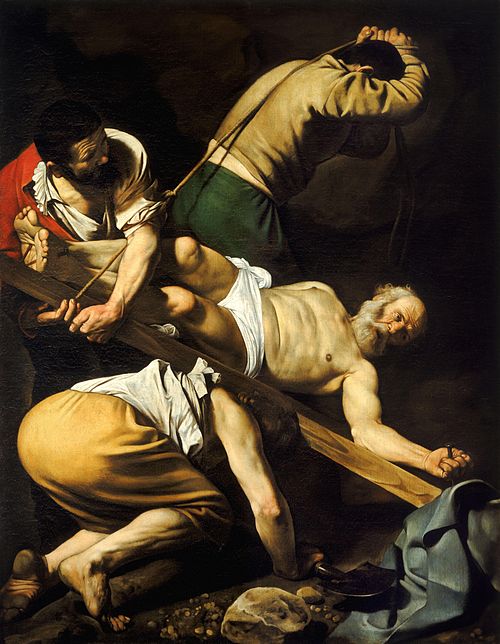
The Martyrdom of St Peter (Crucifixion of St Peter) by Caravaggio, 1601, oil on canvas, Cerasi Chapel, Santa Maria del Popolo, Rome

Overview

About This Work

Painted in 1601, The Martyrdom of St Peter (also known as The Crucifixion of St Peter) is a seminal masterpiece of the Roman Baroque, located in situ in the Cerasi Chapel of Santa Maria del Popolo, Rome. It depicts the final moments of Saint Peter who, according to tradition (specifically the Golden Legend), requested to be crucified upside down as he felt unworthy to die in the same manner as Christ. Commissioned in September 1600 by Monsignor Tiberio Cerasi, Treasurer-General to Pope Clement VIII, the painting sits directly across from Caravaggio's Conversion of St Paul (1601), flanking the chapel's altarpiece, The Assumption of the Virgin by Annibale Carracci. This work represents a radical departure from Mannerist artificiality, grounding sacred history in brutal, physical reality and marking the height of Caravaggio's Roman period.

Visual Analysis

Composition

Structure & Geometry: The composition is dominated by a destabilizing system of diagonals (a chiastic or "X" structure). A large "X" is formed by the wooden cross and the straining bodies of the executioners, creating a sense of dynamic, mechanical tension. Unlike the stable pyramid compositions of the Renaissance, this structure is inherently unstable, capturing a moment of violent transition. The Wheel of Action: The figures are arranged in a tightly rotating circle around the central pivot of the cross. This creates a centrifugal force that pushes the viewer's eye around the canvas in a clockwise motion—from the shovel in the foreground, up the executioner's back, to the rope-puller, and finally to Peter's face. This emphasizes the sheer physical labor involved in the execution rather than spiritual transcendence. Framing & Foreshortening: Caravaggio eliminates the horizon entirely, replacing deep space with an impenetrable darkness. The action is pushed aggressively into the foreground (repoussoir), forcing the viewer to confront the scene intimately, as if stumbling upon it in a dark alley. The saint's left arm extends toward the viewer, and the executioners' limbs are heavily foreshortened, projecting the scene into the viewer's space to heighten the immersive impact. Balance: The composition is weighted heavily towards the bottom left, grounding the scene in gravity and dirt. The massive stone in the foreground (symbolizing Peter as the "rock" on which the Church is built) anchors the dynamic struggle above it.

Colour & Light

Tenebrism: Caravaggio utilizes his signature tenebrism (an extreme form of chiaroscuro), where a stark, single light source cuts through an encompassing darkness. The background is a void of black, stripping away all context of time or place to focus solely on the physical and psychological drama. Palette: The palette is dominated by earthy, humble tones—ochres, burnt umbers, and dull greens—worn by the executioners. This sharply contrasts with the bright white loincloth of Peter and his pale, aging flesh tones, which catch the harshest light. The red of the executioner's jacket serves as a visual anchor, leading the eye into the center of the struggle. Symbolic Light: The light source falls from the upper left (corresponding to the actual light source in the Cerasi Chapel), illuminating Peter's face and torso. In the absence of angels or opening heavens, this light serves as the only manifestation of divine presence, spotlighting the martyr's stoic acceptance.

Materials & Technique

Medium: Oil on canvas. Caravaggio worked directly onto the canvas (alla prima), rejecting the academic practice of detailed preparatory drawings. Process: Recent x-ray analysis reveals he often "drew" directly in the wet ground layer with the handle of his brush (incisions), marking out key positions of limbs and architectural elements before painting. This allowed him to maintain the spontaneity of the live models. The "Rejected" History: This is actually the second version Caravaggio painted for the chapel. The first version, painted on cypress wood (as per the contract), was reportedly rejected by the patron (or withdrawn by the artist himself) and purchased by Cardinal Sannesio. The final version is darker, simpler, and more monumental than what was likely a more cluttered first attempt.

Historical Context

Context

The Artist: Michelangelo Merisi da Caravaggio (1571–1610) was the revolutionary "bad boy" of the Baroque—violent, rebellious, yet brilliantly devout in his art. He sought to bring religious experience down to earth, making the divine accessible to the poor and illiterate by using street people as models for saints. The Period: Created during the Counter-Reformation and the Jubilee Year of 1600. The Council of Trent (1545–1563) had demanded religious art be clear, realistic, and emotionally stimulating to inspire devotion, rejecting the complex intellectual puzzles of Mannerism. The Church wanted art that could speak directly to the faithful, emphasizing martyrdom and the validity of the saints. Commission: Tiberio Cerasi commissioned Caravaggio for the side walls and Annibale Carracci for the altar. This placed the two great rivals of the Roman Baroque—the "Realist" (Caravaggio) and the "Idealist" (Carracci)—in direct competition within the same small space. Cerasi's choice of Peter and Paul (the two patron saints of Rome) reaffirmed the authority of the Papacy during a time of Protestant challenge.

Key Themes

Connection to Baroque

Exam Focus Points

Critical Perspectives

The "Dirty Feet" Controversy: 17th-century critics like Giovanni Pietro Bellori attacked Caravaggio for his "vulgarity" and lack of decorum, specifically citing the prominent dirty feet of the executioner in the foreground (the "buttocks" controversy). They argued he simply copied nature without "correcting" it. However, modern art historians view this as a deliberate theological choice to ground the sacred in the profane reality of the human condition—Peter is a saint of the earth. Comparison with Carracci: In the exam, contrast this work with Carracci's Assumption on the altar. Carracci uses bright colours, idealized figures, and heavenly light (Classicist/Idealist). Caravaggio uses darkness, dirt, and heavy bodies (Naturalist/Realist). This juxtaposition encapsulates the two poles of Baroque art. Absence of the Supernatural: A key exam point is that there are no angels, clouds, or halos. Caravaggio revolutionised religious art by showing that the holy can exist entirely within the physical world, without needing supernatural props to validate it. The spiritual event happens inside the human body. Narrative vs. Iconic: Critics often discuss how Caravaggio freezes the action (the "pregnant moment"). The cross is mid-raise, unstable and heavy. This involves the viewer in the effort of the scene, making them an active participant rather than a passive observer.

On this page

OverviewVisual AnalysisHistorical ContextKey ThemesExam Focus Points