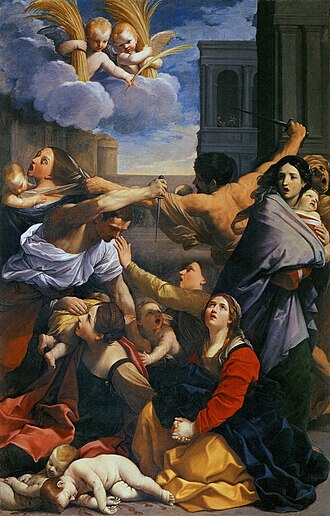
Schopenhauer's Critique: The philosopher Arthur Schopenhauer, in his World as Will and Representation, criticized Reni for depicting "six shrieking, wide-open, gaping mouths." Schopenhauer argued that painting, being a mute art, cannot convincingly depict sound—the open mouths appear ludicrous and break the pictorial illusion. This critique raises the fundamental question: can painting represent emotional extremity without descending into caricature?
The Marino Controversy: Marino's poem was originally thought to reference Reni's painting but scholarship (particularly by Pericolo) has shown that Marino's madrigal was likely written about a different, now-lost painting by Giovanni Paggi. This historical confusion is itself instructive: it reveals how powerfully Reni's work captures the aesthetic and emotional complexity that Marino articulates, making attribution almost secondary to the universal truths the image expresses.
Bolognese Idealism vs. Caravaggian Realism: In exam answers, contrast Reni's approach with Caravaggio's Martyrdom of St. Peter (contemporary, 1601). Where Caravaggio grounds the scene in dirt, shadows, and physical labour, Reni elevates it through classical form, luminosity, and sculptural beauty. Both artists respond to Counter-Reformation demands, but through opposite aesthetic strategies. Reni's choice of idealization does not diminish the horror but rather suggests that beauty and tragedy are inseparable.
The Oxymoron as Artistic Method: The painting's central logic is oxymoronic—beautiful rendering of violence, perfection depicting brutality. This is not a failure of nerve but rather a sophisticated argument about art's capacity to simultaneously beautify and defamiliarize. By making the massacre visually exquisite, Reni prevents easy emotional discharge; the viewer cannot simply pity or condemn, but must hold the contradiction.
Influence on Later Art: The painting became foundational for French Neoclassical painters (Le Sueur, Le Brun) and influenced Picasso's Guernica (1937), which similarly constructs an anti-war statement through formal complexity rather than explicit political rhetoric. This genealogy positions Reni as a proto-modernist, demonstrating that formal innovation and political content are not opposed.