History o' Phoeart
  • Home

Nature

  • Overview
  • Landscape or Seascape in 2D
  • Animals in 2D or 3D
  • The Elements (Fire, Water, Wind or Earth) in 2D or 3D
  • The Relationship between Man/Woman and Nature in 2D or 3D

Identity

  • Overview
  • The Divine in 2D or 3D Works
  • Portraits in 2D Works
  • Portraits in 3D Works
  • Gender Identity in 2D or 3D Works

Renaissance

  • Overview
  • Religious Painting
  • Religious Sculpture
  • Mythological in 2D or 3D
  • Portraits in 2D or 3D

Baroque

  • Overview
  • Religious Painting
  • Religious Sculpture
  • Mythological Painting
  • Mythological Sculpture

About

A comprehensive study resource for Pearson Edexcel History of Art A-Level.

NatureIdentityRenaissanceBaroque

History o' Phoeart - A-Level Study Resource

Pearson Edexcel Specification • Use ⌘K to search

  1. Home
  2. Paper 1
  3. Identity
  4. Gender Identity in 2D or 3D Works
  5. The Silueta Series
Paper 1Identity
Identity
The Divine in 2D or 3D Works
Portraits in 2D Works
Portraits in 3D Works
Gender Identity in 2D or 3D Works
Pre-1850
Post-1850
The Garden of Opportunity

The Garden of Opportunity

Evelyn De Morgan

The Silueta Series

The Silueta Series

Ana Mendieta

Ethnic Identity in 2D or 3D Works
Identity in Architectural Works

6 scopes • 24 artworks

The Silueta Series

Ana Mendieta, 1973-1980
IdentityPost-1850
The Silueta Series by Ana Mendieta
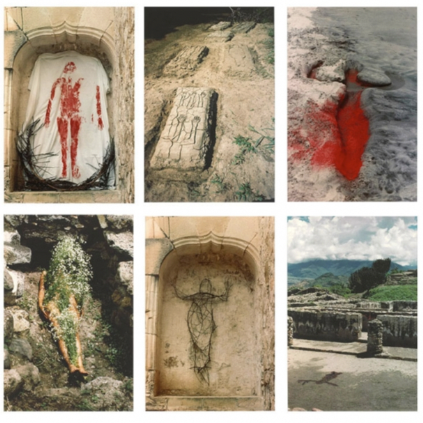
The Silueta Series, Ana Mendieta, 1973–1980, earth-body sculptures documented through photography, various locations including Iowa and Mexico

Overview

About This Work

The Silueta Series (1973–1980) comprises over 200 ephemeral, site-specific performance works by the Cuban-American artist Ana Mendieta (1948–1985). These "earth-body" sculptures—as the artist termed them—exist primarily as documentary photographs. In the series, Mendieta created life-size silhouettes of her body by imprinting, carving, burning, and moulding her form into natural landscapes across Iowa, Mexico, and other locations using materials including earth, sand, snow, ice, flowers, mud, blood, fire, and stone. The series represents one of the most radical contributions to 1970s performance art and feminist body art. Created in the immediate aftermath of Mendieta's relocation to the United States as a 12-year-old Cuban exile (Operation Peter Pan, 1961), the Siluetas address profound themes of displacement, identity, belonging, and the relationship between the (female) body and nature. The works resist commodification by being ephemeral (they erode, disappear, or are destroyed) and exist only through their photographic documentation—a tension between presence and absence that mirrors Mendieta's own liminal position between Cuban and American cultures.

Visual Analysis

Composition

The Body as Trace: Rather than depicting herself as a subject within the frame, Mendieta creates an absence or imprint—a silhouette. Her body is simultaneously present (it creates the mark) and absent (it is not visible in the final artwork). This paradox is fundamental: the documentary photograph shows a trace of something that no longer exists. Life-Size Monumentality: Most Siluetas are rendered at life-size, creating a 1:1 correspondence between the artist's body and the silhouette. This scale is neither monumental (in the public sense) nor intimate; it is exactly the size of a human presence. Aerial and Ground-Level Views: Photographs are often taken from above (creating abstraction) or at ground level (creating intimacy). This varied perspective invites the viewer into different phenomenological relationships with the work.

Colour & Light

Diverse Materials Create Varied Palettes: The series encompasses multiple material approaches: Red paint on sand (stark contrast, evoking blood) White flowers covering the body (merging flesh with flora) Mud on the body (camouflage and transformation) Ice and snow (vulnerable, melting forms suggesting impermanence) Fire (Alma Silueta en Fuego, 1976—the figure is set aflame, consuming itself) Carved stone and limestone (more permanent, but still subject to erosion) The colour red recurs throughout—blood, ochre, fire—suggesting life force, violence, sacrifice, and female bodily experience (menstruation, birth).

Materials & Technique

Landscape as Co-Creator: The landscapes themselves—rivers, beaches, meadows, forests—are not neutral backdrops but active participants. The ocean erodes the sand silhouettes; rain and melting destroy ice works; vegetation reclaims earth-carved forms. Nature constantly undoes Mendieta's mark-making, asserting its own temporality and power. Specific Key Works: • Image from Yagul (1973): The first Silueta, created spontaneously at a pre-Columbian archaeological site in Mexico. Mendieta lies in an unmarked tomb, her body covered with white flowers. • Flowers on Body (c. 1974–77): Mendieta's nude body lies on the earth, covered entirely with wild flowers, photographed from above. • Tree of Life (1976): Mendieta's mud-covered body merges with a tree trunk, limbs extended, literally fusing human anatomy with botanical form. • Alma Silueta en Fuego (1976): A sculptural silhouette made of earth and straw is set on fire, suggesting both destruction and spiritual transformation.

Historical Context

Context

Operation Peter Pan (1961): Mendieta was 12 years old when she and her sister were sent to the United States as part of this government-sponsored program for Cuban children fleeing Castro's Cuba. They were placed in foster care in rural Iowa—a profoundly alienating and culturally disorienting experience for a young girl from Havana. This displacement haunted her entire artistic practice. 1970s Performance Art Boom: The Siluetas emerged during the height of performance art's emergence as a dominant avant-garde form. Artists like Marina Abramović, Yoko Ono, and Carolee Schneemann were exploring the body as medium and subject. Mendieta's work was unique in synthesizing performance, land art (earthworks tradition), feminist theory, and spiritual/indigenous practices. Feminist Body Art: The 1970s saw a flowering of feminist body art addressing the male gaze, objectification, and reclaiming women's bodies. However, Mendieta's approach was distinctive. While many feminist artists sought visibility (challenging the invisibility of women in art), Mendieta pursued disappearance—using her body to merge with nature rather than command attention. Spiritualism and Indigenous Traditions: Mendieta drew on Santería (an Afro-Cuban religion blending Yoruba deities with Catholicism) and Taíno indigenous practices (pre-Columbian Caribbean cultures). The Siluetas function as rituals, evoking goddess figures and returning to pre-colonial, pre-Christian spiritual frameworks.

Key Themes

Identity, Displacement, Exile, Belonging, Gender

The Search for Home: Mendieta herself stated: "I chose to make the Siluetas because it was a way of reclaiming my roots and becoming one with nature." The series is a geographic and spiritual journey back to origins—she created works in Iowa (site of her traumatic displacement), Mexico (culturally resonant, with Latino communities), and eventually returned to Cuba. The Female Body and Nature: The equation of the female body with earth/nature can be read as essentialist—reinforcing the traditional association of women with nature, reproduction, and irrationality (as opposed to male reason). However, Mendieta was strategic about this. By embracing the nature-female equation, she inverts its devaluation, celebrating it as a source of spiritual power and authenticity. Presence Through Absence: The Siluetas are paradoxically present as artworks only through their absence. Once photographed, they erode, disappear, or are destroyed. This mirrors Mendieta's own position as an exile—physically present in Iowa/America, yet spiritually and psychologically absent from her homeland. Gender and Performativity: While many works feature her nude or semi-nude body, Mendieta refuses voyeuristic presentation. Her body is not displayed for the male gaze but absorbed into nature, becoming depersonalized and de-sexualized. The viewer encounters a silhouette, not a sexualized figure.

Exam Focus Points

Critical Perspectives

Performance vs. Documentation: A fundamental paradox: the Siluetas are performance works, yet they exist only as photographs. What is the "art"—the ephemeral performance or the photograph that documents it? Contemporary viewers never experience the performances themselves; we encounter only traces. This raises epistemological questions about how we know and evaluate art. Essentialism vs. Strategic Subversion: Mendieta used essentialist techniques (female body + nature = wholeness) but deployed them strategically to critique fixed gender identities. Critics have debated whether she endorsed essentialism or exploited it. A sophisticated reading acknowledges both: she used essentialist forms while destabilizing their meanings. Land Art and Feminism: Compare Mendieta to male land artists (Robert Smithson, Andy Goldsworthy). Male earthworks often involve massive intervention in landscape; Mendieta's works are small, intimate, and harmonious with the environment. She does not dominate nature but merges with it. This difference reflects broader differences between masculine and feminine approaches to art-making. The Tragic Ending: Mendieta died in 1985 when she fell (or was pushed) from a 34th-floor window in New York. Her husband, the sculptor Carl Andre, was acquitted of her murder. Some critics have interpreted her death as a "final performance" or inevitable conclusion to her art of self-dissolution. This romanticisation is deeply problematic—it aestheticises a woman's death and obscures potential violence. A Level essays should reject this framing. Spiritual Dimensions: Mendieta's work engages with spirituality, shamanism, and pre-Columbian religious practices. This is not merely romantic nostalgia but a deliberate reclamation of indigenous knowledge systems marginalised by Western modernism.

On this page

OverviewVisual AnalysisHistorical ContextKey ThemesExam Focus Points