History o' Phoeart
  • Home

Nature

  • Overview
  • Landscape or Seascape in 2D
  • Animals in 2D or 3D
  • The Elements (Fire, Water, Wind or Earth) in 2D or 3D
  • The Relationship between Man/Woman and Nature in 2D or 3D

Identity

  • Overview
  • The Divine in 2D or 3D Works
  • Portraits in 2D Works
  • Portraits in 3D Works
  • Gender Identity in 2D or 3D Works

Renaissance

  • Overview
  • Religious Painting
  • Religious Sculpture
  • Mythological in 2D or 3D
  • Portraits in 2D or 3D

Baroque

  • Overview
  • Religious Painting
  • Religious Sculpture
  • Mythological Painting
  • Mythological Sculpture

About

A comprehensive study resource for Pearson Edexcel History of Art A-Level.

NatureIdentityRenaissanceBaroque

History o' Phoeart - A-Level Study Resource

Pearson Edexcel Specification • Use ⌘K to search

  1. Home
  2. Paper 1
  3. Identity
  4. Identity in Architectural Works
  5. The Royal Observatory
Paper 1Identity
Identity
The Divine in 2D or 3D Works
Portraits in 2D Works
Portraits in 3D Works
Gender Identity in 2D or 3D Works
Ethnic Identity in 2D or 3D Works
Identity in Architectural Works
Pre-1850
Temple of Heaven

Temple of Heaven

Unknown

St Paul's Cathedral

St Paul's Cathedral

Sir Christopher Wren

The Royal Observatory

The Royal Observatory

Sir Christopher Wren

Post-1850

6 scopes • 24 artworks

The Royal Observatory

Sir Christopher Wren, 1675
IdentityPre-1850
The Royal Observatory by Sir Christopher Wren
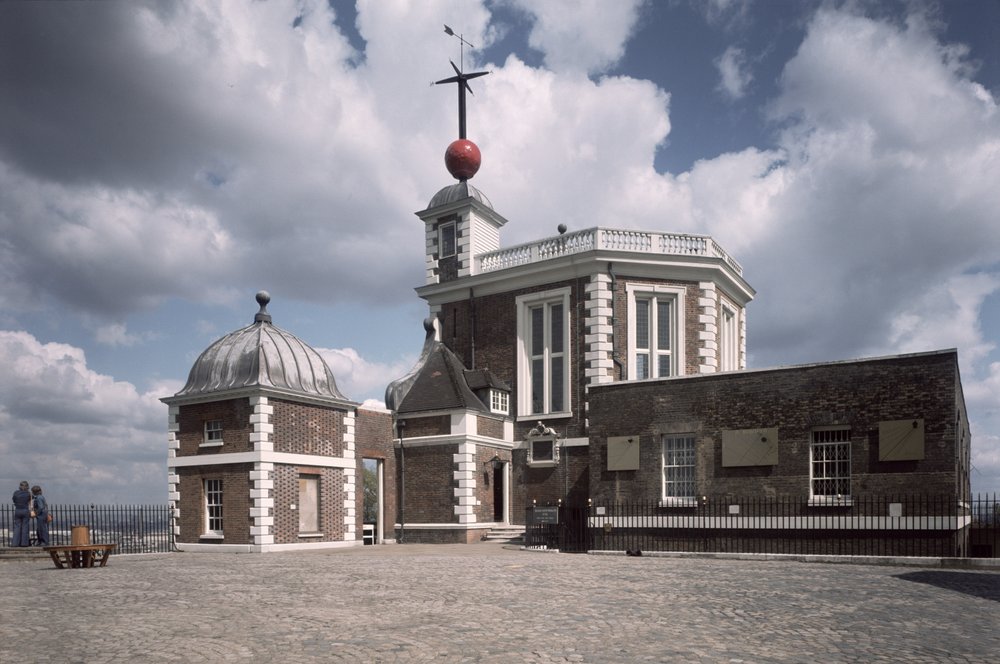
The Royal Observatory, Greenwich, Sir Christopher Wren, 1675, red brick with stone dressings, Greenwich Park, London

Overview

About This Work

The Royal Observatory, Greenwich (specifically the original building known as Flamsteed House) was commissioned by King Charles II in 1675 and designed by Sir Christopher Wren (1632–1723). Located on a hill in Greenwich Park, London, overlooking the River Thames, it is the home of the Prime Meridian (0° longitude) and Greenwich Mean Time (GMT). It was the first purpose-built scientific research facility in Britain, created to solve the problem of finding longitude at sea—a critical issue for the expanding British maritime empire. Wren, who was a Professor of Astronomy at Oxford before he became an architect, designed the building "for the observator's habitation and a little for pompe." The building combines a domestic residence for the Astronomer Royal (John Flamsteed) on the ground floor with a grand, purpose-built scientific space (the Octagon Room) above.

Visual Analysis

Composition

Flamsteed House is a modest, domestic-scale structure built from red brick with stone quoins (cornerstones) and dressings. It reflects the Restoration style (or Carolean style)—pragmatic, somewhat Dutch-influenced, but dignified. The architectural centerpiece is the Octagon Room on the upper floor, an eight-sided chamber designed specifically for observation. It features tall, narrow sash windows on all sides, designed to accommodate long telescopes and quadrants, allowing astronomers to observe the sky in multiple directions. The room is elevated to clear the tree line and the smoke of London, ensuring the best possible viewing conditions.

Colour & Light

The Octagon Room interior was designed with "a little for pompe"—while the exterior is functional, the interior was meant to impress royal visitors with a high ceiling and simple but elegant wood panelling. Ironically, the Octagon Room proved less useful for serious astronomy than intended—the windows were not aligned with the meridian (North-South), meaning the most critical observations had to be done in a shed in the garden. The room functioned more as a ceremonial space for the King and a meeting room for the Royal Society.

Materials & Technique

Due to a tight budget (£500), Wren built the Observatory on the foundations of an old Tudor tower (Duke Humphrey's Tower) and used recycled brick and stone from a demolished gatehouse at the Tower of London and an old fort at Tilbury. This pragmatic reuse gives the building a slightly fortress-like solidity. Above the door is a Latin inscription dedicating the building to Charles II (Carolus II) in 1676, explicitly linking the scientific endeavour to royal patronage. The bright red Time Ball on the roof, although added later (1833), is now an integral visual part of the building—it drops at 1:00 PM every day to allow ships on the Thames to set their marine chronometers.

Historical Context

Context

In the 17th century, sailors could easily calculate their latitude (North/South) by the sun/stars, but had no reliable way to calculate longitude (East/West). This led to disastrous shipwrecks and lost cargoes. Charles II founded the Observatory specifically to "find out the so-much desired longitude of places for the perfecting of the art of navigation." The method proposed involved mapping the position of the moon relative to the stars (the "lunar distance method"), which required decades of precise observation. The first Astronomer Royal, John Flamsteed, lived and worked in the house for 40 years, compiling a catalogue of 3,000 stars that was three times more accurate than any previous map. Wren is the perfect figure for this commission because he embodied the 17th-century ideal of the virtuoso or polymath—a scientist before he was an architect. The design represents the intersection of Enlightenment science and Baroque architecture.

Key Themes

Knowledge, Power, Time and Space

The Observatory is a physical manifestation of the link between scientific knowledge and imperial power. Britain's ability to rule the waves depended on its ability to navigate them—the building is a tool of empire. Unlike private cabinets of curiosity, this was a state-funded institution, marking the beginning of "Big Science"—government investment in research for national strategic goals. The building physically anchors the concept of Global Time. The Prime Meridian (Long 0°) runs through the courtyard (marked by a brass strip). This is the point from which all time and distance on Earth is measured—the centre of the world's map, a powerful symbolic claim by the British Empire.

Exam Focus Points

Critical Perspectives

A key exam point is the tension between the building's aesthetic success and its scientific failure. The Octagon Room is beautiful ("pompe") but was not aligned correctly for meridian observations—real science happened in the garden sheds. This illustrates the 17th-century tension between science as a spectacle for the King and science as practice. Compare Wren's work here to St Paul's: both were part of the post-Fire rebuilding (though Greenwich is outside the city). St Paul's is grand, religious, and public; the Observatory is modest, secular, and specialized. Yet both show Wren's rational, geometric mind at work. Discuss how the use of recycled materials (from a fortress) symbolically transforms a building of war into a building of enlightenment/peace.

On this page

OverviewVisual AnalysisHistorical ContextKey ThemesExam Focus Points