History o' Phoeart
  • Home

Nature

  • Overview
  • Landscape or Seascape in 2D
  • Animals in 2D or 3D
  • The Elements (Fire, Water, Wind or Earth) in 2D or 3D
  • The Relationship between Man/Woman and Nature in 2D or 3D

Identity

  • Overview
  • The Divine in 2D or 3D Works
  • Portraits in 2D Works
  • Portraits in 3D Works
  • Gender Identity in 2D or 3D Works

Renaissance

  • Overview
  • Religious Painting
  • Religious Sculpture
  • Mythological in 2D or 3D
  • Portraits in 2D or 3D

Baroque

  • Overview
  • Religious Painting
  • Religious Sculpture
  • Mythological Painting
  • Mythological Sculpture

About

A comprehensive study resource for Pearson Edexcel History of Art A-Level.

NatureIdentityRenaissanceBaroque

History o' Phoeart - A-Level Study Resource

Pearson Edexcel Specification • Use ⌘K to search

  1. Home
  2. Paper 1
  3. Identity
  4. Portraits in 2D Works
  5. Chairman Mao en route to Anyuan
Paper 1Identity
Identity
The Divine in 2D or 3D Works
Portraits in 2D Works
Pre-1850
Post-1850
Portrait of Lady Lavery as Kathleen Ni Houlihan

Portrait of Lady Lavery as Kathleen Ni Houlihan

Sir John Lavery

Chairman Mao en route to Anyuan

Chairman Mao en route to Anyuan

Liu Cunxia

Mr and Mrs Clark and Percy

Mr and Mrs Clark and Percy

David Hockney

Portraits in 3D Works
Gender Identity in 2D or 3D Works
Ethnic Identity in 2D or 3D Works
Identity in Architectural Works

6 scopes • 24 artworks

Chairman Mao en route to Anyuan

Liu Cunxia, 1967
IdentityPost-1850
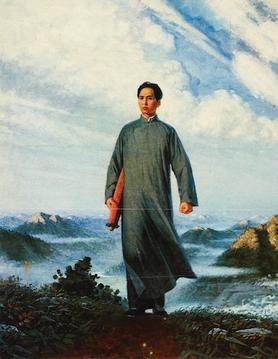
Chairman Mao en route to Anyuan by Liu Cunxia
Chairman Mao En Route to Anyuan, Liu Chunhua, 1967, oil on canvas, 76 × 55 cm, National Museum of China, Beijing

Overview

About This Work

Chairman Mao En Route to Anyuan (1967) is arguably the most reproduced painting in human history, with estimates suggesting over 900 million copies distributed globally. Painted by Liu Chunhua, a 23-year-old member of the Red Guard and student at the Central Academy of Fine Arts in Beijing, the work measures 76 × 55 cm (oil on canvas). It depicts Mao Zedong at approximately age 29, striding across a mountain peak in traditional Chinese dress, umbrella tucked under his arm, one hand clenched in a revolutionary fist, his face resolute and visionary as he gazes into the distance. The painting commemorates Mao's legendary 1921 journey to Anyuan, a coal-mining region in Jiangxi Province, where he allegedly organized the first major workers' strike in China—a moment revised and elevated by Communist Party historiography. Painted during the Great Proletarian Cultural Revolution (1966–1976), the work represents the apex of socialist realism as a propaganda medium in Communist China. It was created for the 1967 exhibition "Mao Zedong's Thought Illuminates the Anyuan Workers Movement" and was explicitly promoted by Jiang Qing (Mao's wife) as an official "model work," the visual counterpart to the revolutionary operas and ballets she endorsed. The painting functions as both artwork and instrument of state ideology, crystallizing the "cult of Mao" at the height of the Cultural Revolution.

Visual Analysis

Composition

The Heroic Ascent: Mao stands alone atop a mountain peak, literally rising above the landscape. This vertical dominance encodes political authority—the leader transcends nature and ordinary humanity, appearing almost superhuman yet grounded in purpose. The Clenched Fist and Umbrella: The raised clenched fist is the iconic symbol of revolutionary will and determination. The umbrella under his arm signals practicality and readiness—even as he conquers mountains, he remains practical. This duality (superhero + pragmatist) makes him simultaneously mythic and relatable. The Gaze: Mao's head is turned upward and outward, surveying the landscape before him. His eyes are not looking at the viewer but gazing into a future he will lead. This denies the viewer direct eye contact, instead inviting us to follow his gaze into the communist future he envisions. The Traditional Robe: Significantly, Chunhua renders Mao in a traditional plain Chinese gown (changshan) rather than the Western suits or military uniforms common in other Mao portraits. This choice is politically loaded: it visually claims Mao as the authentic heir to Chinese civilization and tradition, not as a Western-influenced figure. Landscape Integration: Misty Mountain Imagery: The background depicts swirling mists and clouds typical of Chinese literati painting (shanshui). These evoke the immortal realms of Daoist and Buddhist aesthetics—suggesting Mao occupies a transcendent, almost divine space. Mountains in Chinese tradition symbolize enduring strength, permanence, and spiritual authority. Modern Intrusion: Notably, a telephone pole is discernible in the lower left corner. This subtle inclusion of technology signals modernity and industrialization—suggesting that Mao's revolution is not reactionary nostalgia but forward-looking progress that synthesizes traditional Chinese culture with industrial modernity. Spatial Compression: The painting flattens spatial perspective, compressing the distant landscape into visual proximity. This prevents the viewer from feeling psychologically distant from Mao. He dominates the visual field.

Colour & Light

Cool Blues and Purples: Unlike typical "Mao paintings" that employed warm reds, golds, and clear blue skies, Chunhua uses cool, deep blue and purple tones. This creates a more austere, determined mood—less celebratory, more earnest and resolute. Atmospheric Luminosity: The clouds and mist are rendered with ethereal light, creating a glowing, transcendent atmosphere. There is no obvious light source, yet the scene radiates luminescence—suggesting spiritual illumination. Contrast with Figure: Mao's figure stands out against the landscape not through bright colour but through compositional prominence and the sharpness of his silhouette.

Materials & Technique

Oil on Canvas (Imported Form): The work is painted in oil on canvas, a medium imported from Soviet socialist realism traditions. This represented a radical departure from traditional Chinese ink painting and hanging scrolls. It signals China's alignment with Soviet communism and the rejection of "bourgeois" aesthetic traditions. Socialist Realism Style: The technique prioritizes clear, legible subjects and emotionally moving themes. The brushwork is controlled and precise, with forms rendered with photographic clarity to maximize propaganda legibility. Collective Creation: While Chunhua is credited as the painter, the image was actually "collectively designed and planned by a group of students" under party supervision. Chunhua himself stated that every element carried ideological meaning predetermined by the Party. This denies individual artistic agency—the work is the state's expression, with the artist as executor.

Historical Context

Context

The Cultural Revolution (1966–1976): Initiated by Mao, the Cultural Revolution was ostensibly a campaign to "purify" Chinese communism by eliminating "bourgeois" elements (traditional culture, capitalism, Western influence). In reality, it was a power struggle where Mao, weakened by earlier failures (the Great Leap Forward's catastrophic famine, 1959–62), sought to regain absolute authority by mobilizing radical youth (the Red Guard) to attack his political rivals, particularly Liu Shaoqi (the head of state). Jiang Qing's Role: Mao's wife, Jiang Qing (formerly an actress), wielded extraordinary cultural power during the Cultural Revolution. She controlled artistic production through the "Cultural Group of the State Council," ensuring that art served to glorify Mao and propagandize communist ideology. She explicitly endorsed Chairman Mao En Route to Anyuan as a "model work" to be emulated by other artists. Rewriting Anyuan: The historical Anyuan Miners' Strike (1921–1922) was actually organized by Liu Shaoqi, not Mao. Mao merely visited. However, during the Cultural Revolution, this history was systematically rewritten to credit Mao and minimize Liu Shaoqi's role—justifying Mao's authority while discrediting Liu. Chunhua's painting is an act of historical falsification serving immediate political purposes. The Iconography of Revolution: During the Cultural Revolution, revolutionary imagery saturated public space. Posters, paintings, statues, and even kitchenware bore Mao's image. This mass reproduction transformed Mao into a quasi-religious figure. Citizens carried the image in processions; workers would bow before it; schoolchildren recited "Mao quotations" beneath it.

Key Themes

Power and Authority (The Cult of Mao)

Visual Domination: The painting encodes political authority through visual hierarchy. Mao is spatially dominant (atop the mountain), stylistically distinct (sharpest focus), and psychologically commanding (his gaze directs ours). The landscape serves as a passive stage for his revolutionary will. The "Red Sun" Metaphor: In the artist's own interpretation, the cloudy sky and Mao's figure together evoke "the red sun in our hearts." This solar metaphor is explicitly religious—Mao is treated as a divine, life-giving force. This transforms political authority into spiritual devotion. Historical Myth-Making: By depicting Mao in 1921 at Anyuan, the painting collapses historical time. Mao's revolutionary spirit appears eternal and unchanging. It obscures the reality that Mao in 1967 (then in his seventies, weakened by earlier failures) needed propaganda to restore authority.

Exam Focus Points

Critical Perspectives

Propaganda as Art: This work is explicitly propaganda, not autonomous "fine art." Some critics argue this disqualifies it from serious aesthetic consideration. Others argue that dismissing propaganda as mere "art" reflects a Western bias that separates art from politics. A sophisticated response acknowledges both: the work is a masterpiece of propagandistic visual rhetoric, and precisely because it is so effective as propaganda, it deserves critical analysis. Complicity and Coercion: Chunhua was a Red Guard—a member of the youth movement that committed horrific violence during the Cultural Revolution. Creating propaganda for the regime that mobilized this violence implicates him. Yet many artists had no choice; refusal meant denunciation and torture. A Level essays should grapple with the ethical complexities of art made under totalitarianism without simple judgments. Comparison to Other Revolutionary Art: Compare this to Ai Weiwei's Sunflower Seeds. Both use visual art to engage with Chinese history and politics. Yet where Ai critiques state power (at personal cost), Liu Chunhua served state power. This contrast illuminates how political meaning is context-dependent and reversible. Collective vs. Individual Agency: The work challenges Western romantic notions of the artist as autonomous genius. It is explicitly collective, designed by committee, serving state ideology. This raises questions: Can such art be "great"? Does genius require individual agency? Or is greatness compatible with collective, politically-determined creation? Reproduction and Authenticity: The "original" oil painting now exists in museums, yet the reproduced posters (900+ million) are far more culturally significant. Which is the "real" artwork? This challenges the Western art-historical privilege of the unique, hand-made original.

On this page

OverviewVisual AnalysisHistorical ContextKey ThemesExam Focus Points