History o' Phoeart
  • Home

Nature

  • Overview
  • Landscape or Seascape in 2D
  • Animals in 2D or 3D
  • The Elements (Fire, Water, Wind or Earth) in 2D or 3D
  • The Relationship between Man/Woman and Nature in 2D or 3D

Identity

  • Overview
  • The Divine in 2D or 3D Works
  • Portraits in 2D Works
  • Portraits in 3D Works
  • Gender Identity in 2D or 3D Works

Renaissance

  • Overview
  • Religious Painting
  • Religious Sculpture
  • Mythological in 2D or 3D
  • Portraits in 2D or 3D

Baroque

  • Overview
  • Religious Painting
  • Religious Sculpture
  • Mythological Painting
  • Mythological Sculpture

About

A comprehensive study resource for Pearson Edexcel History of Art A-Level.

NatureIdentityRenaissanceBaroque

History o' Phoeart - A-Level Study Resource

Pearson Edexcel Specification • Use ⌘K to search

  1. Home
  2. Paper 1
  3. Identity
  4. Portraits in 3D Works
  5. Mrs Pinckney and the Emancipated Birds of South Carolina
Paper 1Identity
Identity
The Divine in 2D or 3D Works
Portraits in 2D Works
Portraits in 3D Works
Pre-1850
Post-1850
Mrs Pinckney and the Emancipated Birds of South Carolina

Mrs Pinckney and the Emancipated Birds of South Carolina

Yinka Shonibare

Gender Identity in 2D or 3D Works
Ethnic Identity in 2D or 3D Works
Identity in Architectural Works

6 scopes • 24 artworks

Mrs Pinckney and the Emancipated Birds of South Carolina

Yinka Shonibare, 2017
IdentityPost-1850
Mrs Pinckney and the Emancipated Birds of South Carolina by Yinka Shonibare
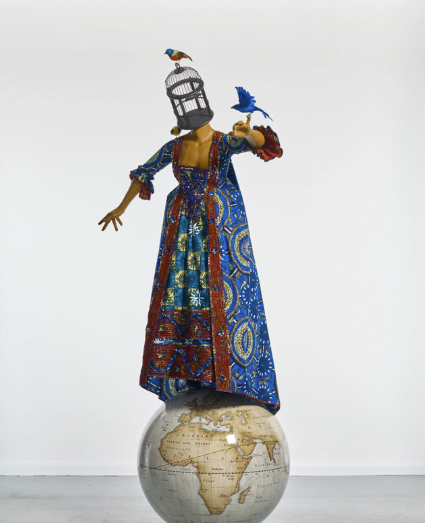
Mrs. Pinckney and the Emancipated Birds of South Carolina, Yinka Shonibare CBE, 2017, fiberglass mannequin, Dutch wax printed cotton textile, birdcage, taxidermy birds, globe, Yale Center for British Art

Overview

About This Work

Mrs. Pinckney and the Emancipated Birds of South Carolina (2017) is a sculptural installation by the British-Nigerian artist Yinka Shonibare CBE (b. 1962). Commissioned by the Yale Center for British Art, the work was created for the exhibition Enlightened Princesses: Caroline, Augusta, Charlotte, and the Shaping of the Modern World. The sculpture depicts a life-size, headless female mannequin dressed in an elaborate 18th-century style gown (complete with wide panniers) made from Dutch wax print fabric (Ankara). Instead of a head, the figure has an open birdcage, from which colourful taxidermy birds are escaping. The figure stands precariously balanced atop a globe. The work references the historical figure Eliza Lucas Pinckney (1722–1793), an 18th-century plantation owner in South Carolina who famously introduced indigo cultivation to the American colonies. It explores themes of colonialism, the transatlantic slave trade, cultural hybridity, and the complex relationship between Enlightenment scientific curiosity and colonial exploitation.

Visual Analysis

Composition

The Headless Mannequin: A signature motif in Shonibare's work, the headlessness removes individual identity and race (the skin is a neutral coffee-colour fiberglass). This transforms the figure into a symbol or archetype rather than a specific portrait. It also playfully references the French Revolution (the guillotine), suggesting the decapitation of the aristocracy. The Birdcage Head: Replacing the head with an open birdcage creates a surreal, Magritte-like image. The cage represents confinement and ownership—the desire to possess and categorize nature (a key Enlightenment obsession). However, the cage door is open, and the birds are flying out, suggesting liberation and the loss of control. The Globe Base: The figure stands on a globe, literalizing the idea of global domination and empire. The British Empire was a global enterprise, and figures like Eliza Pinckney were key agents in this global network of trade and exploitation.

Colour & Light

Vibrant Clashing: The visual impact relies on the clash between the formal, rigid silhouette of the 18th-century dress and the chaotic, vibrant patterns of the fabric. This visual dissonance mirrors the historical dissonance between the "polite" society of the Enlightenment and the brutal reality of slavery that supported it.

Materials & Technique

Dutch Wax Print (Ankara): The gown is the visual focal point. While the cut is strictly 18th-century European (rococo silhouette), the fabric is brightly coloured African wax print. This fabric is central to Shonibare's conceptual practice. The Irony of "African" Fabric: These textiles are often assumed to be authentically African, but their history is colonial. They were originally Indonesian batik designs, mass-produced by the Dutch in the 19th century, and then sold to West Africa when the Indonesian market rejected them. Shonibare uses them as a metaphor for the "constructed" nature of African identity and the tangled web of colonial trade. The Birds: The birds are specific species native to South Carolina: the Indigo Bunting, Painted Bunting, and American Goldfinch. Historically, Eliza Pinckney actually sent such birds as exotic gifts to Princess Augusta in London. In the sculpture, Shonibare "emancipates" them—they are frozen in flight, escaping the cage.

Historical Context

Context

Eliza Lucas Pinckney: Pinckney was a remarkable historical figure—a woman who managed massive plantations in colonial South Carolina at age 16. She is celebrated for successfully cultivating indigo, which became the colony's second most important cash crop (after rice). The blue dye from her indigo was exported to England to dye the textiles of the industrial revolution. Slavery and Indigo: While Pinckney is often celebrated as a female pioneer of agriculture, her success was entirely dependent on the knowledge and labour of enslaved Africans. Indigo production was difficult and toxic work. Shonibare's work reinserts this erased history: the "emancipated birds" function as metaphors for the enslaved people who generated Pinckney's wealth but remained unfree. The Enlightenment and Empire: The work critiques the Enlightenment era. Figures like Princess Augusta and Eliza Pinckney were interested in botany and zoology (hence the birds), but this scientific curiosity was inextricably linked to colonial conquest. Collecting "exotic" birds and plants was a form of asserting control over the natural world of the colonies.

Key Themes

Identities (Post-Colonialism, Hybridity, Freedom)

The "Emancipated" Birds: Shonibare explicitly states that the birds represent the enslaved population. By showing them flying free, he performs a symbolic act of retrospective liberation. He grants them the freedom in art that they were denied in life. Cultural Hybridity: The work embodies Shonibare's concept of the "post-colonial hybrid." It is neither purely British nor purely African, but a messy, beautiful mix of both. The dress (European cut, African/Dutch fabric) physically wraps the colonial body in the material of the colonized (or the complex trade goods of empire). Complicity: The work does not simply demonize Pinckney. It presents her as a complex figure—a powerful, intelligent woman who was nonetheless complicit in a horrific system. The beauty of the sculpture seduces the viewer, just as the wealth of the empire seduced 18th-century consumers, before revealing the darker history (the cage, the slavery context).

Exam Focus Points

Critical Perspectives

Beauty as Trap: Shonibare uses beauty (vibrant colours, elegant fabrics) to lure the viewer in. He rejects the "didactic" or "angry" aesthetic often associated with political art. He wants the viewer to enjoy the work first, then think about the difficult history. It is a "Trojan Horse" strategy. The Fabric as Text: In an exam, always unpack the meaning of the fabric. It is not just "African cloth." It is a product of Dutch imperialism, Indonesian appropriation, and African adoption. It proves that culture is not fixed or pure, but fluid and economic. Feminist vs. Post-Colonial Reading: A feminist reading might celebrate Pinckney as a female entrepreneur in a male world. A post-colonial reading critiques her as a slave owner. Shonibare holds both these truths together in tension.

On this page

OverviewVisual AnalysisHistorical ContextKey ThemesExam Focus Points