History o' Phoeart
  • Home

Nature

  • Overview
  • Landscape or Seascape in 2D
  • Animals in 2D or 3D
  • The Elements (Fire, Water, Wind or Earth) in 2D or 3D
  • The Relationship between Man/Woman and Nature in 2D or 3D

Identity

  • Overview
  • The Divine in 2D or 3D Works
  • Portraits in 2D Works
  • Portraits in 3D Works
  • Gender Identity in 2D or 3D Works

Renaissance

  • Overview
  • Religious Painting
  • Religious Sculpture
  • Mythological in 2D or 3D
  • Portraits in 2D or 3D

Baroque

  • Overview
  • Religious Painting
  • Religious Sculpture
  • Mythological Painting
  • Mythological Sculpture

About

A comprehensive study resource for Pearson Edexcel History of Art A-Level.

NatureIdentityRenaissanceBaroque

History o' Phoeart - A-Level Study Resource

Pearson Edexcel Specification • Use ⌘K to search

  1. Home
  2. Paper 1
  3. Nature
  4. Animals in 2D or 3D
  5. Double-headed Serpent
Paper 1Nature
Nature
Landscape or Seascape in 2D
Animals in 2D or 3D
Pre-1850
Post-1850
Non-Western
Double-headed Serpent

Double-headed Serpent

Unknown (Aztec)

The Elements (Fire, Water, Wind or Earth) in 2D or 3D
The Relationship between Man/Woman and Nature in 2D or 3D
Plants in 2D or 3D
Architecture

6 scopes • 24 artworks

Double-headed Serpent

Unknown (Aztec), 1400-1521
NatureNon-Western
Double-headed Serpent by Unknown (Aztec)
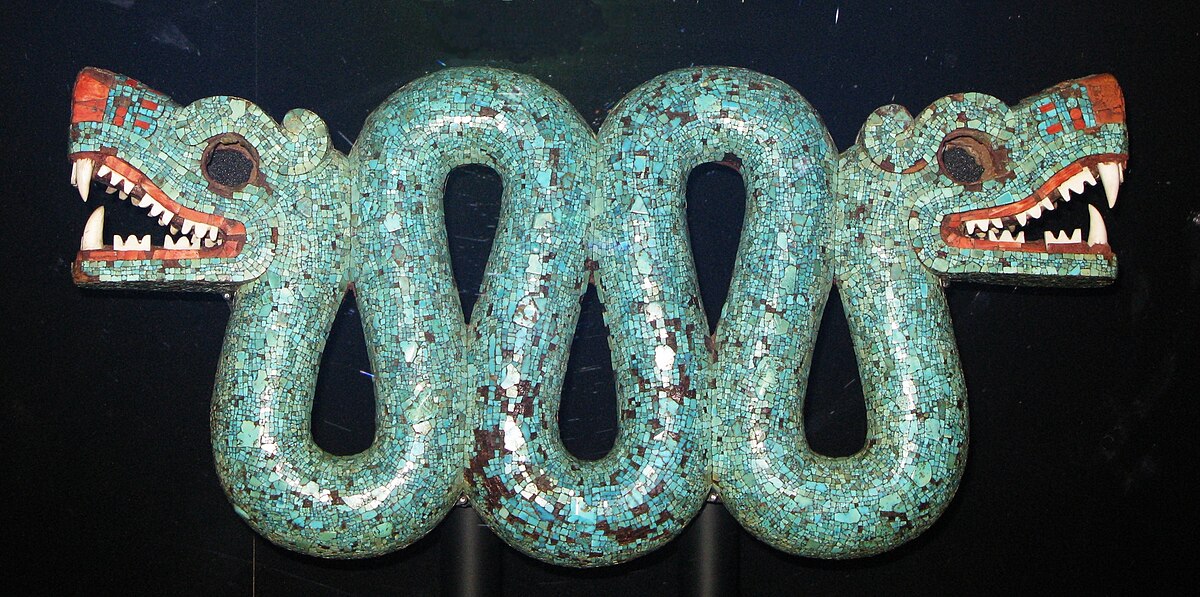
Double-Headed Serpent (Maquizcoatl), 15th–16th century Aztec/Mexica. Turquoise, shell, and wood mosaic, 20.5 × 43.3 cm. British Museum, London.

Overview

About This Work

The Double-Headed Serpent is an Aztec (Mexica) sculptural mosaic, dating to the 15th–early 16th century CE, now held in the British Museum in London. Measuring 20.5 x 43.3 x 5.9 cm, it is constructed from Spanish cedar wood covered with an intricate mosaic of over 2,000 turquoise tesserae, with red and white shell detailing the mouths, gums, and teeth of the two serpent heads. The sculpture was likely worn across the chest as a pectoral ornament during religious ceremonies, possibly by a high priest or the tlatoani (ruler) himself. The serpent form is deeply symbolic in Mesoamerican iconography, representing divine power, cosmic duality, and the feathered serpent deity Quetzalcoatl. It may have been among the treasures sent to the Spanish King Charles V by Hernán Cortés following the conquest of the Aztec Empire in 1519–1521. The object exemplifies the extraordinary skill of Aztec lapidary artists (those who work with precious stones) and stands as one of the finest surviving examples of pre-Columbian Mesoamerican art.

Visual Analysis

Composition

The sculpture's form is dominated by a dramatic undulating curve—the serpent's body forms an "S" or sinuous wave, representing the cosmic serpent that links the earthly and celestial realms. The two heads face outward in opposite directions, emphasizing symmetry and the Mesoamerican concept of duality (life/death, earth/sky, day/night). The body's horizontal arrangement suggests it was designed to be worn flat against the chest, with the heads projecting outward. This orientation created a powerful frontal display during ceremonial processions. The sinuous curves create visual rhythm and movement, animating the static object with implied serpentine motion.

Colour & Light

The dominant turquoise blue carries profound symbolic significance—turquoise (xihuitl) represented water, sky, fire, and divine power in Aztec culture. It was more precious than gold. The red shell (likely Spondylus) outlining the mouths creates strong chromatic contrast, drawing attention to the open jaws and suggesting blood, sacrifice, and vital force. White shell for the teeth and gum areas provides tonal relief and anatomical realism, while the overall blue dominance unifies the composition.

Materials & Technique

The mosaic technique involved adhering thousands of individually shaped turquoise tesserae (small tiles) onto a carved wooden base using pine resin as adhesive. Each tessera was carefully cut and polished to create a smooth, continuous surface. The wooden armature is carved from Cedrela odorata (Spanish cedar), shaped to create the serpent's three-dimensional form with open jaws and curved body. Red thorny oyster shell (Spondylus princeps), white conch shell (Strombus), and traces of pine resin adhesive complete the material palette. The labor required to source, cut, polish, and assemble these materials indicates royal patronage.

Historical Context

Context

The Aztec Empire (c. 1428–1521 CE) dominated central Mexico from its island capital Tenochtitlan (present-day Mexico City). Aztec religion centered on maintaining cosmic order through ritual sacrifice and elaborate ceremonial practices. The serpent occupied a central place in Mesoamerican cosmology for millennia before the Aztecs. The feathered serpent deity (known as Quetzalcoatl to the Aztecs) represented the synthesis of earth (serpent) and sky (feathers/quetzal bird). The object likely entered European collections through Hernán Cortés's gifts to Charles V, Holy Roman Emperor and King of Spain. It subsequently passed through various European collections before reaching the British Museum in 1894.

Key Themes

Cosmic Duality and Sacred Power

The double-headed form embodies the Mesoamerican principle of duality—opposing forces in eternal balance. The two heads may represent the duality of Quetzalcoatl, who descended to the underworld and returned, embodying death and resurrection. Serpents were associated with fertility, water, and agricultural abundance. The undulating form evokes flowing water and the serpentine movement of rivers—essential to maize cultivation. As a pectoral ornament, the object would have transformed its wearer into a divine intermediary, channeling sacred power during ritual performance.

Exam Focus Points

Critical Perspectives

Colonial Acquisition: The object's presence in the British Museum raises questions about cultural patrimony and the ethics of displaying looted or coerced "gifts" from conquered peoples. Mexico has requested the return of various Aztec objects; this context frames contemporary viewing. The "Aztec as Savage" Stereotype: European accounts emphasized Aztec human sacrifice to justify conquest. Scholars now contextualize sacrifice within Aztec cosmology and note that European violence during conquest far exceeded Aztec ritual deaths. Craftsmanship vs. "Artifact": Western art history traditionally distinguished "art" (European painting and sculpture) from "artifact" (non-Western objects). This object challenges such hierarchies—its technical sophistication and symbolic complexity demand recognition as "art." Iconographic Interpretation: Without written Aztec records explaining specific meanings, scholars reconstruct symbolism through colonial-era accounts, comparative Mesoamerican evidence, and archaeological context. All interpretations remain provisional.

On this page

OverviewVisual AnalysisHistorical ContextKey ThemesExam Focus Points