History o' Phoeart
  • Home

Nature

  • Overview
  • Landscape or Seascape in 2D
  • Animals in 2D or 3D
  • The Elements (Fire, Water, Wind or Earth) in 2D or 3D
  • The Relationship between Man/Woman and Nature in 2D or 3D

Identity

  • Overview
  • The Divine in 2D or 3D Works
  • Portraits in 2D Works
  • Portraits in 3D Works
  • Gender Identity in 2D or 3D Works

Renaissance

  • Overview
  • Religious Painting
  • Religious Sculpture
  • Mythological in 2D or 3D
  • Portraits in 2D or 3D

Baroque

  • Overview
  • Religious Painting
  • Religious Sculpture
  • Mythological Painting
  • Mythological Sculpture

About

A comprehensive study resource for Pearson Edexcel History of Art A-Level.

NatureIdentityRenaissanceBaroque

History o' Phoeart - A-Level Study Resource

Pearson Edexcel Specification • Use ⌘K to search

  1. Home
  2. Paper 1
  3. Nature
  4. Architecture
  5. Bahá'í House of Worship, New Delhi
Paper 1Nature
Nature
Landscape or Seascape in 2D
Animals in 2D or 3D
The Elements (Fire, Water, Wind or Earth) in 2D or 3D
The Relationship between Man/Woman and Nature in 2D or 3D
Plants in 2D or 3D
Architecture
Pre-1850
Post-1850
Non-Western
Bahá'í House of Worship, New Delhi

Bahá'í House of Worship, New Delhi

Fariborz Sahba

6 scopes • 24 artworks

Bahá'í House of Worship, New Delhi

Fariborz Sahba, 1986
NatureNon-Western
Bahá'í House of Worship, New Delhi by Fariborz Sahba
Bahá'í House of Worship (Lotus Temple), Fariborz Sahba, 1986. New Delhi, India.

Overview

About This Work

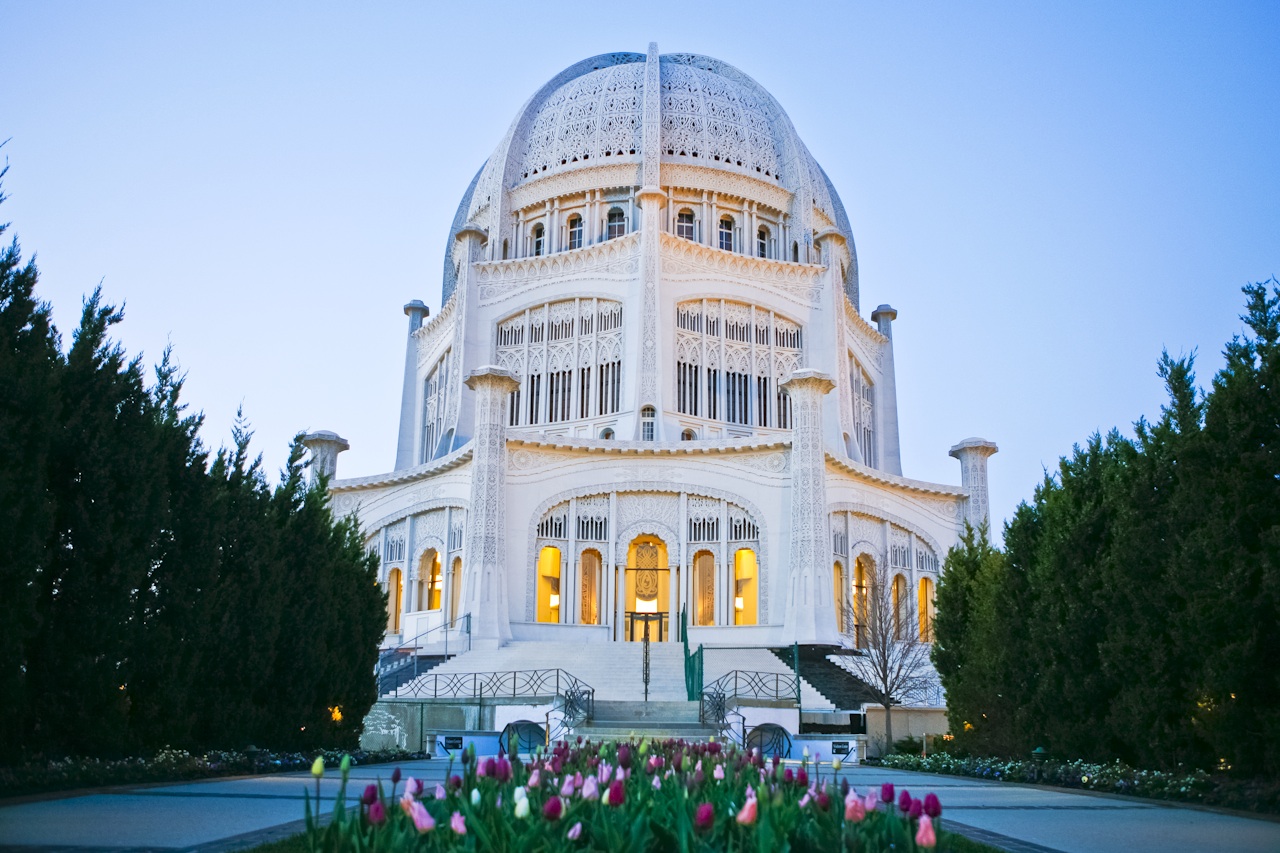
The Bahá'í House of Worship in New Delhi, commonly called the Lotus Temple, is one of the world's most recognizable contemporary religious buildings and one of the most visited architectural landmarks globally (over 70 million visitors since 1986). Designed by Iranian-American architect Fariborz Sahba and completed in 1986, the building comprises 27 giant marble-clad "petals" arranged in clusters of three to form nine sides, creating the impression of a half-open lotus flower afloat, surrounded by nine reflecting pools representing the flower's leaves. The structure stands on 26.5 acres in the Kalkaji district of South Delhi. The temple is constructed primarily from white concrete and clad with pristine white marble quarried from Mount Pentelikon in Greece (the same source as the Parthenon). The interior prayer hall accommodates 2,500 worshippers and is accessed via nine bridges crossing nine ponds, through nine doors leading to a vast central space rising 40 metres with no visible structural supports. The building embodies the Bahá'í Faith's core principles: the unity of all religions, the oneness of mankind, and the rejection of ornament in favour of essential geometric simplicity. It represents a unique synthesis of biomimicry (architecture mimicking natural forms), modernist reduction, and spiritual symbolism, creating a profound meditation on architecture's capacity to express belief.

Visual Analysis

Composition

The Lotus as Living Metaphor: The 27 petals are arranged in three distinct layers, each containing nine petals, forming a unified lotus shape. From above, the building is perfectly circular (reflecting the nine-sided nonagonal plan central to all Bahá'í Houses of Worship). From the ground, it appears as a half-open lotus, with the outer petals tilted outward as if slowly unfurling. This dynamic quality—frozen in time yet suggesting perpetual opening—captures the lotus's daily cycle of opening with sunrise and closing at sunset. The Nine-Fold Geometry: The number nine is fundamental to Bahá'í theology, symbolizing the unity of the world's nine major religions. Every architectural component is repeated nine times: nine doors, nine bridges, nine pools, nine outer petals, nine middle petals, nine inner petals. This repetition creates rhythmic, harmonic proportions throughout the complex. The Central Prayer Hall: The inner "petals" rise above the rest, forming the main structure housing the prayer hall. These inner petals approach but do not meet at the apex, creating a dramatic opening capped by a glass and steel skylight. This opening allows natural light to penetrate the interior, symbolizing divine illumination and the transcendence of sectarian boundaries. The Three Levels of Petals: • Entrance petals: Nine petals at ground level demarcate entrances on each of nine sides. • Outer petals: Nine larger petals form the roof of ancillary spaces. • Inner petals: The nine highest petals enclose the main worship space, creating the focal point. The Podium and Spatial Elevation: The building is elevated on a podium, rising above the surrounding landscape. This elevation—reminiscent of temple traditions across Indian religions—asserts the sacred nature of the space while creating a threshold between the secular world and the spiritual interior.

Colour & Light

Marble Cladding: The external surface is clad with white marble from Mount Pentelikon, Greece (10,000 square meters), each panel precisely cut in Italy to conform to the complex geometric surfaces. The marble reflects light, creating an ethereal, luminous appearance that changes throughout the day and seasons. Exposed Concrete Interior: Paradoxically, while the exterior is pristine marble, the interior reveals raw exposed concrete with a bush-hammered surface showing the imprint of the formwork patterns. This contrast—between the refined exterior and the honest structural expression of the interior—demonstrates the architect's commitment to transparency and truth in materials. The Intricate Dome Pattern: The interior dome features three sets of radial ribs that intersect in complex geometric patterns derived from spherical, cylindrical, and toroidal (donut-shaped) mathematical surfaces. The ribs are expressed in white concrete, creating a visual language of structural honesty. Water as Essential Material: Nine pools surrounding the temple serve both aesthetic and functional purposes. They provide ventilation (cool air rises through the building as water evaporates), support reflection (the temple's image doubles in the water), and embody the lotus's aquatic nature. Water, like light, functions as a primary architectural material rather than mere decoration.

Materials & Technique

Reinforced Concrete Shells: The 27 petals are constructed from pre-cast white concrete using specially sourced materials: dolomite clay from Alwar mines near Delhi, white silica sand from Jaipur, and white cement. The concrete was formulated to achieve the desired colour and durability (critical in India's tropical climate). Complex Geometric Modelling: The design required sophisticated computer modelling (advanced for 1980) to translate the organic lotus form into precise mathematical surfaces. The geometric complexity—each petal derives from unique spherical, cylindrical, and toroidal surfaces—required two and a half years of planning and engineering. Full-Scale Prototyping: Faced with unprecedented structural challenges, engineers constructed full-scale mock-ups to test formwork systems and assembly procedures. This empirical testing demonstrated the commitment to quality and safety despite the innovative design. Precision Anchoring: The marble panels are affixed using specially designed stainless steel brackets and bolts, creating a visible structural system that expresses how the cladding is mechanically attached to the concrete core. This honesty of construction is characteristic of modernist design philosophy.

Historical Context

Context

The Bahá'í Faith: Founded in 1844 in Persia (Iran) by the prophet Bahá'u'lláh, the Bahá'í Faith emphasizes the unity of all religions, the oneness of mankind, and the elimination of prejudice. The faith attracts adherents from diverse cultural and religious backgrounds. Bahá'í scripture mandates that Houses of Worship be open to people of all faiths and beliefs (unlike traditional temples restricted to adherents). The Lotus as Pan-Indian Symbol: The lotus holds profound significance across Indian religions—Hinduism (sacred to Lakshmi and Brahma), Buddhism (symbol of enlightenment emerging from muddy waters), and Jainism (associated with spiritual perfection). By choosing the lotus, Sahba created a symbol that resonates across India's religious traditions while expressing Bahá'í principles of unity. Sahba's Research and Design Process: Before designing the temple, Fariborz Sahba (born in Iran, educated in America) travelled extensively in India, studying classical Hindu and Mughal architecture. He was impressed by the ubiquity of lotus imagery in Indian temples and art. This research informed his decision to express the Bahá'í Faith's universal principles through an indigenous Indian symbol. Post-Colonial India: The temple was built during India's development as a modern nation-state (completed 1986). The architectural innovation—a non-traditional form created by a non-Indian architect—yet rooted in Indian cultural symbolism, reflects India's negotiation between modernization and cultural identity. Global Bahá'í Network: The Lotus Temple is one of eight Bahá'í Houses of Worship worldwide (others in Wilmette Illinois, Sydney, Panama City, Kampala, Apia, Frankfurt, and Santiago). The Delhi temple's scale and prominence made it the most visible expression of Bahá'í architecture globally.

Key Themes

Connection to Nature (Biomimicry, Growth, Spiritual Symbolism)

Nature as Spiritual Metaphor: The lotus is not merely decorative but carries profound spiritual meaning. In Hindu and Buddhist traditions, the lotus emerges from muddy waters (worldly attachment) to bloom unsullied—a metaphor for spiritual purity and enlightenment. Bahá'í use of this symbol suggests that spiritual truth transcends sectarian boundaries. Biomimicry and Organic Form: The building exemplifies biomimicry—the practice of deriving architectural forms from nature. However, unlike contemporary biomimicry (which often prioritizes efficiency), Sahba's lotus is conceptual and symbolic. The form is not functionally optimized for the building's program but chosen for spiritual resonance. Dynamic Transformation: The lotus flower's daily cycle—opening at sunrise, closing at sunset—suggests perpetual transformation. The partially open position captured by the architecture suggests incompleteness or perpetual becoming, philosophically aligned with the Bahá'í belief in humanity's spiritual evolution. Light and Shadow Play: Natural light filtering through the glass skylight creates dynamic patterns throughout the day. The temple's appearance transforms with the angle of the sun, seasons, and weather. This impermanence—the continuous metamorphosis of light and shadow—connects the building to nature's cycles.

Exam Focus Points

Critical Perspectives

Universalism vs. Cultural Specificity: The temple claims to express universal religious principles through a specifically Indian symbol. Critics might question: Does appropriating Hindu symbolism constitute respectful engagement or cultural appropriation? How does a religion founded in Persia authentically express itself through Indian cultural forms? These tensions merit examination without dismissing the building's achievements. Ornament and Simplicity: The Bahá'í faith explicitly rejects ornamental statuary, altars, and iconography. Instead of decorative carvings and sculptures, the temple uses light and water as primary aesthetic elements. This strategy raises questions: Is pure geometry and simplicity more or less "ornamental" than carved decoration? Does reduction to essential forms constitute spiritual authenticity or aesthetic ideology? Technology and Spirituality: The temple represents a sophisticated synthesis of modernist technology (computer modelling, precise marble cladding, structural engineering) and spiritual aspiration. Does technological sophistication enhance or diminish spiritual experience? The building's accessibility (no pilgrimage required; open to all) democratizes religious experience in unprecedented ways. Global Reception and Authenticity: The temple's enormous popularity (70+ million visitors) has made it one of the world's most visited buildings. Yet it attracts visitors as a tourist spectacle as much as a place of worship. Does mass visitation and media celebrity undermine or democratize sacred space? Comparison to Religious Precedents: Unlike traditional Hindu temples (ornate, figurative, processional) or churches (hierarchical, focused on altar), the Lotus Temple is egalitarian and non-hierarchical. The vast central prayer hall has no focal point; worshippers face inward toward one another rather than toward a clergy or icon. This architectural expression of religious equality is revolutionary. Materiality and Meaning: The contrast between the pristine marble exterior and the honest, exposed concrete interior creates productive tension. The exterior addresses the public sphere with monumentality and refinement; the interior addresses the spiritual seeker with truth and simplicity. This duality reflects the temple's dual role as civic monument and sacred space.

On this page

OverviewVisual AnalysisHistorical ContextKey ThemesExam Focus Points