Villa Rotonda
Andrea Palladio, 1556-71
Overview
About This Work
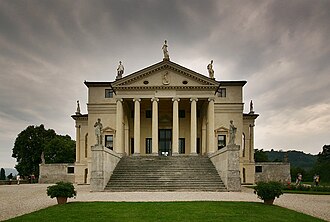
Villa Rotonda (also known as Villa Almerico Capra) is the most famous and influential domestic building of the Italian Renaissance, located just outside Vicenza in northern Italy. Designed by Andrea Palladio (1508–1580) for the retired papal prelate Paolo Almerico, it was begun around 1566–1570 and completed after Palladio's death by his pupil Vincenzo Scamozzi. The building is a masterpiece of symmetry and classical proportion, famously described by Palladio himself not as a villa but as a "palazzo" due to its proximity to the city. Its revolutionary design consists of a square block surmounted by a central dome (hence "La Rotonda") and faced on all four sides by identical temple-front porticoes. This radial symmetry means the building has no front or back; it addresses the surrounding landscape equally in all directions. It exemplifies Palladianism, an architectural style based on Roman antiquity (particularly Vitruvian principles) that would profoundly influence Western architecture for centuries, from British country houses (Chiswick House) to American civic buildings (The White House, Monticello).