History o' Phoeart
  • Home

Nature

  • Overview
  • Landscape or Seascape in 2D
  • Animals in 2D or 3D
  • The Elements (Fire, Water, Wind or Earth) in 2D or 3D
  • The Relationship between Man/Woman and Nature in 2D or 3D

Identity

  • Overview
  • The Divine in 2D or 3D Works
  • Portraits in 2D Works
  • Portraits in 3D Works
  • Gender Identity in 2D or 3D Works

Renaissance

  • Overview
  • Religious Painting
  • Religious Sculpture
  • Mythological in 2D or 3D
  • Portraits in 2D or 3D

Baroque

  • Overview
  • Religious Painting
  • Religious Sculpture
  • Mythological Painting
  • Mythological Sculpture

About

A comprehensive study resource for Pearson Edexcel History of Art A-Level.

NatureIdentityRenaissanceBaroque

History o' Phoeart - A-Level Study Resource

Pearson Edexcel Specification • Use ⌘K to search

  1. Home
  2. Paper 1
  3. Nature
  4. Landscape or Seascape in 2D
  5. Starry Night
Paper 1Nature
Nature
Landscape or Seascape in 2D
Pre-1850
Post-1850
Impression: Sunrise

Impression: Sunrise

Claude Monet

Starry Night

Starry Night

Vincent Van Gogh

Non-Western
Animals in 2D or 3D
The Elements (Fire, Water, Wind or Earth) in 2D or 3D
The Relationship between Man/Woman and Nature in 2D or 3D
Plants in 2D or 3D
Architecture

6 scopes • 24 artworks

Starry Night

Vincent Van Gogh, 1889
NaturePost-1850
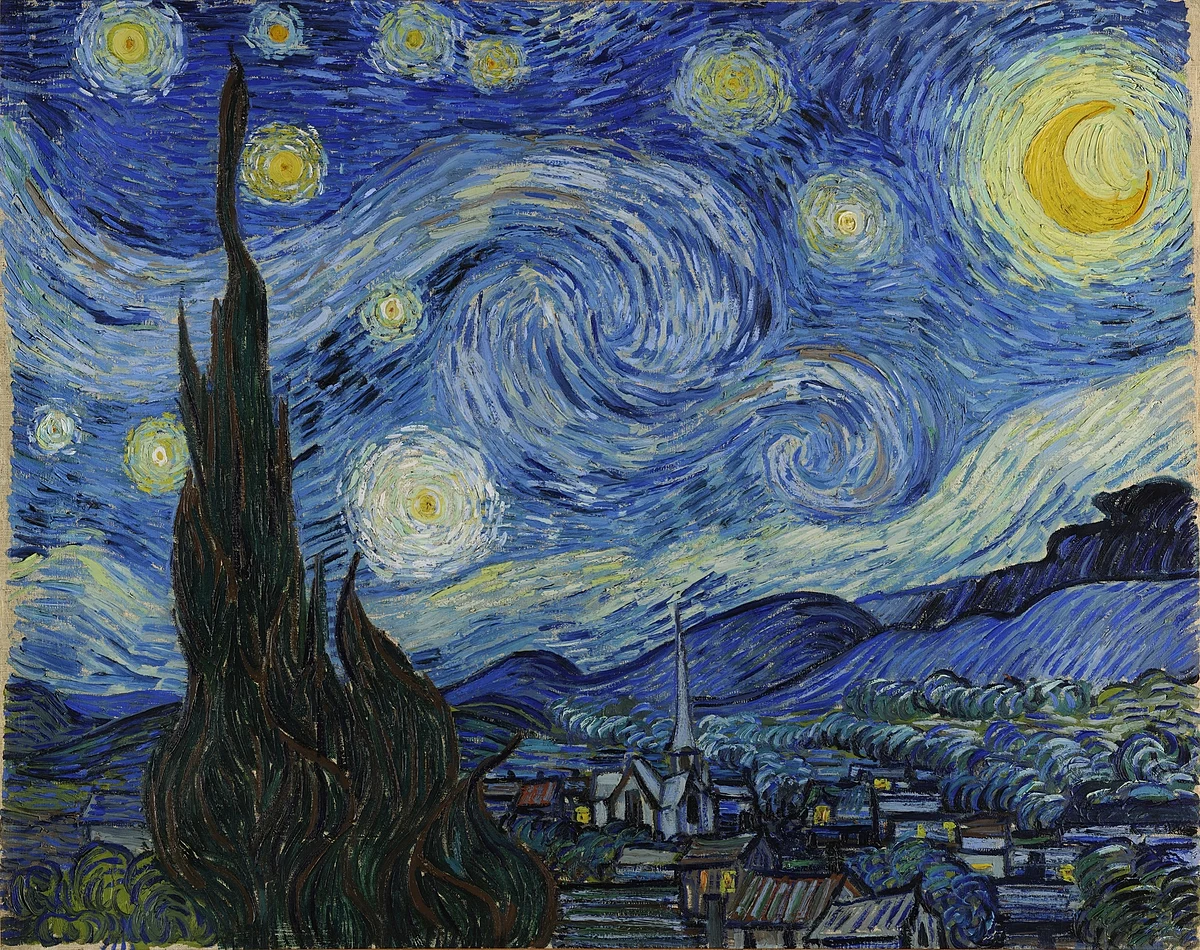
Starry Night by Vincent Van Gogh
Vincent van Gogh, The Starry Night, 1889, Oil on canvas, 74 × 92 cm, Museum of Modern Art, New York

Overview

About This Work

Painted in June 1889, The Starry Night (De sterrennacht) is one of the most recognizable paintings in Western art history and a defining masterpiece of Post-Impressionism. It depicts the view from the east-facing window of Van Gogh's asylum room at Saint-Rémy-de-Provence, just before sunrise, with the addition of an imaginary village. Unlike many of his earlier works painted en plein air (outdoors), this was composed in the studio, synthesizing observation with memory and imagination. It measures approximately 74 x 92 cm and is currently housed in the Museum of Modern Art (MoMA) in New York. It marks a critical shift in 19th-century art: moving from the objective recording of light (Impressionism) to the subjective expression of internal emotion.

Visual Analysis

Composition

The Cypress: A massive, dark cypress tree dominates the left foreground. Resembling a black flame, it serves as a repoussoir device to push the viewer's eye back into the scene, while also acting as a vertical bridge connecting the earth to the sky. The Swirling Sky: The composition is dominated by the turbulent sky, which occupies two-thirds of the canvas. The great wave-like spiral moving from left to right creates a sense of overwhelming energy that dwarfs the human settlement below. The Village: The village is painted with straight, rigid lines (contrasting with the curved sky) and appears small and huddled. The church spire, which breaks the horizon, is distinctly Dutch in style rather than French—a detail Van Gogh likely added from memory of his homeland.

Colour & Light

Complementary Contrast: The painting is built on the intense opposition of ultramarine and cobalt blues (the sky and hills) against Indian and zinc yellows (the stars and moon). This use of complementary colours (blue vs. orange/yellow) creates an optical vibration, making the lights appear to twinkle and pulse. The "Morning Star": The brightest white/yellow star to the left of the centre is Venus, the Morning Star, which Van Gogh wrote about seeing "very big" in the early dawn. Emotional Palette: Van Gogh uses colour expressively rather than descriptively. The pervasive blues suggest a mood of quiet melancholy or spiritual depth, while the explosive yellows offer a beacon of hope and warmth.

Materials & Technique

Impasto: Van Gogh used his characteristic impasto technique, applying paint so thickly that it stands off the canvas in ridges. This gives the surface a tactile, relief-like quality. Directional Brushwork: The brushstrokes are rhythmic and follow the form of the objects. In the sky, they churn and swirl; on the hills, they undulate; in the trees, they flame upwards. This infuses the entire image with a sense of vibration and motion. Canvas Visibility: In several areas, the bare canvas is visible between the frantic strokes, revealing the speed and urgency of Van Gogh's execution.

Historical Context

Context

The Asylum Period: Van Gogh painted this shortly after voluntarily admitting himself to the Saint-Paul-de-Mausole asylum in Saint-Rémy-de-Provence following a severe mental breakdown (the ear-cutting incident) in Arles. During this period, he was restricted to the asylum grounds and his room, making the window view his primary connection to the outside world. Post-Impressionism: This work exemplifies the Post-Impressionist goal: not to record the world as it looks (as Monet did), but as it feels. Van Gogh sought to express the enduring, spiritual structure of the world rather than fleeting atmospheric effects. Religious Sublimation: Van Gogh wrote to his brother Theo: "I have a tremendous need for, shall I say the word—for religion—so I go outside at night to paint the stars." The painting can be seen as a substitute for traditional religious imagery, finding the divine in the cosmos rather than in the church.

Key Themes

Connection to Nature

Pantheism: The painting suggests a pantheistic worldview (the belief that God is present in all things). The sky is not empty space but a living, breathing force. The stars are not distant points but exploding suns. The Sublime: This is a vision of the Romantic Sublime—nature is vast, powerful, and terrifyingly beautiful. The swirling energy of the cosmos makes the human village look fragile and insignificant, yet the two coexist. Cycle of Life/Death: The cypress tree was traditionally associated with mourning and graveyards in southern France (similar to yew trees in Britain). By placing it so prominently, Van Gogh links the earthly realm of death with the celestial realm of the stars (which he famously equated with the afterlife, saying "we take death to reach a star").

Exam Focus Points

Critical Perspectives

Meyer Schapiro: The renowned art historian interpreted the painting as an "apocalyptic fantasy." He suggested that the swirling sky represents Van Gogh's internal psychological turbulence projected onto nature—making this a foundational work of Expressionism. Albert Boime: Boime challenged the "mad genius" narrative by arguing the painting is astronomically accurate. He identified the moon's phase (waning crescent) and the position of Venus (the white star) as they would have actually appeared in June 1889. This argues that Van Gogh remained a disciplined observer even during illness. Stylisation vs. Reality: Use this painting to discuss the balance between observation and invention. The sky is observed (astronomically correct), but the village is invented (Dutch spire). This makes it a perfect example of how Post-Impressionists synthesized multiple sources to create a "truer" image than reality. Mathematical Turbulence: Interestingly, modern physicists have noted that the swirls in the sky mathematically match the principles of turbulent flow in fluid dynamics—a complex pattern often seen in nature but difficult to depict. This supports the argument of Van Gogh's supreme intuition for natural forces.

On this page

OverviewVisual AnalysisHistorical ContextKey ThemesExam Focus Points