History o' Phoeart
  • Home

Nature

  • Overview
  • Landscape or Seascape in 2D
  • Animals in 2D or 3D
  • The Elements (Fire, Water, Wind or Earth) in 2D or 3D
  • The Relationship between Man/Woman and Nature in 2D or 3D

Identity

  • Overview
  • The Divine in 2D or 3D Works
  • Portraits in 2D Works
  • Portraits in 3D Works
  • Gender Identity in 2D or 3D Works

Renaissance

  • Overview
  • Religious Painting
  • Religious Sculpture
  • Mythological in 2D or 3D
  • Portraits in 2D or 3D

Baroque

  • Overview
  • Religious Painting
  • Religious Sculpture
  • Mythological Painting
  • Mythological Sculpture

About

A comprehensive study resource for Pearson Edexcel History of Art A-Level.

NatureIdentityRenaissanceBaroque

History o' Phoeart - A-Level Study Resource

Pearson Edexcel Specification • Use ⌘K to search

  1. Home
  2. Paper 1
  3. Nature
  4. The Relationship between Man/Woman and Nature in 2D or 3D
  5. Wanderer above the Mists
Paper 1Nature
Nature
Landscape or Seascape in 2D
Animals in 2D or 3D
The Elements (Fire, Water, Wind or Earth) in 2D or 3D
The Relationship between Man/Woman and Nature in 2D or 3D
Pre-1850
Wanderer above the Mists

Wanderer above the Mists

Caspar David Friedrich

Post-1850
Plants in 2D or 3D
Architecture

6 scopes • 24 artworks

Wanderer above the Mists

Caspar David Friedrich, 1817
NaturePre-1850
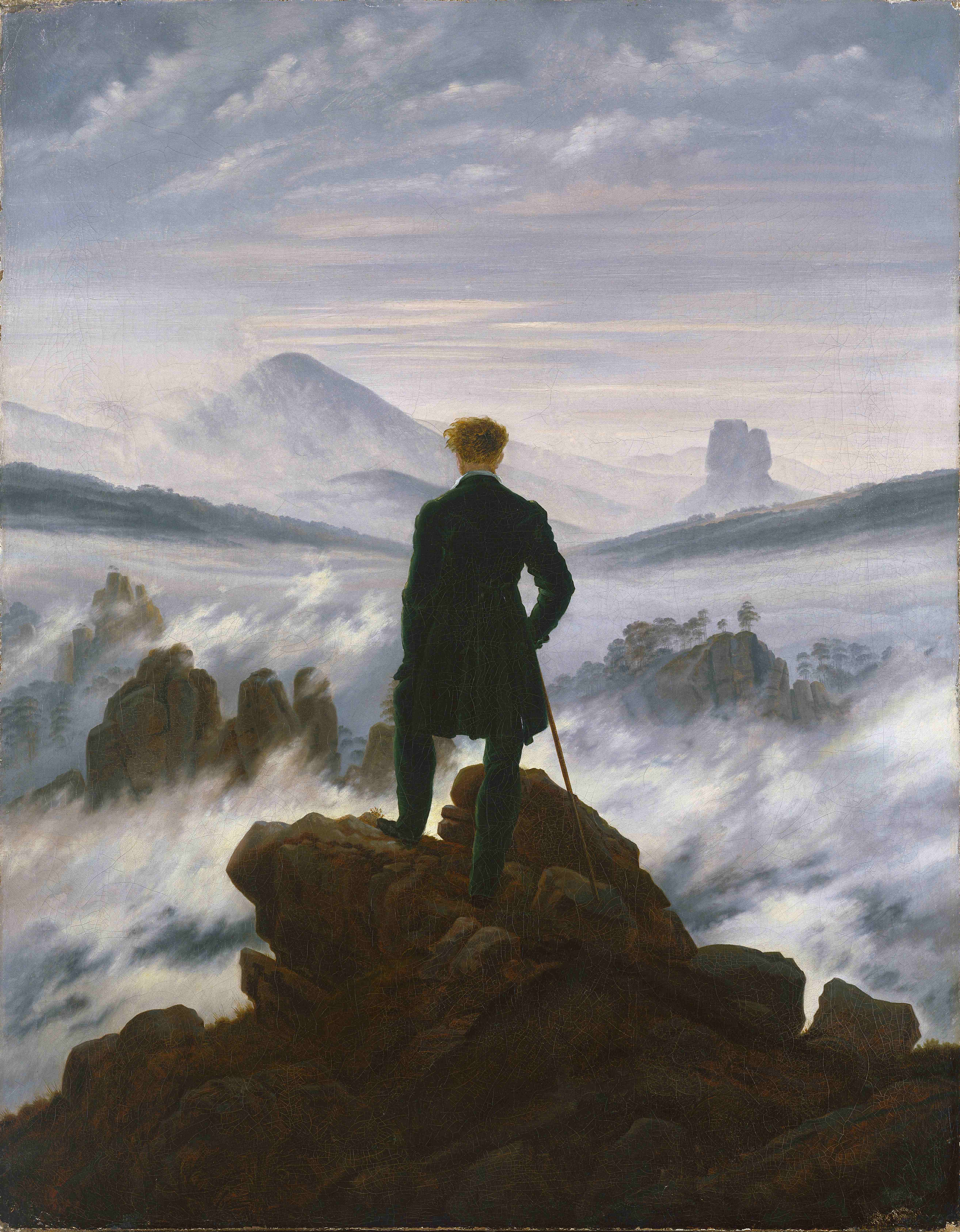
Wanderer above the Mists by Caspar David Friedrich
Wanderer above the Sea of Fog (Der Wanderer über dem Nebelmeer), c. 1817-1818. Oil on canvas, 94.8 × 74.8 cm. Hamburger Kunsthalle, Hamburg.

Overview

About This Work

Wanderer above the Mists (Der Wanderer über dem Nebelmeer, c. 1817–1818) is the quintessential masterpiece of German Romanticism and arguably the most famous landscape painting of the 19th century. Measuring 94.8 x 74.8 cm (oil on canvas), it is housed in the Hamburger Kunsthalle in Hamburg. The painting depicts a lone man standing on a rocky precipice, his back to the viewer, gazing out over a vast landscape of jagged peaks emerging from a thick sea of fog. The work has become the definitive visual icon of the Romantic Sublime—capturing the individual's solitary contemplation of nature's vastness, mystery, and power. Unlike traditional landscapes that offer a clear, panoramic view, Friedrich presents a vision of obscurity and ambiguity, where the external world is partly hidden, inviting internal reflection. It serves as a visual manifesto for the Romantic belief that the artist's role is not merely to record nature but to reflect the soul's response to it.

Visual Analysis

Composition

The most critical compositional device is the central figure standing with his back to the viewer. This is the Rückenfigur, Friedrich's signature motif—a figure seen from behind who serves as a surrogate for the viewer, inviting us to project ourselves into the scene and share in the contemplation. The figure stands at the exact vertical centre of the canvas, creating a strong axis of symmetry. Yet the landscape behind is deliberately asymmetrical and chaotic—rocky peaks emerge unevenly from the fog, creating visual tension between human order and natural disorder. The composition is structured in receding planes: foreground rock, middle-ground fog, and distant peaks fading into the sky. Each plane is progressively lighter in tone, creating depth through atmospheric perspective.

Colour & Light

The palette is deliberately restricted—predominantly cool greys, blues, and muted greens, with warmer ochres and browns in the foreground rocks. This limited palette creates a contemplative, melancholic mood. Light emanates from an unseen source beyond the horizon, creating a luminous glow in the upper portion of the canvas. This heavenly light suggests transcendence and the spiritual dimension of nature. The fog itself is the painting's most remarkable chromatic achievement—Friedrich creates subtle gradations from dense grey-white in the valleys to translucent veils that partially reveal rocky forms.

Materials & Technique

Oil on canvas, with careful attention to smooth, almost invisible brushwork. Friedrich rejected the bravura brushstrokes of earlier Baroque painting in favor of meticulous, controlled application that emphasizes clarity and stillness. The figure's clothing is rendered with precise detail—the dark green coat, walking stick, and windswept hair are carefully observed. This specificity contrasts with the generalized, atmospheric treatment of the landscape. Friedrich composed his landscapes from studies made during walking tours in the Saxon Switzerland region and Riesengebirge mountains, combining multiple sketches into imaginary composite views.

Historical Context

Context

Friedrich painted during the aftermath of the Napoleonic Wars, which had devastated the German states. The period saw a surge in German nationalism and Romantic philosophy emphasizing individual spiritual experience over Enlightenment rationalism. The walking figure may represent a specific individual—possibly a Saxon official who died in the Napoleonic Wars. The green coat suggests a forest ranger's or surveyor's uniform, lending potential commemorative significance. German Romantic philosophy, particularly the writings of Friedrich Schelling and the Schlegel brothers, profoundly influenced Friedrich. They argued that nature was not merely an object to be studied scientifically but a mirror of the human soul and a pathway to divine truth.

Key Themes

The Sublime and Human Transcendence

The painting embodies the Romantic Sublime—the experience of awe, terror, and exaltation before nature's vastness and power. Unlike the "Beautiful" (which pleases through harmony), the Sublime overwhelms and humbles the viewer. The fog represents the limits of human knowledge—we cannot see clearly, cannot know fully. This epistemological uncertainty was central to Romantic thought, which rejected Enlightenment confidence in human reason. The solitary figure embodies Romantic individualism—the belief that authentic experience comes through personal encounter with nature, not through social convention or inherited tradition.

Exam Focus Points

Critical Perspectives

The Rückenfigur invites projection and identification, yet also creates distance—we see what he sees, but we also see him. This double vision raises questions about the nature of artistic representation and viewer engagement. Feminist scholars have noted the gendering of the sublime landscape—the masculine figure "conquers" the feminized nature below. This reading contextualizes Romantic landscape within broader patterns of gender ideology. The painting's status as "icon of Romanticism" is itself historically constructed—it became famous primarily in the 20th century. Earlier reception was more ambivalent; some critics found Friedrich's mysticism obscure or excessive. Post-colonial readings examine how European Romanticism's celebration of "wild nature" depended on the erasure of indigenous peoples and the fantasy of empty, unpeopled landscapes available for aesthetic contemplation.

On this page

OverviewVisual AnalysisHistorical ContextKey ThemesExam Focus Points