History o' Phoeart
  • Home

Nature

  • Overview
  • Landscape or Seascape in 2D
  • Animals in 2D or 3D
  • The Elements (Fire, Water, Wind or Earth) in 2D or 3D
  • The Relationship between Man/Woman and Nature in 2D or 3D

Identity

  • Overview
  • The Divine in 2D or 3D Works
  • Portraits in 2D Works
  • Portraits in 3D Works
  • Gender Identity in 2D or 3D Works

Renaissance

  • Overview
  • Religious Painting
  • Religious Sculpture
  • Mythological in 2D or 3D
  • Portraits in 2D or 3D

Baroque

  • Overview
  • Religious Painting
  • Religious Sculpture
  • Mythological Painting
  • Mythological Sculpture

About

A comprehensive study resource for Pearson Edexcel History of Art A-Level.

NatureIdentityRenaissanceBaroque

History o' Phoeart - A-Level Study Resource

Pearson Edexcel Specification • Use ⌘K to search

  1. Home
  2. Paper 1
  3. Nature
  4. Plants in 2D or 3D
  5. Flowers in a Glass Vase with a Tulip
Paper 1Nature
Nature
Landscape or Seascape in 2D
Animals in 2D or 3D
The Elements (Fire, Water, Wind or Earth) in 2D or 3D
The Relationship between Man/Woman and Nature in 2D or 3D
Plants in 2D or 3D
Pre-1850
Flowers in a Glass Vase with a Tulip

Flowers in a Glass Vase with a Tulip

Rachel Ruysch

Post-1850
Non-Western
Architecture

6 scopes • 24 artworks

Flowers in a Glass Vase with a Tulip

Rachel Ruysch, 1716
NaturePre-1850
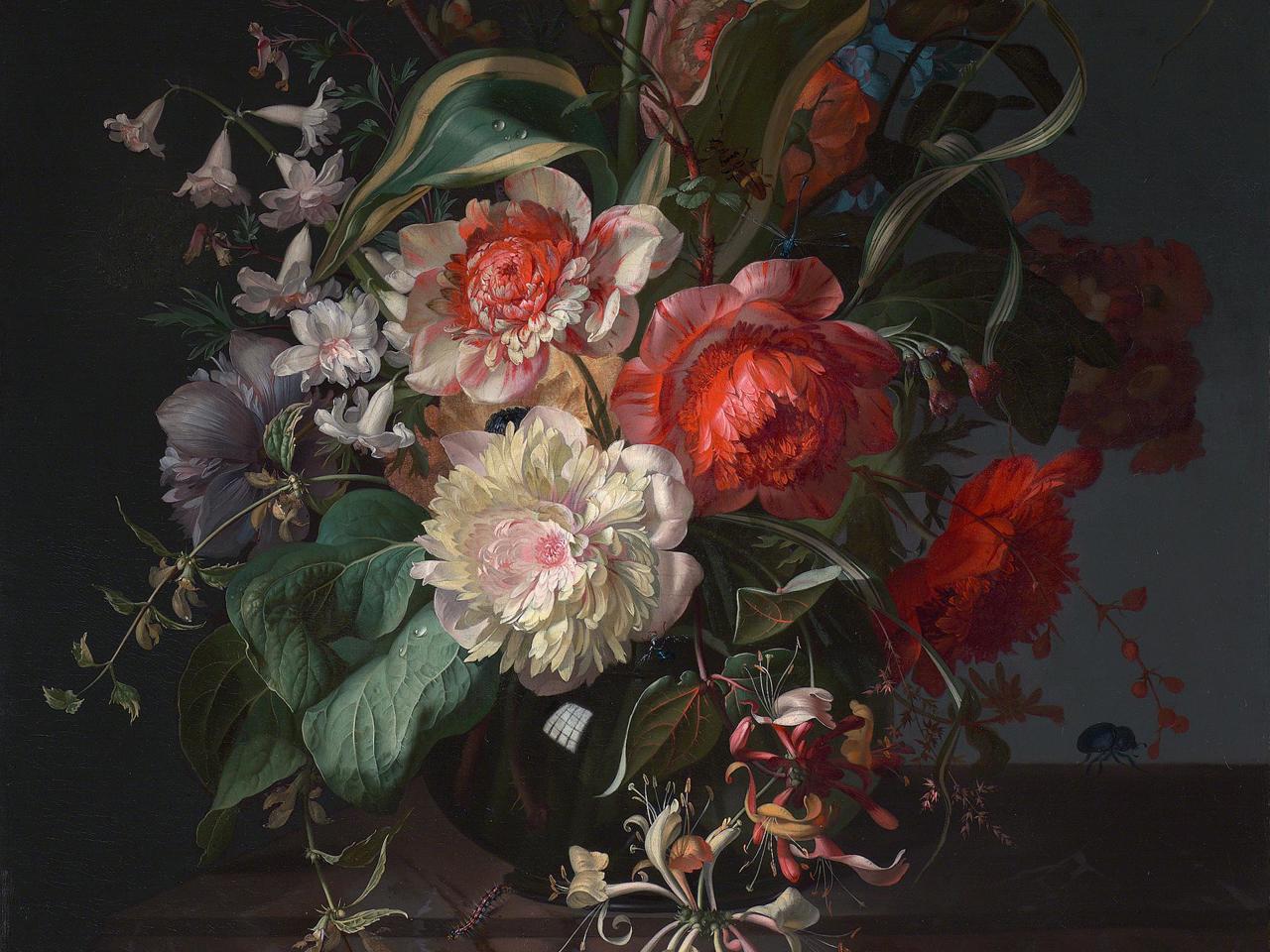
Flowers in a Glass Vase with a Tulip by Rachel Ruysch
Rachel Ruysch, Flowers in a Glass Vase with a Tulip, 1716, oil on canvas, 46.5 × 36 cm, National Gallery, London (on loan)

Overview

About This Work

Flowers in a Glass Vase with a Tulip (1716) is a masterpiece of Dutch still-life painting by Rachel Ruysch (1664–1750), one of the most successful female artists of the Dutch Golden Age. Measuring 46.5 x 36 cm (oil on canvas), it is currently on display at the National Gallery, London (on loan). Ruysch was internationally renowned in her lifetime—her works commanded higher prices than Rembrandt's—and she served as court painter to the Elector Palatine in Düsseldorf. This painting typifies her mature style: a lush, scientifically precise floral arrangement set against a dark background, enlivened by dramatic lighting (chiaroscuro) and the presence of insects. Unlike earlier static flower pieces, Ruysch's composition is dynamic and full of movement, with stems curving and flowers nodding as if caught in a breeze. The work is not merely decorative; it is a complex synthesis of scientific observation (botany) and moral symbolism (vanitas), reflecting the Dutch cultural obsession with flowers (particularly tulips) and the philosophical awareness of life's transience.

Visual Analysis

Composition

The S-Curve (Hogarth's Line of Beauty): The arrangement is not symmetrical but dynamic. Ruysch creates a subtle S-curve (or serpentine line) that leads the eye from the drooping marigold in the lower left, up through the central white roses, and culminating in the magnificent red-and-white tulip at the apex. This creates a sense of organic growth and movement, preventing the composition from feeling static or rigid. Asymmetry and Naturalism: Unlike the formal, stiff bouquets of earlier 17th-century painters (like Ambrosius Bosschaert), Ruysch's arrangement feels more natural and informal. Stems cross each other; flowers turn away from the viewer; some blooms droop heavily. This "studied informality" requires sophisticated compositional skill to balance the visual weight without symmetry. Pyramidal Structure: Despite the asymmetry, the overall mass of flowers forms a loose pyramid, providing stability. The glass vase anchors the composition at the base, while the striped tulip forms the crowning pinnacle. Impossibility of the Bouquet: While naturalistic in detail, the bouquet is botanically impossible. It combines flowers that bloom in different seasons (e.g., spring tulips with summer roses and autumn marigolds). This reveals that the painting is an artificial construction—an idealized assembly of nature's best moments, not a snapshot of a real bouquet.

Colour & Light

Dramatic Chiaroscuro: Ruysch sets the brightly coloured flowers against a dark, indefinite background. This high contrast (chiaroscuro) makes the flowers appear to glow and project forward into the viewer's space. The lighting is theatrical, spotlighting the central blooms while leaving the edges in shadow. Sophisticated Palette: The colour scheme is carefully balanced. The warm reds and oranges of the tulip and marigolds are cooled by the lush greens of the foliage and the pale whites/pinks of the roses. The central white rose serves as a "high key" focal point, drawing the eye immediately. Tactile Textural Differentiation: Ruysch excels at rendering specific textures. The waxy smoothness of the tulip petals contrasts with the thin, crinkled paper-like texture of the poppies and the soft, velvety surface of the roses. The glass vase reflects the studio window (a common Dutch trope), demonstrating her virtuosity in painting transparency and reflection.

Materials & Technique

Scientific Precision: Ruysch's father was Frederik Ruysch, a famous anatomist and botanist. Growing up surrounded by preserved specimens, Rachel developed a scientific eye for detail. Every stamen, pistil, and vein is rendered with botanical accuracy. She used fine brushes to achieve this microscopic level of detail, likely using a magnifying glass. Thin Glazing: Like many Dutch masters, Ruysch built up the image using thin, transparent layers of oil paint (glazes) over a monochrome underpainting. This technique allows light to penetrate the paint layers and reflect off the white ground, giving the flowers their luminous, jewel-like quality. Wet-in-Wet Technique: For softer petals and foliage, she occasionally worked "wet-in-wet" (blending colours directly on the canvas before they dried), creating soft transitions and organic softness.

Historical Context

Context

The Dutch Golden Age: The painting dates to the late Golden Age (early 18th century), a period of unprecedented wealth in the Netherlands driven by maritime trade. The Dutch middle class had disposable income to purchase art, creating a thriving open market for paintings (unlike the church/state patronage in Catholic Europe). Flower paintings were highly prized status symbols. Tulip Mania (Tulpenmanie): The prominence of the red-and-white striped tulip is significant. In the 1630s, the Netherlands experienced "Tulip Mania," where rare tulip bulbs sold for the price of houses. Although the market crashed in 1637, tulips remained iconic symbols of Dutch identity and wealth. The striped pattern (caused by a virus) was particularly broken and prized. Female Artists in the 17th Century: Ruysch was an exception to the rule. While women were generally excluded from artistic training, Ruysch was apprenticed to the famous flower painter Willem van Aelst at age 15. She continued painting even after marriage and having 10 children, maintaining a professional career for over 60 years—a testament to her extraordinary talent and determination. Scientific Revolution: The painting reflects the era's fascination with empirical observation and classification. Botany was a burgeoning science, and collectors amassed "cabinets of curiosity" containing exotic specimens. Ruysch's paintings functioned similarly—as collections of rare and beautiful specimens preserved forever in paint.

Key Themes

Connection to Nature (Vanitas and Transience)

Vanitas / Memento Mori: Beneath the beauty lies a moral message. The painting is a vanitas—a reminder of the emptiness of worldly possessions and the inevitability of death. Cut flowers are inherently dying; their beauty is fleeting. By freezing them in paint, Ruysch paradoxically preserves what is transient, but the message remains: life is short. Signs of Decay: If you look closely, the bouquet is not perfect. Leaves are eaten by insects; some flowers are fully open and about to drop their petals; the marigold droops. These are deliberate signs of decay, reinforcing the theme of mortality. Insects as Symbols: The painting includes tiny creatures—a caterpillar, a beetle, a butterfly. These are not just decoration. The caterpillar/beetle represents earthly decay and destruction. The butterfly (often depicted emerging from a chrysalis) represents the Resurrection and the soul leaving the body. Thus, the painting encapsulates the Christian cycle of life, death, and resurrection. Religious Symbolism: White Rose/Poppy: Often associated with the Virgin Mary or purity. Tulip: Represents wealth and worldly vanity (foolishness). Wheat/Grapes (if present, though less prominent here): Eucharistic symbols (bread and wine). Ruysch was a devout Protestant; her paintings were intended to inspire contemplation of God's creation (the "Book of Nature").

Exam Focus Points

Critical Perspectives

Art vs. Nature: Ruysch creates a "hyper-reality." She improves upon nature by creating a perfect composition that could never exist in reality (due to seasonal differences) and preserving it forever. Is the painting a celebration of nature, or a demonstration of the artist's power over nature? Gender and Genre: Flower painting was often dismissed by the Academy as a "lesser" genre suitable for women (who were thought to lack the intellect for history painting). However, Ruysch elevated the genre to high art through her compositional complexity and scientific rigour. Modern feminist art historians celebrate her for subverting the limitations placed on her gender. Commercialism: The painting is explicitly a luxury object. It depicts luxury commodities (rare flowers) and was sold as a luxury commodity to wealthy buyers. It celebrates the very materialism it ostensibly critiques (through the vanitas theme). This tension—between celebrating wealth and warning against it—is central to Dutch Golden Age culture. The Gaze: The painting invites close looking. The extreme detail rewards intimate inspection, contrasting with the grand, distant view of history paintings. It invites a "possessive gaze"—the viewer "owns" these flowers visually.

On this page

OverviewVisual AnalysisHistorical ContextKey ThemesExam Focus Points