History of (tagg)Art...
HomeNatureIdentityRenaissanceBaroque

Nature

  • All Nature artworks
  • Landscape or Seascape in 2D
  • Animals in 2D or 3D
  • The Elements (Fire, Water, Wind or Earth) in 2D or 3D
  • +3 more topics

Identity

  • All Identity artworks
  • The Divine in 2D or 3D Works
  • Portraits in 2D Works
  • Portraits in 3D Works
  • +3 more topics

Renaissance

  • All Renaissance artworks
  • Religious Painting
  • Religious Sculpture
  • Mythological in 2D or 3D
  • +3 more topics

Baroque

  • All Baroque artworks
  • Religious Painting
  • Religious Sculpture
  • Mythological Painting
  • +6 more topics

About

A comprehensive study resource for Pearson Edexcel History of Art A-Level.

NatureIdentityRenaissanceBaroque

History of (tagg)Art... - A-Level Study Resource

Pearson Edexcel Specification

Admin
  1. Home
  2. Renaissance
  3. Ca' d'Oro

Ca' d'Oro

Bartolommeo + Giovanni Bon, 1428-30
RenaissanceSecular ArchitectureVenice
Ca' d'Oro by Bartolommeo + Giovanni Bon
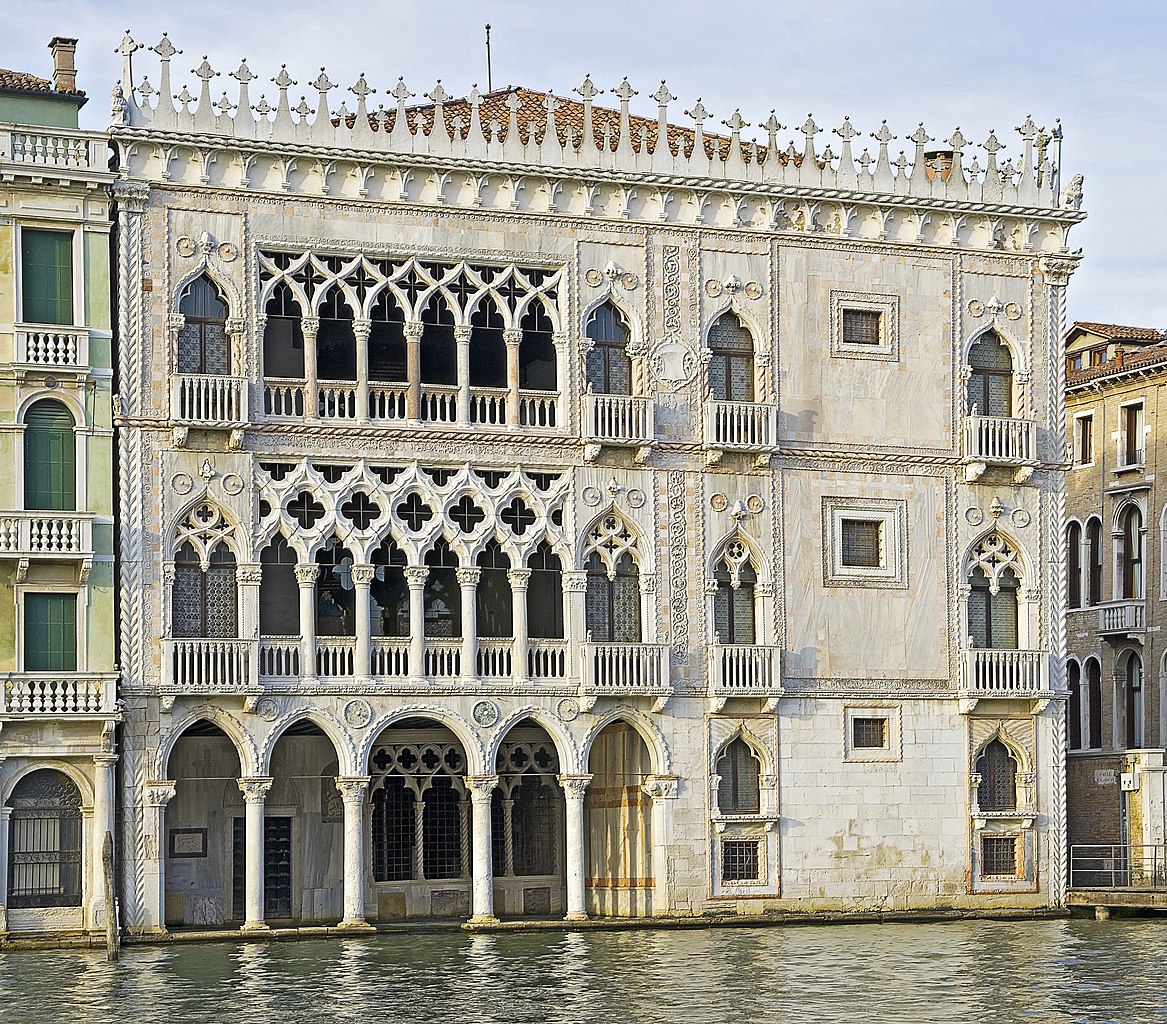
Ca' d'Oro, Giovanni and Bartolomeo Bon, 1428-1430, Venice. View from the Grand Canal showing the three-story facade with ground-floor loggia, quatrefoil tracery windows, and asymmetrical composition.

Overview

About This Work

Ca' d'Oro (literally "House of Gold"; also known as Palazzo Santa Sofia) is a palace on the Grand Canal in Venice built between 1428 and 1430 for Marino Contarini, a wealthy Venetian patrician of one of Venice's oldest and most prominent families (the Contarini had provided eight different Doges to the Venetian Republic between 1043 and 1676). The palace was designed by Giovanni Bon and his son Bartolomeo Bon, master sculptors and architects renowned for their work on the Palazzo Ducale (Doge's Palace) and the Porta della Carta (the ceremonial entrance to the palace with monumental sculpture). The Ca' d'Oro is "the best surviving palazzo in Venetian Gothic architecture," representing the pinnacle of fifteenth-century Venetian domestic design. The building exemplifies the distinctive synthesis of architectural traditions that characterizes Venetian Gothic: Byzantine, Islamic, and Northern (English) Gothic influences merge in a uniquely Venetian vocabulary of ornament, proportion, and spatial organization. The facade was originally adorned with gilt and polychrome decorations (gold leaf, brilliant ultramarine blue pigment made from imported lapis lazuli, red Verona marble, pale green marble, white Istrian stone)—ornamentation so lavish and luminous that it gave the building its enduring nickname. The Ca' d'Oro demonstrates that Venice created an entirely distinct architectural tradition from the classical Renaissance being developed simultaneously in Florence. While Florentine architects like Michelozzo and Alberti were reviving classical orders and proportions, Venetian architects like the Bons were perfecting an ornamental, light-infused Gothic vocabulary that celebrated commercial prosperity and cosmopolitan sophistication. The building represents not a preliminary stage or a backward glance, but rather a fully mature, sophisticated, and distinctly Venetian alternative to classical Renaissance architecture.

Visual Analysis

Composition

The principal facade of the Ca' d'Oro facing the Grand Canal is organized into three distinct horizontal stories, each progressively more ornate as the eye ascends. This vertical emphasis—becoming increasingly refined toward the roofline—creates a sense of ascending grace and elegance. The ground floor features a recessed colonnaded loggia with five large pointed arches. The central arch is wider and more prominent than the flanking arches on either side—a hierarchical arrangement that draws the eye to the center while maintaining visual order through symmetrical flanking. The arches are supported by slender columns with Byzantine-influenced capitals. The loggia opens directly to the waterfront, creating a gondola landing where boats could be moored. Above the ground-floor loggia is an enclosed balcony belonging to the gran salone (great hall), the principal reception room on the piano nobile (main residential floor). This balcony features multiple arched openings topped with ornate quatrefoil traceries—Gothic window designs resembling four-petaled flowers. The quatrefoils are composed of slender marble columns and intricately carved stone lattice-work. These are among the finest Gothic quatrefoils in Venice, traditionally attributed to Matteo Raverti, the Milanese architect-sculptor brought to Venice specifically to execute the elaborate traceries. One of the Ca' d'Oro's most distinctive characteristics is its deliberate asymmetry. The left side of the facade is remarkably sparse and open—dominated by void rather than solid wall. The right side is densely covered with ornamental marble in various colors and patterns. This asymmetry creates extraordinary visual effect through the play of light and shadow: the left side's voids cast deep shadows creating visual depth; the right side's densely carved marble reflects light in complex patterns. This asymmetrical organization was not arbitrary or accidental but rather was deliberately designed to accommodate practical requirements. Yet despite this apparent irregularity, the facade is fundamentally harmonious. The arrangement of arches and columns follows a precise proportional logic: the wide central arch of the ground floor is flanked symmetrically by narrower arches; the arrangement of columns and arches in the upper balconies corresponds perfectly with one another (column over column, arch over arch).

Colour & Light

The original appearance of the Ca' d'Oro was extraordinarily colorful and lustrous. The facade was adorned with materials including: Gold leaf covering the parapet balls, window finials, capitals, moldings, and other sculptural details. Ultramarine blue paint (made from crushed lapis lazuli imported from Afghanistan) highlighting selected architectural elements. Red Verona marble panels creating warm, rich color accents. White and pale green marble in geometric patterns. White lead and oil applied to Istrian stone to create a marble-like sheen. The combination of these materials created a facade that gleamed and shimmered in Mediterranean light. The gold leaf and ultramarine were particularly significant: ultramarine was more valuable than gold itself in this period, its cost reflecting the expense of importing lapis lazuli from Afghanistan through Venetian mercantile networks. The use of ultramarine paint on a private palazzo demonstrated extraordinary wealth and cosmopolitan connections. Over time, the gold has worn away, the ultramarine paint has faded, and the marbles have weathered. Yet the building retains its nickname "Ca' d'Oro" even centuries later, testimony to the lasting impression made by the original gilded appearance. The nickname endures even as the golden decoration has vanished—a poignant reminder of the building's original magnificence. The play of light and shadow remains central to the building's visual impact. The left side's voids create deep shadows and visual depth; the right side's carved marble reflects light in complex patterns. This creates an impression of carved lace rather than solid wall—a subtle, transparent diaphragm between interior and exterior that embodies the Venetian exchange between public and private life.

Materials & Technique

The palazzo was built with brick faced with marble veneer—the brick exposed on interior courtyard walls and side facades not visible from the Grand Canal, demonstrating the concentration of expense on the canal facade. Construction began in 1421 and took approximately 15 years, with the palazzo substantially complete by 1436–1437. Marino Contarini kept detailed records of the entire construction process, offering scholars invaluable insight into medieval and Renaissance building practices. The quatrefoil windows are perhaps the most striking technical achievement of the Ca' d'Oro. These four-lobed tracery patterns appear in both the second and third stories, yet in different configurations. The quatrefoils are composed of white and pale red marble arranged in intricate geometric lattice-work. The carving is extraordinarily fine and delicate—the stone appears almost to dissolve into tracery, creating an impression of carved lace rather than solid structural material. Throughout the facade appear sculptural elements of exceptional quality: lion heads serve as capitals (supporting members crowning columns); scrollwork and foliage ornament moldings; ball finials and pinnacles crown the roofline. These sculptural elements draw heavily on Byzantine and Islamic precedents—lion symbolism appears throughout Islamic and Byzantine art; the vegetal ornamentation reflects Islamic decorative traditions. The corners of the building are articulated with marine-inspired capitals—lion heads and sea creatures that reference Venice's maritime identity. Behind the loggia is a large atrium (androne) that extends deep into the palazzo. This atrium provided covered circulation from the waterfront to interior spaces and connected to a small inner courtyard with a central wellhead by Bartolomeo Bon. The courtyard provides light and ventilation to interior spaces and contains a small garden—a precious amenity in dense urban Venice.

Historical Context

Context

Marino Contarini was a member of one of Venice's oldest and most powerful patrician families. The Contarini family was among Venice's founding families, members of the oligarchic merchant elite that governed the Venetian Republic. Between 1043 and 1676, the Contarini family produced eight different Doges—the elected heads of the Venetian state. The commission of the Ca' d'Oro was an assertion of family power and prosperity. The building's location "not far from the Rialto Bridge on the left bank of the Grand Canal" placed it in one of Venice's most prominent locations—on the city's main waterway, near the commercial heart of the city. Giovanni Bon and his son Bartolomeo Bon were among Venice's most renowned master sculptors and architects. They are best known for their work on the Palazzo Ducale (Doge's Palace), particularly the Porta della Carta (1438–1442)—the ceremonial entrance to the palace featuring monumental sculpture. The Bons worked in a distinctly Venetian floral Gothic style—an ornamental vocabulary combining Byzantine heritage, Gothic pointed forms, Islamic geometric patterning, and specifically Venetian maritime symbolism. The Ca' d'Oro exemplifies the Venetian ability to synthesize diverse architectural traditions into a coherent, sophisticated style. The building draws on Byzantine traditions (rounded arches, domed spaces, emphasis on light and color), Islamic influences (geometric patterning, vegetal ornamentation, marine symbolism), Northern Gothic (pointed arches, quatrefoil tracery, vertical emphasis), and classical fragments (marine capitals, proportional relationships). Significantly, the Ca' d'Oro represents a completely different architectural trajectory from what was occurring simultaneously in Florence. While Florentine architects like Michelozzo (Palazzo Medici, 1444–1484), Alberti, and Bramante were reviving classical orders, proportions, and principles, Venetian architects were perfecting an ornamental, light-filled, non-classical Gothic vocabulary. This choice was artistically successful: the Ca' d'Oro is universally recognized as a masterpiece of architecture, and Venetian Gothic remained the dominant style in Venice into the sixteenth century. After the fall of the Venetian Republic, the Ca' d'Oro changed ownership multiple times. In the nineteenth century, it was owned by the famous ballet dancer Marie Taglioni, who made reckless renovations, removing Gothic staircases and ornate balconies overlooking the courtyard. In 1894, Baron Giorgio Franchetti purchased the palazzo and undertook careful restoration, recovering architectural elements that had been sold off. The palazzo was converted into a museum and art gallery, which continues to this day as the Galleria Giorgio Franchetti.

Key Themes

Connection to Renaissance

Exam Focus Points

Critical Perspectives

The Ca' d'Oro provides essential material for exam questions concerning Venetian Gothic architecture, the diversity of Renaissance traditions, patronage and display, and architectural synthesis. Key examination themes include: The building as the finest surviving example of Venetian Gothic domestic architecture, representing the pinnacle of a distinctly Venetian tradition that developed independently from Florentine classical Renaissance. The deliberate asymmetry of the facade—with sparse, open left side and densely ornamented right side—demonstrates sophisticated response to urban context while maintaining underlying proportional harmony. The quatrefoil windows as technical and aesthetic achievement—carved stone lattice-work of extraordinary delicacy attributed to Matteo Raverti, creating impression of carved lace rather than solid structure. The original gilt and polychrome decoration (gold leaf, ultramarine blue from lapis lazuli, colored marbles) that gave the building its enduring nickname. Giovanni and Bartolomeo Bon as master sculptors and architects working in distinctly Venetian floral Gothic style—their work on the Doge's Palace and Porta della Carta establishing their reputation. Marino Contarini as patrician patron from one of Venice's most prominent families (eight Doges between 1043–1676), commissioning the palazzo as assertion of family power on prime Grand Canal location. The Venetian synthesis of Byzantine, Islamic, and Northern Gothic traditions creating a uniquely Venetian architectural vocabulary—expressing the city's cosmopolitan mercantile identity. The contrast with contemporary Florentine developments (Palazzo Medici, 1444) demonstrating that Renaissance achievement encompassed diverse aesthetic traditions beyond classical revival.

On this page

OverviewVisual AnalysisHistorical ContextKey ThemesExam Focus Points