History of (tagg)Art...
HomeNatureIdentityRenaissanceBaroque

Nature

  • All Nature artworks
  • Landscape or Seascape in 2D
  • Animals in 2D or 3D
  • The Elements (Fire, Water, Wind or Earth) in 2D or 3D
  • +3 more topics

Identity

  • All Identity artworks
  • The Divine in 2D or 3D Works
  • Portraits in 2D Works
  • Portraits in 3D Works
  • +3 more topics

Renaissance

  • All Renaissance artworks
  • Religious Painting
  • Religious Sculpture
  • Mythological in 2D or 3D
  • +3 more topics

Baroque

  • All Baroque artworks
  • Religious Painting
  • Religious Sculpture
  • Mythological Painting
  • +6 more topics

About

A comprehensive study resource for Pearson Edexcel History of Art A-Level.

NatureIdentityRenaissanceBaroque

History of (tagg)Art... - A-Level Study Resource

Pearson Edexcel Specification

Admin
  1. Home
  2. Renaissance
  3. Palazzo Caprini

Palazzo Caprini

Bramante, c.1510
RenaissanceSecular ArchitectureRome
Palazzo Caprini by Bramante
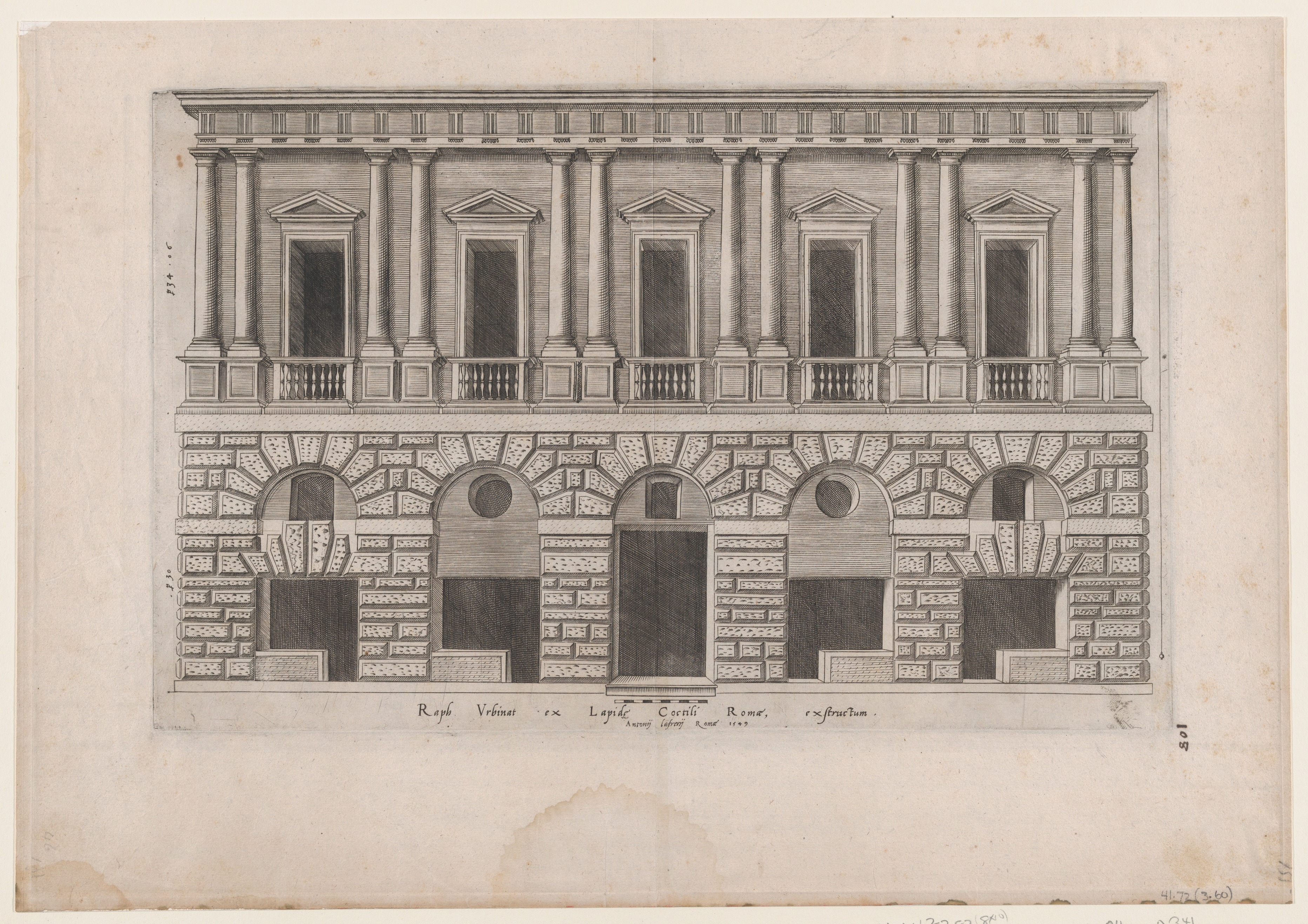
Palazzo Caprini (House of Raphael), engraving by Antoine Lafréry after Bramante's design, c.1501-1510

Overview

About This Work

Palazzo Caprini is a Renaissance palazzo in Rome designed by Donato Bramante and erected between approximately 1501 and 1510 for Adriano Caprini, an apostolic protonotary (high church official). The palazzo subsequently became famous as the "House of Raphael," after the great Renaissance painter Raphael (Raffaello Sanzio) purchased it in 1517 and lived there until his death in 1520. The building is now destroyed—it was demolished in the early twentieth century—yet it survives in historical consciousness and influence through contemporary engravings and drawings, most famously the etching by Antoine Lafréry and a partial sketch attributed to Andrea Palladio. Despite being destroyed, the Palazzo Caprini was "one of the most influential buildings of the Renaissance." It became the prototype for High Renaissance palazzo design throughout Italy and Europe, establishing conventions that would dominate domestic architecture for centuries. The building was "simple in its conception and harmonious in its proportions," yet this simplicity concealed profound architectural sophistication. It demonstrated how classical principles of proportion and order could be applied to practical urban residential needs, creating a building that housed shops at street level (generating income) while providing refined residential quarters above. The palazzo represents Bramante's genius for synthesis: it merged the rusticated ground-story arcades characteristic of fifteenth-century Florentine palaces (like the Palazzo Medici and Palazzo Pitti) with classical orders properly employed on the upper stories in a way no earlier building had achieved. The result was an architectural vocabulary that proved so effective and harmonious that it became a standard template for Renaissance and subsequent palace design.

Visual Analysis

Composition

The Palazzo Caprini's facade is five bays wide and two stories high, creating a composition that is markedly horizontal in its silhouette. This proportional relationship—width significantly exceeding height—conveys stability, territorial command, and visual breadth. The facade is organized with absolute clarity: each of the five bays is identical in its upper-story arrangement, while the ground-story openings vary slightly in placement and shape (the two on the left mirror the two on the right, with the center bay distinct). This simple, legible organization is deceptive. While the overall composition is immediately comprehensible, the building actually contains four stories: the two main stories (ground and piano nobile) plus a mezzanine level (with windows visible in the upper portions of the ground-story arches) and an attic level (whose windows are concealed within the entablature at the roofline). The complexity is subordinated to clarity—a hallmark of Bramante's design philosophy. The stark contrast between ground and upper stories is intentional and meaningful. The ground story is uniform, textured, fortress-like—expressing strength and load-bearing capacity. The piano nobile is refined, articulated with classical elements, elegant—expressing civilization and cultivation. The contrast embodies Renaissance ideals: crude strength at the base supports refined civilization above. Scholars note that this visual hierarchy parallels the social hierarchy of the building's functions and occupants. The ground-floor shops and storage areas were occupied by tradesmen and servants of lower social status and less formal education. The piano nobile housed the family and was used for receiving guests and conducting business—requiring refined, civilized appearance.

Colour & Light

The ground story is faced with stucco imitating rusticated masonry. Rather than cutting expensive stone blocks, Bramante employed a revolutionary technique: cast mortar was modeled in wooden forms to create the appearance of cut stone, then textured to simulate rustication. This technique was economical yet visually convincing—it achieved the visual and symbolic effects of costly stone at a fraction of the expense. The rustication consists of large, rough-textured blocks arranged in a precise, repetitive pattern that extends across all five bays. The rough texture is not arbitrary decoration; it expresses the ground story's structural function. The textured surface communicates that this story is bearing weight, supporting the refined story above. The appearance of rusticated strength was a status symbol, declaring that the patron (Caprini) was sufficiently wealthy and important to commission impressive materials. Bramante's choice to use engaged columns rather than flat pilasters (as Alberti had employed at the Palazzo Rucellai) increased the facade's "plasticity"—its three-dimensional quality. The engaged columns, though attached to the wall, appear to project forward, creating rounded forms that catch light dramatically. They create the visual impression of columns serving as a screen in front of the wall rather than being merely surface decoration.

Materials & Technique

The ground story is articulated by five arches spanning the bays. These arches frame shop openings (the palazzo, like Roman insulae or apartment buildings, rented out commercial space at street level to generate income). The voussoirs (wedge-shaped arch stones) have squared-off, horizontally and vertically cut facings rather than the curved facings typical of Florentine arches. This was a classical Roman technique used in ancient times and revived by Renaissance architects such as Giuliano da Sangallo at the Palazzo Gondi. The upper story presents a dramatic visual contrast to the ground floor. Here, between each of the five bays, rise pairs of engaged Doric columns standing on rusticated piers. The columns are slender and fluted, displaying classical Doric capitals with their characteristic simplicity and strength. Engagement (being carved from the wall surface rather than projecting freely) reduces the columns' three-dimensionality compared to free-standing columns, yet still gives them visual presence and sculptural quality. Between each pair of engaged columns are tall rectangular windows topped with classical pedimented frames (triangular pediments crowning the windows). Below each window is a projecting balustrade or balcony, serving both practical (safety) and aesthetic (visual refinement) functions. Above the windows runs a complete Doric entablature with architrave, frieze (with triglyphs and metopes characteristic of the Doric order), and cornice. This proper classical entablature articulates the roofline, providing visual closure and expressing structural logic. The Doric entablature crowning the piano nobile is detailed with complete propriety, following Vitruvian principles for the classical Doric order. This proper classical articulation was significant historically. While Alberti and earlier Renaissance architects had engaged classical orders, Bramante's precision in following classical rules demonstrated deeper knowledge of ancient architecture, likely derived from his study of Roman ruins and Vitruvian texts.

Historical Context

Context

The palazzo was commissioned by Adriano Caprini, an apostolic protonotary (a church official of high rank). Caprini manifested his will to build a home in the Borgo district of Rome (the papal neighborhood) as early as 1501. By the time of his death in 1510, the building was already standing and being rented out by his heirs. Bramante designed the palazzo around 1506–1508, though exact dating is uncertain. The building thus occupies a position in Bramante's career roughly contemporary with his work on the Tempietto (1502–1510) and his early work on the Belvedere Court in the Vatican (begun c. 1505). In January 1517, the renowned painter Raphael Sanzio (1483–1520) purchased the palazzo. Raphael was at the height of his fame and success; he had just completed the Vatican frescoes (including the School of Athens and Disputation of the Sacrament) and was the leading artist in Rome. By acquiring the Palazzo Caprini, Raphael made it his residence and studio until his death in 1520 at the relatively young age of 37. According to Giorgio Vasari, the great Renaissance biographer, Bramante and Raphael had a collaborative relationship. Vasari states that Bramante had designed the architectural background for Raphael's School of Athens fresco (painted 1508–1511 in the Vatican), and in return, Raphael included Bramante's portrait in the fresco, depicting him as the ancient mathematician Euclid. The Palazzo Caprini thus became known as the "House of Raphael," and this association enhanced its historical fame and artistic significance.

Key Themes

Connection to Renaissance

Exam Focus Points

Critical Perspectives

Scholars emphasize the Palazzo Caprini's revolutionary status as the prototype for High Renaissance palazzo design. Despite its destruction, the building's influence persists through historical documentation and its profound impact on subsequent architecture. The palazzo demonstrates Bramante's genius for synthesis—merging Florentine rustication traditions with proper classical orders in a way that became the standard model for centuries. Key exam points include: the five-bay, two-story composition with actual four-story complexity; the stucco rustication technique simulating expensive stonework; paired engaged Doric columns on the piano nobile; the proper Vitruvian Doric entablature; Raphael's purchase and residence (1517-1520); the commercial ground floor following Roman insula tradition; and the building's influence on palaces throughout Italy and Europe including Somerset House and the Louvre Colonnade.

On this page

OverviewVisual AnalysisHistorical ContextKey ThemesExam Focus Points