History of (tagg)Art...
HomeNatureIdentityRenaissanceBaroque

Nature

  • All Nature artworks
  • Landscape or Seascape in 2D
  • Animals in 2D or 3D
  • The Elements (Fire, Water, Wind or Earth) in 2D or 3D
  • +3 more topics

Identity

  • All Identity artworks
  • The Divine in 2D or 3D Works
  • Portraits in 2D Works
  • Portraits in 3D Works
  • +3 more topics

Renaissance

  • All Renaissance artworks
  • Religious Painting
  • Religious Sculpture
  • Mythological in 2D or 3D
  • +3 more topics

Baroque

  • All Baroque artworks
  • Religious Painting
  • Religious Sculpture
  • Mythological Painting
  • +6 more topics

About

A comprehensive study resource for Pearson Edexcel History of Art A-Level.

NatureIdentityRenaissanceBaroque

History of (tagg)Art... - A-Level Study Resource

Pearson Edexcel Specification

Admin
  1. Home
  2. Renaissance
  3. Tribute Money

Tribute Money

Masaccio, c.1425
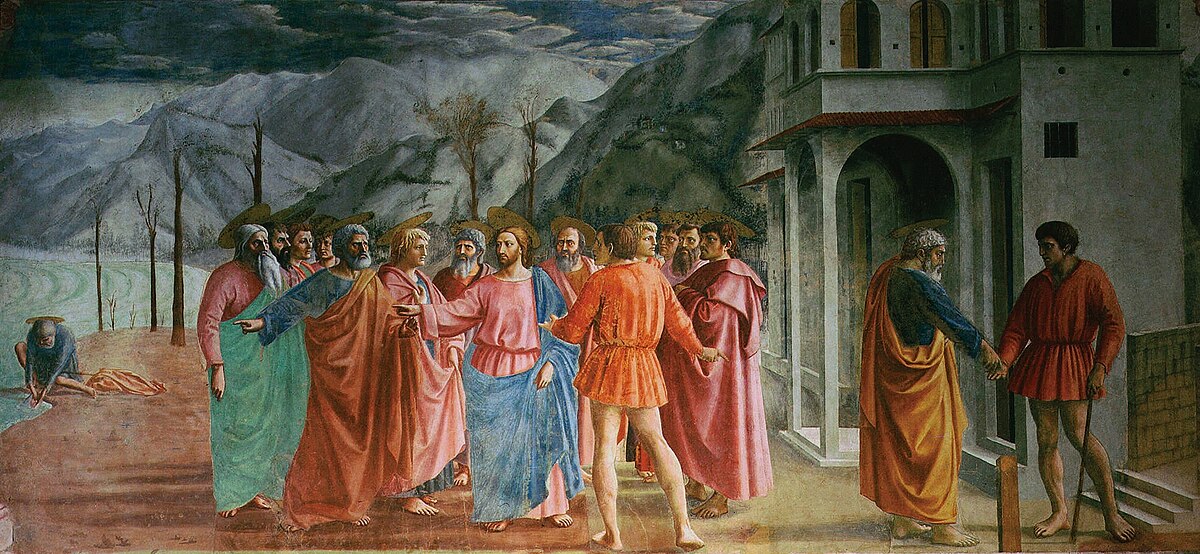
RenaissanceReligious PaintingFlorence
Tribute Money by Masaccio
Masaccio, Tribute Money, c. 1425-1427, fresco, 247 x 597 cm, Brancacci Chapel, Santa Maria del Carmine, Florence

Overview

About This Work

Tribute Money is a fresco by the Florentine painter Masaccio (1401–1428), located in the Brancacci Chapel of the Church of Santa Maria del Carmine in Florence. Painted between 1425 and 1427, it is one of the foundational masterpieces of the Italian Early Renaissance. Measuring 8 feet 1 inch by 19 feet 7 inches, it depicts a narrative from the Gospel of Matthew (17:24–27), in which Jesus instructs the apostle Peter to find a coin in the mouth of a fish to pay the temple tax. The fresco revolutionized painting through its systematic use of linear perspective, chiaroscuro (the modeling of light and shadow), and atmospheric perspective—techniques that would define the Renaissance. Although Masaccio died at age 26, this single chapel became a pilgrimage site for generations of artists seeking to understand how to paint space, light, and the human form. For Leonardo da Vinci, Michelangelo, and Raphael, the Brancacci Chapel was a masterclass in anatomy and perspective that no academy could provide.

Visual Analysis

Composition

Continuous Narrative: The fresco employs an ancient storytelling device called continuous narrative, in which multiple moments of a story unfold simultaneously within a single unified space. The three scenes unfold temporally but spatially coexist: Center (Scene 1): Jesus stands calmly surrounded by the apostles, with the tax collector facing them, gesturing impatiently with an open palm. Peter, confused, points toward the lake. Christ, unperturbed, directs Peter to find a coin in the fish's mouth. Far Left (Scene 2): In the background distance, Peter kneels by the shore, fishing. He has found the fish and is retrieving the coin from its mouth—shown as a small, pale figure receding into the distance. Far Right (Scene 3): Peter returns and pays the tax collector, shown from a different angle than the opening scene, allowing the viewer to mentally "walk around" the figures in three-dimensional space. This technique avoids the medieval practice of isolating each scene in a separate frame. Instead, all three scenes unfold in a continuous landscape, creating a temporal and spatial unity that feels more lifelike and naturalistic. Linear Perspective and Architectural Space: Masaccio employs single-point linear perspective, discovered (or rediscovered) by the architect Filippo Brunelleschi. All orthogonal (receding) lines—the edges of the buildings, the pavement lines, the architectural details—converge on a single point located at Christ's head. This is not accidental: by making Christ the vanishing point, Masaccio reinforces that He is the spiritual and compositional center of the scene. The classical buildings on the right (added by Masaccio, not mentioned in the biblical text) serve purely as perspective devices. Their arcades, columns, and receding walls create a grid that pulls the eye toward Christ. The figures diminish in size as they recede—Peter fishing in the background is noticeably smaller than the figures in the foreground, reinforcing the illusion of distance.

Colour & Light

Chiaroscuro - Light and Shadow: Masaccio introduces a revolutionary treatment of light: Single Light Source: The light comes consistently from the upper right, mimicking the actual light entering the Brancacci Chapel from a window on that wall. This creates a unified, believable illumination that ties the painting to the viewer's real architectural space. Cast Shadows: For the first time since classical antiquity, Masaccio paints cast shadows—the shadows thrown by the figures onto the ground. These shadows fall consistently to the left (away from the light source). Giotto, in the 14th century, had used light and shadow to model form, but he did not paint cast shadows. Masaccio's innovation is subtle but profound: it creates an almost photographic sense of solidity and "weather." Volumetric Modeling: The figures are modeled with gradations of light and dark, giving them a sculptural weight and presence. They are not outlined; they emerge from shadow into light. This contrasts dramatically with medieval figures, which were often flatly colored and outlined in dark lines. Atmospheric (Aerial) Perspective: In the background, the mountains fade from a darker green to pale blue-white as they recede into the distance. Similarly, Peter (on the left background) is rendered in paler, less saturated colors than the foreground figures. This mimics the optical effect of viewing distant landscape through the atmosphere, which scatters light and reduces color saturation.

Materials & Technique

Fresco Technique: The Tribute Money was painted in buon fresco (true fresco), where pigments are applied to wet lime plaster. As the plaster dries, the pigment becomes chemically bonded to the wall, creating remarkable durability. Masaccio worked in giornate (day sections), completing each area while the plaster remained wet. Gesture and Expression: The fresco is psychologically charged through gesture and expression: The Tax Collector: Standing with his back to the viewer, he gestures impatiently with his right hand pointed downward and left palm open. This pose creates spatial illusion (turning the figure away from us) while conveying his emotional state—impatience, demand, earthly authority. Peter: He points toward the lake in a gesture that mirrors Christ's gesture. His posture conveys confusion and obedience simultaneously. He is the emotional center of the drama. Christ: By contrast, Christ is perfectly calm and centered. He stands in contrapposto (weight shifted to one leg), a classical stance that suggests confidence and divine authority. His serenity amid the apostles' confusion is conveyed through stillness.

Historical Context

Context

The Brancacci Chapel and its Patrons: The chapel was commissioned by Felice Brancacci, a wealthy silk merchant involved in Mediterranean trade and a member of Florence's Board of Maritime Consuls. The fresco cycle depicts the life of Saint Peter, emphasizing his role as the founder of the Church. The Tribute Money was likely commissioned after Pope Martin V's 1423 agreement that the Florentine church be subjected to state taxation—a politically sensitive moment. The painting thus doubles as political propaganda: Jesus accepts the legitimacy of taxation, blessing both spiritual and earthly authority. The coin from the fish's mouth also carried commercial symbolism: Brancacci's wealth came from maritime trade, and the recovery of treasure from the sea was a potent image of mercantile prosperity. Masaccio the Prodigy: Masaccio lived only 26 years (1401–1428), yet he is revered as one of history's greatest painters. His precocious talent and innovative vision suggest that he may have studied the works of the sculptor Donatello (his contemporary, also pioneering classical realism) and the architect Brunelleschi. Around 1423, Masaccio is believed to have traveled to Rome with his older collaborator Masolino, where he studied classical Roman art and architecture. This experience profoundly shaped his visual language. The Brancacci Chapel was left incomplete when Masolino departed for Hungary around 1428, shortly after Masaccio's death. It was not finished until the 1480s by Filippino Lippi. This delay is fortunate for art history: generations of Renaissance masters—Michelangelo included—studied Masaccio's frescoes in their unfinished state, copying his techniques and being inspired by his innovations.

Key Themes

The Discovery of Perspective and Classical Humanism

The Discovery of Perspective: The fresco represents a watershed moment in European art. For over 1,000 years (from the fall of Rome to the medieval period), artists had lost the ability to systematically represent three-dimensional space on a two-dimensional surface. Masaccio recovered this ancient knowledge through geometry and reason. This was not merely a technical achievement; it reflected a profound shift in how Renaissance thinkers understood the world. If space could be mathematically mapped and reconstructed through perspective, then nature itself was rational and knowable. The painting embodies the Enlightenment two centuries before the Enlightenment officially began. Classical Humanism: The figures are dressed in classical Greco-Roman garments (tunics and cloaks), not medieval dress. The architecture is classical (arcaded buildings, classical columns). This is not nostalgic decoration; it is a conscious assertion that the values of classical antiquity—reason, naturalism, human dignity—are being revived. The apostles are depicted not as ethereal, otherworldly saints but as solid, dignified men wrestling with a practical problem. Their humanity is central. The Sacred and the Secular: The fresco reconciles spiritual authority (Christ's miraculous provision) with secular authority (the tax collector's legitimate demand). Christ does not condemn the tax or the state; he demonstrates that both the spiritual and temporal orders have legitimacy. This reflects Renaissance political philosophy and the Florentine context (where the Church and State often clashed over taxation and power).

Exam Focus Points

Critical Perspectives

Technical Analysis: Linear Perspective: Understand the concept of the vanishing point and how Masaccio uses it. Be able to identify the orthogonal lines converging on Christ's head. Discuss how this differs from medieval space. Chiaroscuro: Explain how light and shadow create form. Note the use of a single light source and cast shadows as revolutionary. Atmospheric Perspective: Describe how Masaccio uses color and tone to suggest distance (mountains fading, Peter dimmer in background). Composition: Continuous Narrative: Explain how three moments in time are shown in one fresco. This is an ancient technique revived by the Renaissance. Gesture and Emotion: Analyze how posture and gesture convey psychological states. The tax collector's impatience, Peter's confusion, Christ's calm. Influence and Significance: Discuss how this fresco became a model for High Renaissance artists (Michelangelo, Leonardo, Raphael). Compare to Masolino's Expulsion from Paradise (painted on the opposite wall of the chapel), which is softer, more decorative, and less spatially coherent. This contrast illustrates the break between late Gothic and Early Renaissance. Consider Masaccio's short life and disproportionate influence. Why did his work matter so much?

On this page

OverviewVisual AnalysisHistorical ContextKey ThemesExam Focus Points