History of (tagg)Art...
HomeNatureIdentityRenaissanceBaroque

Nature

  • All Nature artworks
  • Landscape or Seascape in 2D
  • Animals in 2D or 3D
  • The Elements (Fire, Water, Wind or Earth) in 2D or 3D
  • +3 more topics

Identity

  • All Identity artworks
  • The Divine in 2D or 3D Works
  • Portraits in 2D Works
  • Portraits in 3D Works
  • +3 more topics

Renaissance

  • All Renaissance artworks
  • Religious Painting
  • Religious Sculpture
  • Mythological in 2D or 3D
  • +3 more topics

Baroque

  • All Baroque artworks
  • Religious Painting
  • Religious Sculpture
  • Mythological Painting
  • +6 more topics

About

A comprehensive study resource for Pearson Edexcel History of Art A-Level.

NatureIdentityRenaissanceBaroque

History of (tagg)Art... - A-Level Study Resource

Pearson Edexcel Specification

Admin
  1. Home
  2. Renaissance
  3. Trinity

Trinity

Masaccio, c.1427

RenaissanceReligious PaintingFlorence
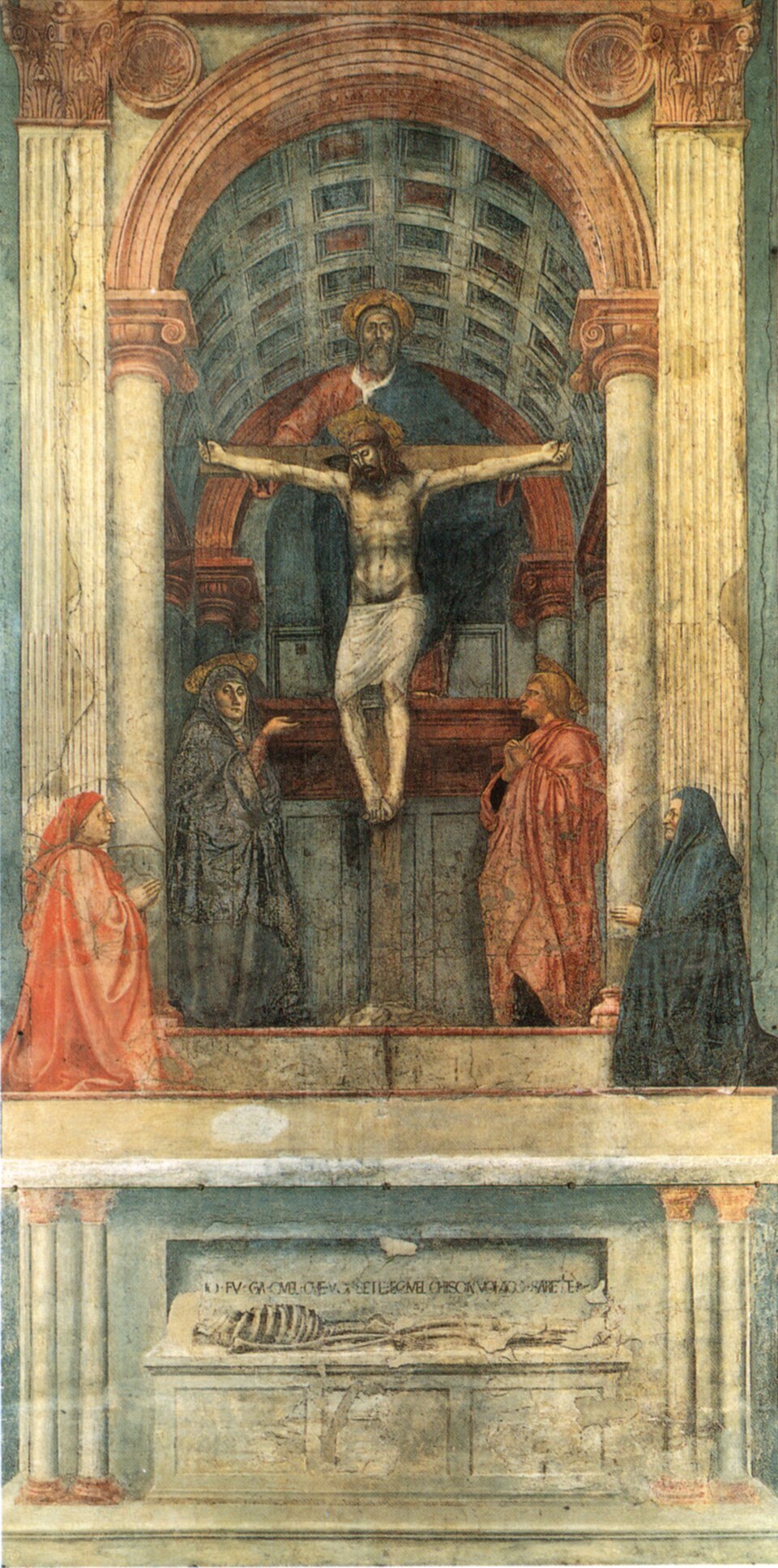
Trinity by Masaccio
Masaccio, Trinity, c.1427, fresco, 667 × 317 cm, Santa Maria Novella, Florence

Overview

About This Work

The Holy Trinity (Italian: Santa Trinità), commonly known as Trinity, is a monumental fresco by Masaccio (1401–1428) located in the Church of Santa Maria Novella in Florence. Painted around 1427, it stands as one of the most revolutionary works in Western art history. The fresco measures 6.67 meters by 3.17 meters and was commissioned as a donor portrait for the family chapel by Domenico Lenzi and his wife (possibly posthumous, as Domenico died in January 1427). What makes this fresco historically transformative is that it was the first major painting to apply systematic linear perspective—the mathematical method of creating three-dimensional illusion on a flat surface. Eight years before Leon Battista Alberti formally published Brunelleschi's perspective theory, Masaccio had already demonstrated its power in this fresco. The painting merges medieval devotional content (the Trinity, the crucifix, the memento mori) with Renaissance scientific technique (linear perspective, chiaroscuro, classical architecture), creating a work that proved art could be both spiritually moving and intellectually rigorous. For generations of Renaissance artists, Trinity became a pilgrimage site—a textbook in stone and pigment on how to construct believable space and depict the human form with weight and dignity.

Visual Analysis

Composition

The Architectural Frame: The composition is framed by a Roman triumphal arch, a classical reference that symbolizes Christ's triumph over death and sin. The arch itself is painted with perfect architectural detail—fluted columns, a coffered entablature, and capitals rendered with precise classical proportions. This is not mere decoration; it is part of Masaccio's larger claim that the Classical world and Christian theology are united in a rational, intelligible order. The arch frames a barrel-vaulted niche, a semi-cylindrical recession of space that appears to extend several metres behind the picture plane. The Vanishing Point: Masaccio placed the vanishing point at the base of the crucifix, precisely at the eye level of the kneeling donors. All orthogonal lines—the receding edges of the barrel vault's coffered ceiling—converge toward this single point. This creates the optical illusion that the viewer is standing at ground level, looking upward into a real architectural space. The mathematical precision is extraordinary: modern analysis shows Masaccio's recession calculations to be accurate to within two parts in one thousand. The most visible expression of this perspective is the coffered barrel vault above the crucifix. The square coffers and circular rosettes diminish in size and compress in depth as they recede. Each coffer is slightly smaller than the one in front of it, following a mathematical progression. Vasari famously wrote that the vault looked so convincing "there seems to be a hole in the wall"—a perfect description of how successfully Masaccio created the illusion of three-dimensional depth. The Trinity: Within the vaulted niche are the three figures of the Trinity: God the Father stands behind the crucifix, His massive arms outstretched to embrace the cross, looking directly at the viewer with piercing eyes. Christ on the Cross is anatomically accurate, physically vulnerable, and deeply human—His musculature rendered with careful chiaroscuro. The Holy Spirit appears as a white dove hovering above the cross. The Witnesses: The Virgin Mary stands on the left in traditional blue robes, her face expressing sorrow as she looks directly at the viewer. Saint John the Evangelist stands on the right, contemplative and withdrawn. Both are rendered with human dignity and psychological depth. The Donors: Below the crucifix, two figures kneel in prayer—the patrons who commissioned the fresco, likely Domenico Lenzi and his wife. Their contemporary Florentine dress and profile positioning suggest posthumous portraits, ensuring their perpetual spiritual presence. The Memento Mori: Beneath the painted altar lies a skeleton in a marble sarcophagus with the Latin inscription: "IO FUI GIA QUEL CHE VOI SIETE E QUEL CH'I SONO VOI ANCO[R] SARETE" ("I was once what you are and what I am you also will be").
Colour & Light

Light comes consistently from the upper right throughout the fresco. Figures are modeled with gradations of light and shadow, creating volumetric form that was revolutionary for its time. The chiaroscuro technique—the careful rendering of light and shadow—gives each figure weight and three-dimensionality. The colour palette is restrained but meaningful: the Virgin's traditional blue robes, the warm reds and ochres of the donors' contemporary Florentine dress, the flesh tones rendered with unprecedented naturalism, and the cool greys and blues of the architectural elements creating spatial recession. The skeleton at the bottom is rendered with anatomical precision and horrifying realism through careful chiaroscuro, making the memento mori viscerally powerful rather than merely symbolic. This contrasts sharply with medieval art, which was flatter and more decorative.

Materials & Technique

Trinity is executed in true fresco (buon fresco), where pigments are applied to wet plaster, becoming chemically bonded to the wall as it dries. This technique requires careful planning and rapid execution, as each section must be completed before the plaster dries. The mathematical precision of the perspective construction suggests Masaccio carefully prepared the composition with preliminary drawings and possibly architectural instruments. The recession calculations are accurate to within two parts in one thousand—extraordinary precision that reveals either direct consultation with Brunelleschi or deep study of his perspective methods. The fresco's survival for nearly 600 years (despite being temporarily covered by a Vasari altarpiece in 1570 and later rediscovered) testifies to the durability of the buon fresco technique and the quality of Masaccio's materials and preparation.

Historical Context

Context

Santa Maria Novella was the principal church of the Dominican order in Florence. The Dominicans were intellectuals, theologians, and schoolmen—they valued rationality, systematic thought, and the reconciliation of faith with reason. The fresco's emphasis on mathematical perspective and classical architecture aligns perfectly with Dominican values. Fra Alessio Strozzi, a Dominican friar and theologian, may have advised on the theological content. Domenico Lenzi was a wealthy merchant and member of Florence's Board of Maritime Consuls. The fresco served as both a spiritual monument (praying for Domenico's soul after his death in January 1427) and a public statement of the family's piety and status. It is widely believed that Filippo Brunelleschi either directly advised Masaccio on the perspective construction or that Masaccio learned perspective through Brunelleschi's architectural circle. Brunelleschi had invented single-point linear perspective around 1413, but applied it only to architecture. Masaccio was the first to apply Brunelleschi's method to a monumental religious fresco—making him the bridge between Brunelleschi's theoretical innovation and its application to painting. The fresco was likely completed in 1427, Masaccio's final year of work in Florence before his mysterious death at age 26. This makes Trinity one of his last major commissions, representing the culmination of his artistic vision.

Key Themes

Art as Science: The Renaissance Synthesis

The Trinity represents the quintessential Renaissance idea: that art and science are not opposites but complements. The mathematical precision of linear perspective proves that the universe is rational and intelligible. God created order; human reason (geometry, mathematics) can unlock that order; and art is the medium through which this revelation is made visible. As theologian Mary McCarthy observed: "The fresco, with its terrible logic, is like a proof in philosophy or mathematics; God the Father, with His unrelenting eyes, being the axiom from which everything else irrevocably flows." The Hierarchy of Being: The fresco encodes a complex spiritual hierarchy—God the Father at the top (transcendent, eternal, rational), Christ at the center (mediator, human and divine), donors in the middle (pious humans seeking salvation), the skeleton below (physical death, material decay), and the viewer at the bottom (living mortal, looking up toward salvation). This is theology made visible through spatial arrangement. Death and Salvation: The inclusion of the skeleton creates a stark memento mori—a meditation on mortality. But this is not nihilistic. The presence of the crucifix above the skeleton means that death is not the final word; Christ has conquered death through His crucifixion and resurrection. The viewer, confronted with the skeleton's reminder of mortality, is encouraged to look upward (both physically and spiritually) to Christ and the Trinity for salvation.

Exam Focus Points

Critical Perspectives

Linear Perspective: This is one of the first monumental paintings to use systematic linear perspective. Identify the vanishing point at the base of the cross (at eye level of the donors). Trace the orthogonal lines created by the coffered barrel vault receding toward the vanishing point. Discuss how the mathematical precision creates the illusion of three-dimensional architectural space. Compare to earlier medieval paintings, which used arbitrary spatial relationships—Trinity establishes rational, measurable space. Classical Influences: The Roman triumphal arch frame is a deliberate classical reference, symbolizing Christ's triumph. The architectural vocabulary (columns, entablature, coffers) is classical, not Gothic. This reflects Renaissance humanism—the belief that classical civilization and Christian theology are harmonious. Composition—Three Tiers, Three Levels of Meaning: Theological (the Trinity, Crucifixion, redemption), Spiritual (the donors' perpetual prayer for salvation), and Mortal (the skeleton's reminder of death). Each tier is spatially and symbolically distinct, yet unified by the rational perspectival space. Donor Portraits and Commemoration: The kneeling figures are likely posthumous portraits of the patrons. Their positioning (kneeling, in profile, closer to viewer but lower than the Trinity) encodes their status. The fresco served dual purposes: devotional (praying for their souls) and commemorative (celebrating their piety and wealth). Historical Significance: Masaccio died at 26, but this single fresco became a masterclass for subsequent Renaissance painters. Michelangelo, Leonardo, and Raphael studied this work intensively. It demonstrates that art could be both spiritually moving and scientifically rigorous—a model for the High Renaissance.

On this page

OverviewVisual AnalysisHistorical ContextKey ThemesExam Focus Points