History of (tagg)Art...
HomeNatureIdentityRenaissanceBaroque

Nature

  • All Nature artworks
  • Landscape or Seascape in 2D
  • Animals in 2D or 3D
  • The Elements (Fire, Water, Wind or Earth) in 2D or 3D
  • +3 more topics

Identity

  • All Identity artworks
  • The Divine in 2D or 3D Works
  • Portraits in 2D Works
  • Portraits in 3D Works
  • +3 more topics

Renaissance

  • All Renaissance artworks
  • Religious Painting
  • Religious Sculpture
  • Mythological in 2D or 3D
  • +3 more topics

Baroque

  • All Baroque artworks
  • Religious Painting
  • Religious Sculpture
  • Mythological Painting
  • +6 more topics

About

A comprehensive study resource for Pearson Edexcel History of Art A-Level.

NatureIdentityRenaissanceBaroque

History of (tagg)Art... - A-Level Study Resource

Pearson Edexcel Specification

Admin
  1. Home
  2. Baroque
  3. The Abduction of Europa

The Abduction of Europa

Simon Vouet, c.1640-1641
BaroqueMythological PaintingNon-Italian Artists
The Abduction of Europa by Simon Vouet
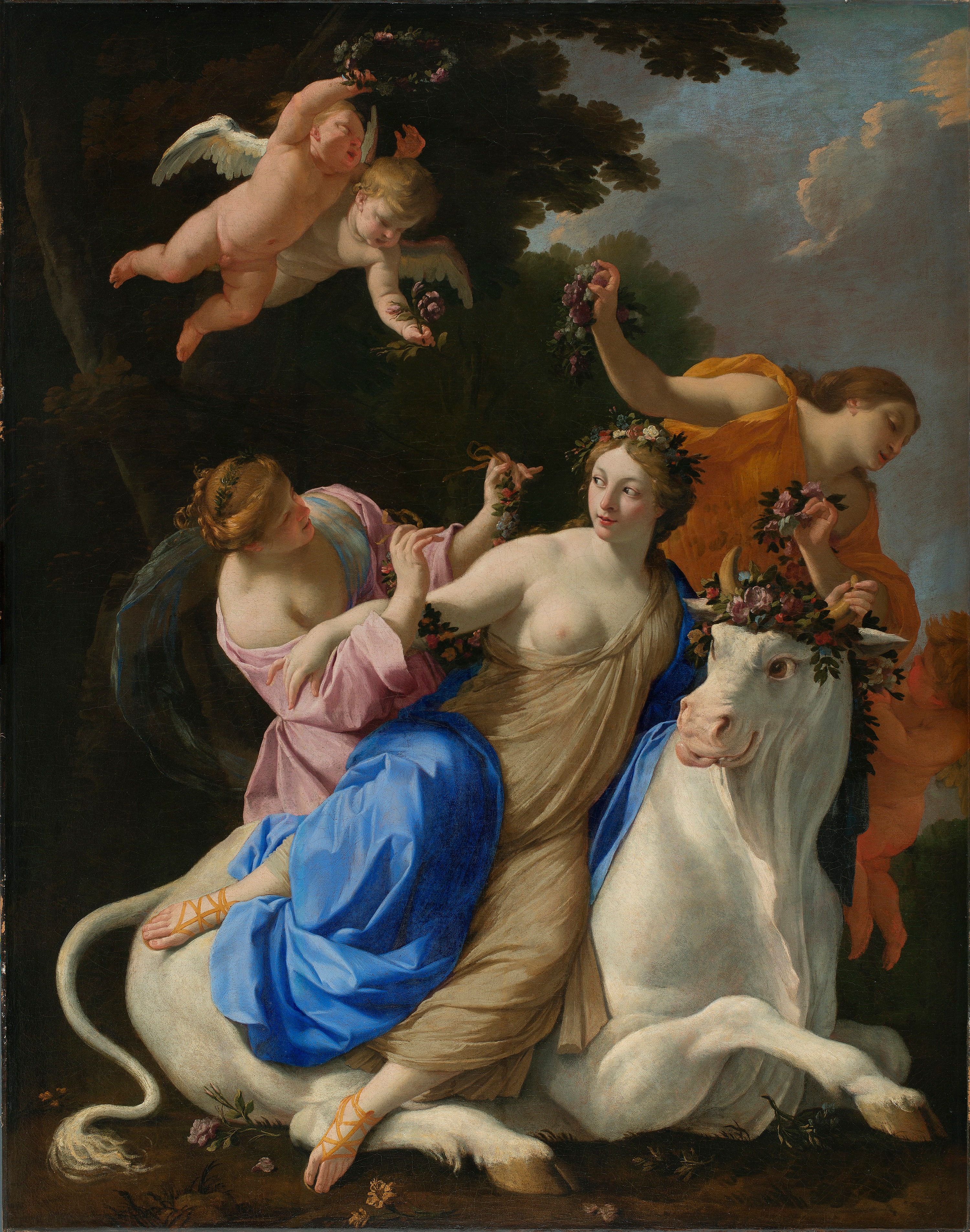
Simon Vouet, The Abduction of Europa, c. 1640-1641. Oil on canvas, 179 x 141.5 cm. Museo Nacional Thyssen-Bornemisza, Madrid.

Overview

About This Work

Painted circa 1640–1641, The Abduction of Europa by Simon Vouet (1590–1649) is an oil on canvas measuring 179 x 141.5 cm, now in the Museo Nacional Thyssen-Bornemisza, Madrid. The work depicts the climactic moment of the famous Ovidian myth: the Phoenician princess Europa, having adorned a beautiful white bull (Jupiter in disguise) with flower garlands, sits upon its back just as the god begins his movement toward the seashore preparatory to whisking her across the Mediterranean to Crete. The composition captures a moment of exquisite narrative tension—Europa and her attendants remain unaware that the docile animal will momentarily transform their pastoral pleasure into catastrophic abduction. Vouet's rendering exemplifies his mature Parisian style: a departure from the dramatic tenebrism of his Roman Caravaggist period toward a luminous, decorative approach influenced by Venetian colourists (particularly Veronese) and the classical Baroque painters of the Carracci school. The work was likely conceived as one element in a larger decorative program for a palace or aristocratic residence, as established by the Michel Dorigny engraving of 1642 that reproduced the composition and disseminated it throughout Europe. Vouet, who had returned to Paris in 1627 at the behest of Louis XIII and was appointed "First Painter to the Crown," dominated French painting for the next two decades, establishing an influential atelier that trained subsequent generation masters including Charles Le Brun.

Visual Analysis

Composition

Vouet's compositional choice—to depict the moment immediately before the abduction rather than during or after it—demonstrates sophisticated narrative judgment. Unlike Titian's violent, chaotic rendering (with figures in tumultuous gesture and the bull already plunging seaward) or Rembrandt's escape scene (with Europa and attendants visible in the churning ocean), Vouet presents a moment of maximum psychological tension precisely because action has not yet commenced. Europa sits upon the bull's back, unaware of impending catastrophe. The attendants tend to her, adorning her with flowers. The white animal stands docile, gentle-eyed. The composition arranges figures in a tightly clustered, pyramidal grouping. Europa, at the apex, is the visual and narrative centre. Her companions cluster around and below her, their gazes and gestures directed toward her elevated position. The bull, beneath her, provides a stable base for the human figures' activity. This arrangement creates what might be termed "centripetal motion": all compositional energy flows inward toward the moment of contact between Europa and the bull. A rocky, sandy shore in the immediate foreground anchors the scene spatially. The turbulent sea beyond—rendered with whitecaps and dramatic waves—provides a backdrop that suggests danger without overwhelming the human drama. The landscape recedes through atmospheric perspective, cooler tones in the distance creating spatial depth.

Colour & Light

Vouet's colour organization exemplifies what one contemporary observer noted as "masterful" arrangement: "large areas of single colours in the tunics and cloaks of the figures in primary hues such as blue, yellow and red of varying shades." This is not naturalistic colour modeling but rather a decorative, almost heraldic deployment of colour areas. Europa wears pale drapery (whites, pale golds) that catches and reflects light; her companions wear deeper hues (rich blues, reds, yellows). The bull, white or pale grey, reads as a luminous form against the surrounding darker tones. Unlike the harsh spotlighting of Caravaggian tenebrism, which Vouet had practiced in his early Roman period, the mature Parisian Abduction employs a soft, diffuse golden light that bathes the entire composition in warmth. This light does not isolate figures but rather includes and harmonizes them. It models the forms with subtlety—suggesting volume and three-dimensionality without harsh contrasts. The effect is one of Rococo-anticipating luminosity. The rendering of Europa's flesh—particularly the exposed breast that occupies "the very centre of the composition"—exemplifies Vouet's technical mastery in flesh painting. The tones are warm and creamy, modeled with soft blending and subtle highlight/shadow transitions. The flesh reads as simultaneously idealized and sensual.

Materials & Technique

Vouet worked in oil, employing glazing techniques—transparent layers of paint applied successively over an underdrawing and initial underpainting—to achieve the luminous effects characteristic of his mature style. The initial composition was likely sketched in charcoal or brown underdrawing on the primed canvas. An underpainting in browns and ochres established the basic tonal structure. Subsequent layers of translucent and opaque oil paint built up the forms, with final details and highlights applied with relatively quick, assured brushwork. Unlike the highly finished, nearly sculptural surfaces favored by some Renaissance and Mannerist painters (or by Poussin, Vouet's great rival), Vouet's technique allows individual brushstrokes to remain visible, particularly in the drapery and foliage. The paint is applied with what contemporary observers called "facile technique"—a facility and speed of execution that suggests confidence and mastery. This technique, influenced by Venetian painters (particularly Veronese, whom Vouet had studied in Venice), creates a liveliness that prevents the painting from becoming overly precious or laboured. Vouet was renowned as a "superb draftsman," and his workshop practice included extensive life drawing. Models posed for the various figures; multiple studies from life ensured anatomical accuracy.

Historical Context

Context

Simon Vouet (1590–1649) represents a crucial historical moment in the diffusion of Italian Baroque to northern Europe. Born in Paris to a painter father, he traveled through Constantinople (1611), Venice, and Genoa before settling in Rome in 1614. In Rome, he initially adopted the dramatic tenebrism of Caravaggio and his followers. By 1620, however, Vouet had begun to absorb other influences: the colour harmonies of Veronese, the classicizing restraint of the Carracci school (Guercino, Guido Reni, Domenichino), the decorative sophistication of Roman Baroque fresco painters. By 1624, when he was elected head (Principe) of the Accademia di San Luca, Vouet had become one of Rome's most respected painters. Vouet's arrival in Paris in 1627, at the summons of Louis XIII, initiated a transformation of French painting. Prior to his return, French art was dominated by Mannerist conventions and provincial workshop practices. Vouet's introduction of Italian Baroque innovations—the emotional intensity, the sophisticated use of light and colour, the knowledge of fresco decoration and grand-scale composition—revolutionized French painting. He received the most prestigious commissions: decorations for the royal châteaux, for major nobles, and for Cardinal Richelieu himself. The Abduction of Europa, while an independent easel painting, likely formed part of a larger decorative program. The subject, format, and style all suggest this work was intended for inclusion in a broader thematic cycle—perhaps a sequence of mythological subjects drawn from Ovid's Metamorphoses. The Michel Dorigny engraving of 1642 confirms that Vouet valued the design sufficiently to have it translated into print form for dissemination.

Key Themes

Connection to Baroque

Exam Focus Points

Critical Perspectives

The Moment Selection as Narrative Strategy: Unlike Titian's violent abduction scene or Rembrandt's chaotic flight, Vouet selects suspenseful waiting. This choice demonstrates sophisticated understanding of how artistic form can heighten psychological tension. The viewer's knowledge exceeds the figures' knowledge, creating dramatic irony that makes the moment more psychologically charged than explicit action would be. Colour as Formal Language: Vouet's deployment of primary hues in simplified, large colour areas represents a conscious departure from naturalistic colour modeling. The heraldic clarity of the colour zones—blues, reds, yellows in varying intensities—creates compositional coherence and visual pleasure independent of narrative content. This prioritization of colour as formal language influenced subsequent French painting, particularly the Rococo. The Female Nude in Mythological Context: The prominent display of Europa's bare breast, positioned at the compositional centre, would be difficult to justify in religious imagery during the Counter-Reformation. Yet the mythological narrative framework permits this sensuality. The painting reveals the latitude permitted for depicting female sexuality when classical authority (Ovid) sanctioned the subject. Vouet as Bridge Between Artistic Traditions: The painting exemplifies Vouet's role as the crucial intermediary who introduced Italian Baroque to France while adapting it to French classical taste. His technical mastery (acquired in Rome), his colour sophistication (influenced by Veronese), and his decorative sensibility combine to create a distinctly hybrid aesthetic. Displacement and Replacement: Vouet's 1627–1649 dominance of French painting was remarkably complete; yet he was virtually erased from the historical record after his death, overshadowed by Poussin and by Le Brun (his own pupil). Recent scholarship has begun to rehabilitate Vouet's reputation, recognizing him as a major innovator rather than merely a secondary figure.

On this page

OverviewVisual AnalysisHistorical ContextKey ThemesExam Focus Points