Romulus and Remus Given Shelter by Faustulus
Pietro da Cortona, c.1643
Overview
About This Work
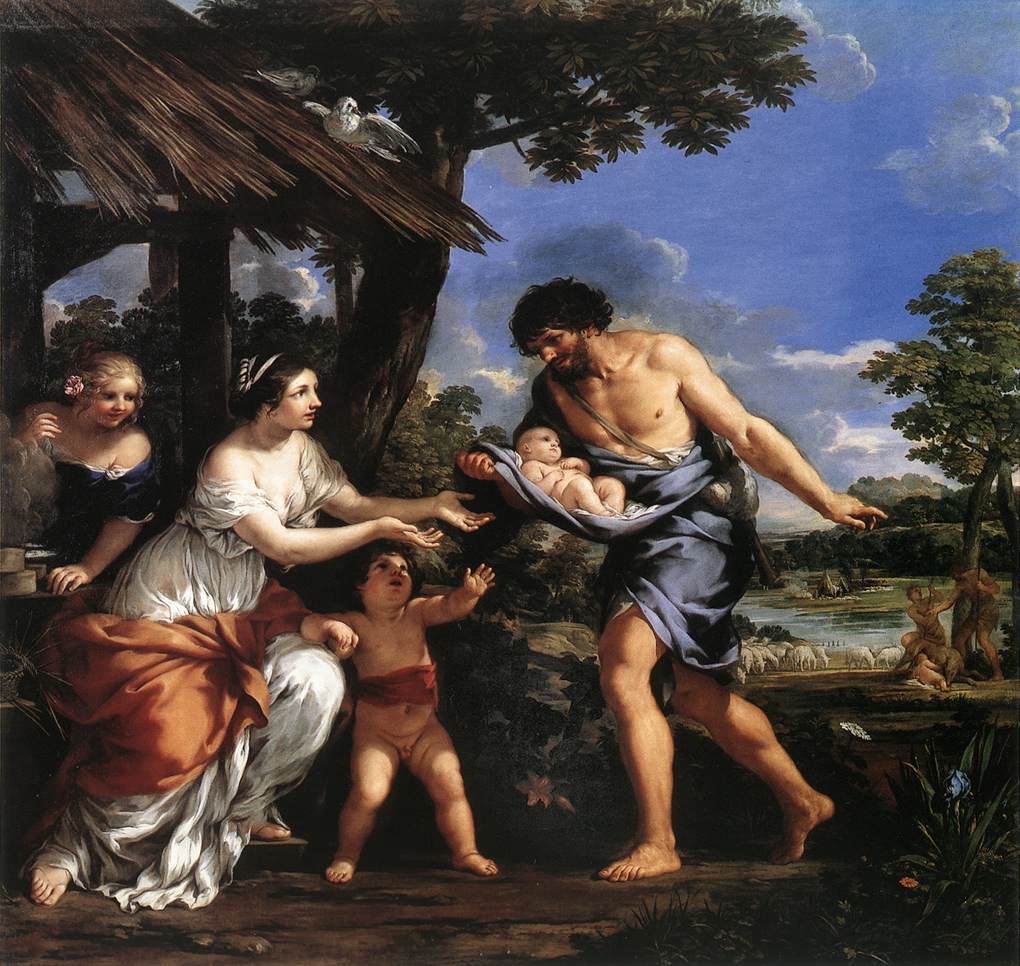
Painted circa 1643, Romulus and Remus Given Shelter by Faustulus is an oil on canvas by Pietro da Cortona (1596–1669), measuring 251 x 266 cm, now housed in the Louvre Museum, Paris. The work depicts the climactic moment of the legendary foundling narrative: the shepherd Faustulus, having discovered the abandoned twin infants Romulus and Remus—who had survived drowning in the river Tiber and been suckled by a she-wolf and protected by a woodpecker—now presents the first child to his wife Acca Larentia at their rustic cottage. The moment crystallizes the transition from nature's sustenance to civilization's compassion: the infants, destined to found Rome, are welcomed into human society not through institutional authority or kinship but through the spontaneous maternal mercy of a shepherd's wife. Commissioned by Louis Phélypeaux, the French nobleman and state official known as the Seigneur de La Vrillière, the painting was conceived as one of several mythological works decorating the gilded gallery of his new hôtel (townhouse) in Paris—a humanistic display of erudition and cultural prestige. Cortona's interpretation exemplifies his mature style: a composition of baroque dynamism and centrifugal energy, populated with idealized figures rendered in warm earth tones beneath a soft, luminous golden light that suggests divine blessing. Yet unlike his contemporaries' more violent or spectacularly supernatural renderings of foundling narratives, Cortona selects the quiet domestic interior, the moment of human acceptance. This choice reflects both an artistic philosophy—his celebrated belief that history painting could accommodate complex, multi-figural narratives—and a Counter-Reformation theology: that compassion toward foundlings and vulnerable infants represents a redemptive virtue, sanctioned by divine light itself.