Carolus Borromeuskerk
Pieter Huyssens, 1615-1621
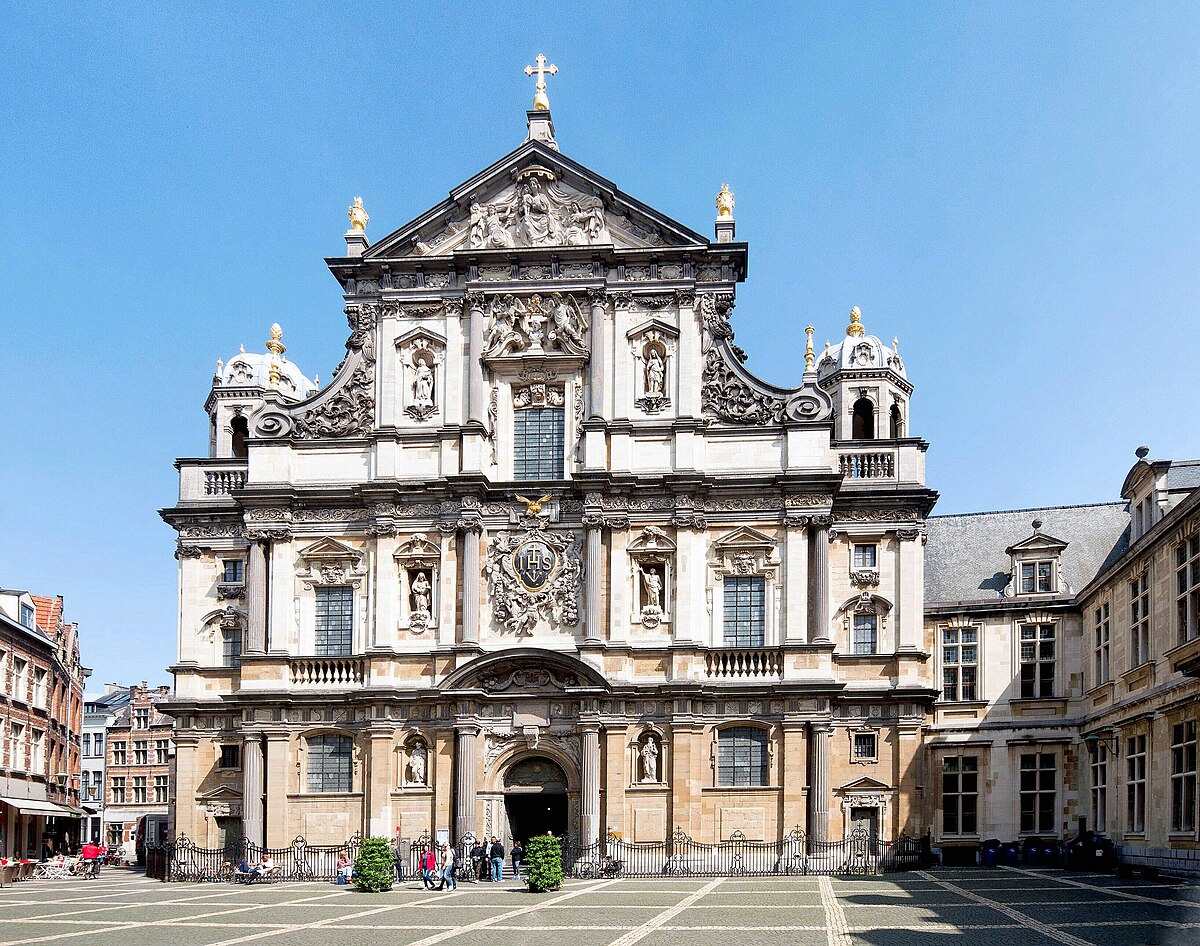
Overview
About This Work
Built between 1615 and 1621, the Sint-Carolus Borromeuskerk (Church of St. Charles Borromeo, initially dedicated to St. Ignatius Loyola) in Antwerp, Belgium, was designed by François d'Aguilon (Franciscus Aguilonius, 1566–1617), a Jesuit mathematician, physician, and architect, with completion and substantial contributions by Pieter Huyssens (1577–1637), a Flemish Jesuit brother and trained architect. The church functioned as the principal Jesuit church in Antwerp and represents one of the finest achievements of Northern European Baroque architecture. The design was profoundly influenced by the Roman mother church of the Jesuits, the Gesù (Church of the Holy Name of Jesus), begun in 1568 by Giacomo da Vignola, yet Huyssens adapted and modified this Roman model to create a distinctly Flemish interpretation: a harmonious synthesis of Italian Baroque principles with Flemish decorative sensibility, embodying what scholars term "vigorous expansive Baroque." The church's monumental white sandstone façade, divided into three levels with superimposed classical orders (Doric, Ionic, Corinthian), presents a theatrical, sculptural treatment that draws the eye and welcomes the viewer into a luminous interior. The interior—a traditional three-aisled basilica plan—employs a broad barrel vault supported by galleries of Doric and Ionic columns, creating what one contemporary described as a "marble temple," originally adorned with 39 ceiling paintings by Peter Paul Rubens, elaborate decoration in expensive marbles, and rich sculptural ornament. Tragically, a lightning strike in 1718 destroyed the ceiling paintings and much of the interior decoration, necessitating substantial restoration that altered the interior's original appearance. Yet the church remains a supreme achievement in Counter-Reformation ecclesiastical architecture, representing the Jesuits' use of visual splendor and artistic magnificence as vehicles for Catholic spiritual renewal. The church embodies a radical departure from Gothic ecclesiastical architecture: where medieval churches employed skeletal stone structure and coloured glass, the Baroque church employs mass, ornament, and theatrical spatial effects.