History of (tagg)Art...
HomeNatureIdentityRenaissanceBaroque

Nature

  • All Nature artworks
  • Landscape or Seascape in 2D
  • Animals in 2D or 3D
  • The Elements (Fire, Water, Wind or Earth) in 2D or 3D
  • +3 more topics

Identity

  • All Identity artworks
  • The Divine in 2D or 3D Works
  • Portraits in 2D Works
  • Portraits in 3D Works
  • +3 more topics

Renaissance

  • All Renaissance artworks
  • Religious Painting
  • Religious Sculpture
  • Mythological in 2D or 3D
  • +3 more topics

Baroque

  • All Baroque artworks
  • Religious Painting
  • Religious Sculpture
  • Mythological Painting
  • +6 more topics

About

A comprehensive study resource for Pearson Edexcel History of Art A-Level.

NatureIdentityRenaissanceBaroque

History of (tagg)Art... - A-Level Study Resource

Pearson Edexcel Specification

Admin
  1. Home
  2. Baroque
  3. Death Comes to the Banquet Table

Death Comes to the Banquet Table

Giovanni Martinelli, c.1630-1640
BaroqueGenre ScenesItalian Artists
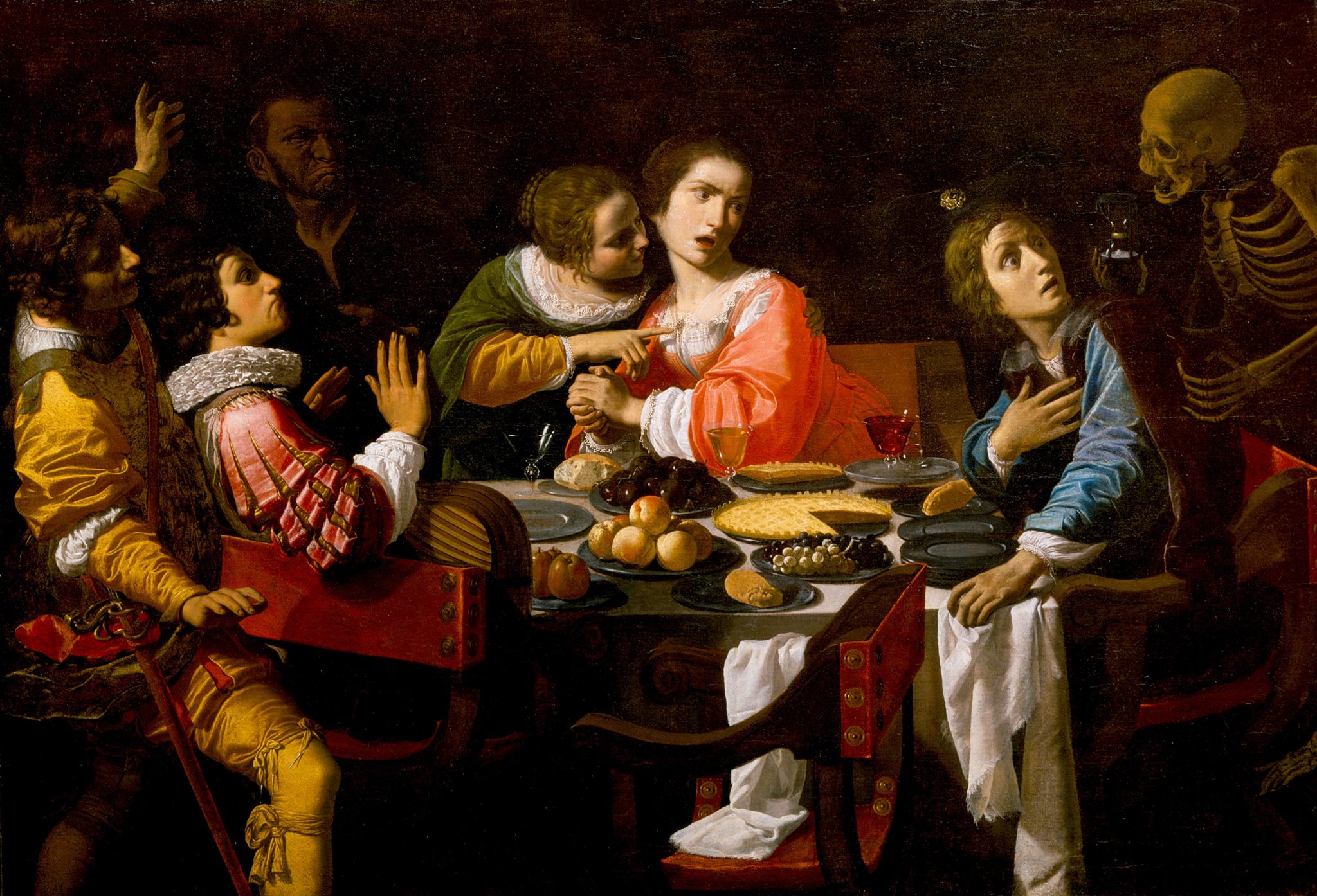
Death Comes to the Banquet Table by Giovanni Martinelli
Giovanni Martinelli, Death Comes to the Banquet Table (Memento Mori), c. 1630-1640. Oil on canvas, New Orleans Museum of Art.

Overview

About This Work

Painted between approximately 1630 and 1640, Death Comes to the Banquet Table (also known as Memento Mori: Death Comes to the Table or Death Appearing to the Banqueters) is an oil on canvas by Giovanni Martinelli (c. 1600–1659), now housed in the New Orleans Museum of Art. The painting depicts a baroque drama of extraordinary psychological intensity: a scene of earthly revelry—young men and women gathered around a table laden with wine, food, and luxurious objects—is disrupted by the sudden, terrifying appearance of Death itself, rendered as a skeletal figure emerging from the darkness, holding aloft an empty hourglass as the ultimate message: time has expired. The composition employs dramatic tenebrism—the Caravaggian vocabulary of sharp contrasts between brilliantly illuminated foreground figures and deep, obscuring darkness—to heighten the psychological impact. The diners' fine clothing, rendered in jewel-like colours (crimsons, golds, blues), glows with almost hallucinatory brightness against the featureless blackness from which the skeleton emerges. At the table's centre sits a pie, partially eaten—its missing slice serving as visual metaphor for the brevity of life, the portion consumed representing the youth already spent. The positioning of wine glasses (one red, symbolizing ecclesiastical communion; one white, symbolizing worldly indulgence) beside the pie's remnant communicates a moral judgment: the young man whose time has run out lived for earthly pleasure, neglecting spiritual salvation. Martinelli's Death Comes to the Banquet Table is quintessentially a Counter-Reformation work: it functions as a visual sermon addressing the viewer directly, insisting on meditation on mortality, reminding the wealthy and pleasure-seeking that death strikes indiscriminately, that no amount of worldly goods or sensual indulgence can purchase exemption from the universal fate. The painting was likely executed in the context of repeated plague outbreaks ravaging Italy in the 1630s, giving its message urgent contemporary relevance.

Visual Analysis

Composition

The Disruption of the Banquet Scene: The painting's fundamental compositional strategy rests on the sudden, violent disruption of a scene of comfortable worldly pleasure. The diners are arranged around a table laden with food, wine, and luxury objects, their postures and expressions suggesting engagement in flirtation, conversation, and sensual gratification. Yet this scene is invaded by a skeletal figure of Death, emerging from the darkness at the composition's upper left. The intrusion is sudden and jarring: there is no warning, no gentle transition, but rather an abrupt appearance that violates the space of the banquet. This compositional violence mirrors the violence of death itself—its unpredictability, its indifference to human happiness or comfort. The Diagonal Thrust and Spatial Conflict: The skeleton, thrusting forward with the empty hourglass, creates a powerful diagonal vector that cuts across the horizontal arrangement of the diners. This diagonal movement—characteristic of Baroque compositional strategy—creates visual tension and psychological disruption. The skeleton's forward movement seems to penetrate the protected space of the banquet, introducing a zone of danger into what had been a scene of pleasure. The diners' reactions vary: some look up in alarm, others seem unaware of the terrible intrusion, some attempt to resist or flee. This variety of responses creates a complex psychological narrative: death's approach affects different people differently, but none can ultimately escape its inevitability. The Spatial Organization and Vulnerability: The diners are positioned in a relatively confined space—pressed around a table, their bodies close together, their movements constrained. This spatial confinement creates a sense of vulnerability: there is nowhere to flee, no escape from the skeletal intruder. The table itself becomes a kind of trap or barrier that, rather than protecting the diners, constrains them and renders them vulnerable. The arrangement of figures—some leaning, some gesturing, some frozen in alarm—suggests bodies caught in extremis, unable to respond effectively to the crisis of death's arrival. The Empty Hourglass as Focal Point: The skeletal figure holds aloft an empty hourglass—the ultimate symbol of time exhausted, of opportunity expired. The hourglass functions as the painting's central symbolic statement: all the pleasures visible on the table, all the wine consumed, all the flirtation and conversation, all the jewels and fine clothing—all of this has consumed time, and time is now gone. The empty hourglass is the painting's supreme moral judgment: the time available for salvation and virtue has been wasted on earthly indulgence.

Colour & Light

The Caravaggian Tenebrism: The painting employs dramatic contrasts between brilliant illumination and deep darkness—a technique pioneered by Caravaggio and widely adopted by Baroque painters. The foreground figures—the diners and the table with its food and wine—are rendered in sharp, brilliant light that makes the colours almost luminous. Crimsons, golds, blues, and warm flesh tones glow with hallucinatory intensity. Against this brilliance, the background dissolves into featureless black, from which the skeleton appears. This extreme contrast creates psychological effect: the light seems to isolate and intensify the sensual world of the banquet, rendering it simultaneously beautiful and doomed. The Jewel-Like Colour: The colours of the diners' clothing and the luxury objects on the table are rendered as if enhanced, intensified beyond naturalism. The reds are deeper, more saturated; the blues more vivid; the golds more luminous. This heightening of colour creates a kind of visual seduction: the painting makes the pleasures of the banquet extraordinarily beautiful and appealing, which then increases the moral force of the message: look at these beautiful, tempting things, yet death comes for you. The colour thus serves a didactic function: it makes the viewer feel the attraction of worldly pleasure so that the reminder of death's inevitability becomes more psychologically powerful. The Death-Black Background: The featureless black background—a technical accomplishment requiring considerable skill to execute so completely—creates a void, a nothingness from which death emerges. This darkness is not merely the absence of light but rather seems to represent the realm of death itself, the underworld, the void that awaits. The skeleton emerging from this blackness thus appears not as a foreign invader but rather as a native denizen of the realm of darkness, an emissary from the realm of the dead.

Materials & Technique

The Oil on Canvas Medium: The painting is executed in oil on canvas, the standard medium for ambitious history paintings in the seventeenth century. The medium permitted the subtle glazing and dramatic light effects central to Martinelli's realization of the memento mori theme. The Preparatory Process: As a Florentine academic painter (Martinelli enrolled in the Accademia del Disegno in Florence in 1636), Martinelli would have executed careful preliminary drawings establishing the composition, the spatial relationships, and the proportional systems. These drawings would establish the fundamental structure upon which the oil painting would be built. The Dramatic Light Technique: The execution of the painting required exceptional technical skill. The rendering of the brilliant illumination on the foreground figures—achieving the glowing, almost supernatural quality of the flesh and drapery—required careful glazing and precise control of pigment application. The execution of the featureless black background—creating a convincing void that is neither muddy nor flat—demonstrates technical mastery. The skeleton itself—detailed enough to be legible yet rendered with minimal light so it seems to emerge from darkness—required precise control of light and shadow. The Varied Surface Treatment: While overall the painting maintains a carefully finished surface appropriate to its ambitious subject, Martinelli varies the treatment of different elements. The foreground figures and objects are rendered with sharp definition and bright colours; the middle distance becomes hazier; the background dissolves into darkness. This graduated approach creates atmospheric recession and directs the viewer's attention to the banquet scene while maintaining the mysterious, threatening quality of the surrounding darkness.

Historical Context

Context

Giovanni Martinelli and the Florentine Baroque: Giovanni Martinelli (c. 1600–1659) was born in Montevarchi, in the Arezzo region of Tuscany. He moved to Florence by 1621 and apprenticed with Jacopo Ligozzi, the celebrated late-Renaissance/early-Baroque Florentine painter. By 1623, Martinelli is documented as living in Ligozzi's house and receiving commissions (now lost) from Francesco dell'Antella, the Commander of the Order of Malta, who had also been a patron of Caravaggio during the latter's stay in Malta. This patronage connection reveals Martinelli's early access to Caravaggesque influences. The Roman Sojourn (c. 1625–1635): While Martinelli is not documented in Florence during the decade 1625–1635, it is now widely accepted by scholars that he spent this period in Rome, where he encountered directly the works of Caravaggio and the broader Caravaggesque tradition. This Roman experience profoundly influenced his artistic development, particularly his mastery of light effects, dramatic tenebrism, and naturalistic figure representation. His study of Roman painters—particularly Valentin de Boulogne, Simon Vouet, and the Gentileschi family—informed the sophisticated approach to allegory, drama, and psychological intensity characteristic of his mature work. The Florentine Return and Academic Prominence (1636 onward): Martinelli returned to Florence and by 1636 had achieved sufficient status to enroll in the prestigious Accademia del Disegno, becoming a full member by 1637. By the mid-1630s, he had established himself as a successful painter working primarily for private collectors and for ecclesiastical institutions. His works from this period—including Death Comes to the Banquet Table—demonstrate sophisticated integration of Caravaggesque naturalism and light effects with Florentine classical traditions and Counter-Reformation allegorical concerns. The Plague Context: The years 1630–1640, when Martinelli executed Death Comes to the Banquet Table, coincided with devastating plague outbreaks throughout Italy. Northern Italy, in particular, suffered from the Thirty Years' War (1618–1648) and the consequent disruptions to trade and sanitation that facilitated plague transmission. Unlike the wealthy, who could sometimes flee cities and rural estates, plague struck indiscriminately—killing rich and poor, young and old, virtuous and wicked alike. This context gave contemporary urgency to the memento mori theme: the painting was not merely abstract theological meditation but rather direct response to lived experience of sudden, indiscriminate mortality. Wealthy patrons, surrounded by material luxuries, commissioned such paintings partly to signal their piety and awareness of human finitude, partly as spiritual preparation for potential death. The Memento Mori Tradition and Popularity: The 1630s saw flourishing production of memento mori paintings throughout Europe, particularly in the Baroque Catholic regions (Italy, Spain, Southern Netherlands) but also in Protestant areas. The tradition combined ancient Christian themes with Baroque dramatic intensity. While vanitas paintings (still-lifes depicting skulls, hourglasses, withered flowers, and other symbols of transience) were particularly popular in the Netherlands and among Dutch collectors, Martinelli's approach—depicting dramatic narrative scenes in which death physically intrudes—represented a different, more theatrical response to the theme. His painting belongs to a tradition of allegorical narratives featuring Death (such as medieval "Dances of Death") but executed in contemporary Baroque visual language.

Key Themes

The Theology of Death, Futility of Wealth, and the Irresistibility of Mortality

The Theology of Death and Salvation: Death Comes to the Banquet Table functions as a visual sermon on Catholic theology of salvation in the face of death. The Counter-Reformation Church emphasized that death could come suddenly, that the soul's fate—eternal salvation or damnation—was determined at the moment of death, and that therefore constant spiritual vigilance and preparation for death was essential. The painting's depiction of sudden death interrupting worldly pleasure enacts this theological message: the diners, engaged in sensual indulgence, have no warning, no time to prepare. The painting thus functions as a call to repentance, a reminder that any moment might be one's last, and that time spent in pursuit of worldly pleasure is time stolen from spiritual preparation. The Futility of Worldly Wealth and Pleasure: The painting's elaborate still-life details—the wine, the food, the luxurious clothing, the jewels—function to demonstrate the ultimate futility of worldly accumulation and sensual enjoyment. All of these beautiful, expensive, desirable objects are utterly powerless against death. The person with the finest clothes dies just as surely as the pauper; the person who has consumed the finest food and wine dies as surely as the hungry beggar. This message would have been particularly pointed for wealthy patrons who commissioned such paintings: the painting says to them, essentially, "all of your wealth and pleasure are meaningless in the face of death." Yet simultaneously, the painting's careful, loving attention to the beauty of these objects (the painting is, after all, extraordinarily beautiful) creates a kind of paradox: it asserts that worldly beauty is meaningless, yet renders that beauty with exquisite attention. The Irresistibility of Death: The skeleton's forceful intrusion into the protected space of the banquet asserts the absolute irresistibility of death. There is no defense, no escape, no negotiation. The skeleton does not politely request entry but rather violently penetrates the space. Some of the diners attempt gestures of resistance, but their resistance is clearly futile. The painting thus makes an assertion about human powerlessness: despite all our wealth, despite all our pleasure, despite all our attempts at self-protection and self-preservation, death will come, and there is nothing we can do to prevent it. The Undiscriminating Character of Death: The painting emphasizes that death does not respect social hierarchy or moral worth. Young and old, rich and poor, virtuous and wicked—all die. The presence of both men and women at the table, the variety of ages represented, emphasizes this universal reach of death. This egalitarian message—that death is a great leveler—was particularly powerful during periods of plague, when the disease did indeed strike across social classes. The painting asserts that no amount of status or wealth can purchase exemption.

Exam Focus Points

Critical Perspectives

The Caravaggesque Inheritance: Martinelli's Death Comes to the Banquet Table demonstrates the profound influence of Caravaggio's revolutionary approach to painting, yet modifies it toward allegorical rather than religious narrative. Where Caravaggio employed dramatic tenebrism and psychological realism to render biblical narratives, Martinelli employs similar formal strategies in service of abstract allegory. The skeleton is not a human figure but rather a personification, yet Martinelli renders it with Caravaggian specificity and psychological force. The Still-Life Elements and Symbolic Language: The painting incorporates elaborate still-life elements—the wine glasses, the pie, the food, the wine, the luxury objects—which function simultaneously as realistic depiction of a sumptuous table and as symbolic language. The pie's missing slice, the distinction between red and white wine, the careful placement of objects—all communicate specific meanings to a viewer educated in symbolic interpretation. This integration of realistic still-life with allegorical symbolism represents sophisticated engagement with the memento mori tradition. The Florentine Classical Influence: Despite the Roman Caravaggesque influences, Martinelli's painting maintains Florentine classical clarity and compositional order. The figures are arranged with classical control; the spatial relationships are rationally organized; the symbolic meanings are clearly legible. This synthesis—Caravaggesque drama combined with Florentine classical order—distinguishes Martinelli from more purely Caravaggesque painters working in Rome or Naples. The Psychological Intensity: The painting's power derives significantly from its psychological portrayal of the moment of death's arrival. The varied reactions of the diners—some in denial, some in terror, some apparently unaware—create a complex psychological narrative. This attention to the psychology of confronting death represents a sophisticated response to the theme, moving beyond mere symbolic representation toward genuine exploration of the human experience of mortality. Comparison with Vanitas Still Life: Compare Death Comes to the Banquet Table with Northern European vanitas still-life paintings (such as works by Pieter Claesz or Andries Both). Where vanitas paintings depict objects symbolizing transience (skulls, hourglasses, candles, withered flowers), Martinelli dramatizes the theme through narrative and personification. The approaches represent different cultural responses to the same fundamental theme: vanitas paintings address the viewer through symbolic contemplation; Martinelli's painting addresses the viewer through dramatic shock.

On this page

OverviewVisual AnalysisHistorical ContextKey ThemesExam Focus Points