The Fortune Teller
Simon Vouet, 1617
Overview
About This Work
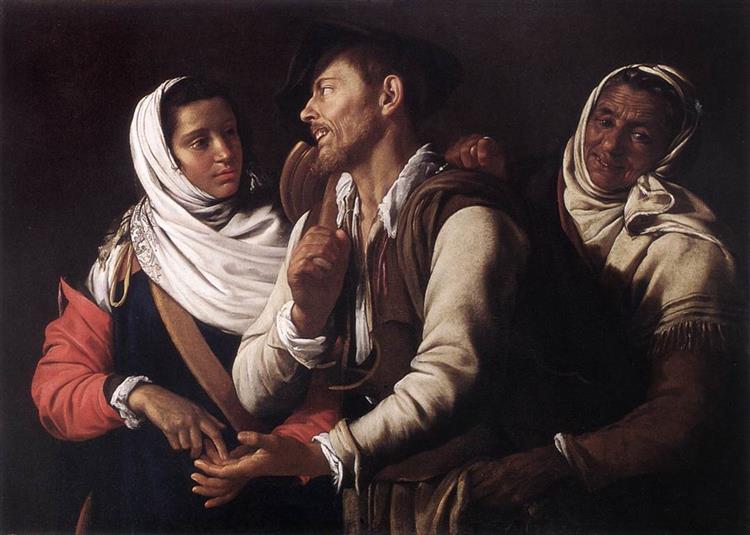
Painted in 1617, The Fortune Teller (Italian: La Buona Ventura; also known as The Gypsy Fortune Teller) is an oil on canvas by Simon Vouet (1590–1649), measuring 95 x 135 cm, now housed in the Galleria Nazionale d'Arte Antica (Palazzo Barberini), Rome. The painting depicts a scene of calculated deception: a young, well-dressed artisan or tradesman sits before a beautiful young woman who reads his palm while smiling seductively into his face; simultaneously, an older woman (visible at the right edge) extends her left hand into his pocket to steal his valuables, her right hand making a vulgar gesture of contempt (the thumb protruding between the first and second fingers—a medieval Tuscan gesture of mockery referenced by Dante in the Divine Comedy). A third figure—a woman in elegant pink drapery—looks directly outward at the viewer, apparently inviting complicity in the spectacle or serving as witness to the fraud. The inscription on the back of the canvas, discovered during twentieth-century restoration, provides contemporary documentation: "aegiptia. vulgo. zingara. fatvi. cerdonis. divinatrix. a. Simoe. Voet. ad. vivum. depicta. MCDXVII" ("The Egyptian woman, commonly called a gypsy, fortune-teller of the foolish artisan, painted from life by Simon Vouet 1617"). The painting was commissioned by Cassiano dal Pozzo, a powerful Roman antiquarian, collector, and cultural impresario connected to French interests in Rome. It represents Vouet's direct engagement with Caravaggesque genre painting—his response to and reinterpretation of Caravaggio's two versions of The Fortune Teller (1594, c. 1600). Where Caravaggio's paintings render the moment with psychological subtlety and ambiguity, Vouet's interpretation is theatrical and explicit: the fraud is unmistakable, the complicity of all three women in the theft is clear, and the viewer is directly implicated as a witness to the scene. The painting exemplifies the Caravaggesque tradition's engagement with street life, social marginality, and moral complexity.