Ecce Homo
Pedro da Mena, 1674-1685
Overview
About This Work
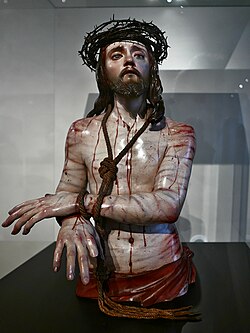
Created circa 1674–1685, Ecce Homo by Pedro de Mena (1628–1688) is a carved wood sculpture, polychromed and partially gilded, existing in multiple versions of varying size, the most renowned being a bust-length composition approximately 62.9 x 45.1 x 46.7 cm (now in the Metropolitan Museum of Art, New York). The work depicts the biblical moment when Pontius Pilate presents Christ to the assembled crowds with the words Ecce homo—"Behold, the man"—after the scourging, coronation with thorns, and mockery of the Roman soldiers. Mena renders Christ as a half-length bust looking directly forward at the viewer with an expression of devastating resignation and spiritual dignity despite manifest physical suffering: his face bears the marks of torture (blood splattered on the forehead running in rivulets down nose, mouth, and eyes), his flesh displays bruising rendered in subtle blue underpaint, his cropped beard and damp hair frame a gaunt, elongated face, and a crimson cloak fastened at his chest drapes his shoulders. The hyperrealism achieved through polychrome wood carving, glass eyes, human hair, ivory teeth, and gilded accents represents the apex of Spanish Baroque devotional sculpture and embodies the Counter-Reformation's demand for emotionally immediate, viscerally truthful religious imagery. The work was typically intended for private devotion in the chapel of a nobleman, nunnery, or church's inner sanctum, positioned at eye-level to invite the closest possible viewer proximity and unmediated emotional engagement.