History of (tagg)Art...
HomeNatureIdentityRenaissanceBaroque

Nature

  • All Nature artworks
  • Landscape or Seascape in 2D
  • Animals in 2D or 3D
  • The Elements (Fire, Water, Wind or Earth) in 2D or 3D
  • +3 more topics

Identity

  • All Identity artworks
  • The Divine in 2D or 3D Works
  • Portraits in 2D Works
  • Portraits in 3D Works
  • +3 more topics

Renaissance

  • All Renaissance artworks
  • Religious Painting
  • Religious Sculpture
  • Mythological in 2D or 3D
  • +3 more topics

Baroque

  • All Baroque artworks
  • Religious Painting
  • Religious Sculpture
  • Mythological Painting
  • +6 more topics

About

A comprehensive study resource for Pearson Edexcel History of Art A-Level.

NatureIdentityRenaissanceBaroque

History of (tagg)Art... - A-Level Study Resource

Pearson Edexcel Specification

Admin
  1. Home
  2. Baroque
  3. St Veronica

St Veronica

Francesco Mochi, 1629-1640
BaroqueReligious SculptureItalian Artists
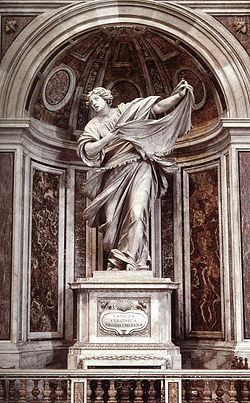
St Veronica by Francesco Mochi
Francesco Mochi, St Veronica, 1629-1640. Marble, approximately 3.8-4 metres. St. Peter's Basilica, Vatican City.

Overview

About This Work

Carved between 1629 and 1640, St Veronica is a monumental marble sculpture by Francesco Mochi (1580–1654), standing approximately 3.8–4 metres in height (including pedestal) within the crossing of St. Peter's Basilica in Rome. The work depicts the apocryphal saint Veronica at the moment of supreme spiritual agency: holding aloft the cloth (veil) with which she wiped Christ's face during his ascent to Calvary, upon which the miraculous imprint of his countenance became eternally impressed. Mochi's figure is characterized by extraordinary dynamism—a twisted, spiralling pose of such pronounced forward lean that both feet appear to lift from the ground, as if the saint is about to burst forth from her niche in ecstatic presentation of the sacred relic. Commissioned by Pope Urban VIII as part of Bernini's comprehensive reconstruction of the basilica's crossing, the sculpture was unveiled on 4 November 1640 to immediate acclaim and lasting controversy. The work represents the apex of Mochi's career and is now recognized as embodying an alternative Baroque sculptural vision—one equally revolutionary to Bernini's but aesthetically and philosophically distinct, prioritizing drapery expressiveness and formal risk over optical illusion and theatrical containment. More fundamentally, Mochi's St Veronica crystallizes Counter-Reformation theology made visible: the compassionate witness—a woman—whose merciful gesture toward the suffering Christ becomes the occasion for the most sacred image in Christendom, thereby validating female spiritual authority within the institutional Church.

Visual Analysis

Composition

The Figura Serpentinata Reimagined: The sculpture's foundational compositional strategy employs the figura serpentinata (serpentine figure)—a S-curved, twisting form that Michelangelo had elevated to paradigmatic status in Renaissance sculpture. However, Mochi fundamentally transforms this inherited vocabulary. Where Michelangelo's serpentine figures exude controlled power, with musculature visibly counterbalancing the torsion, Mochi's Veronica appears to spiral out of control, defying gravity and compositional equilibrium. The body twists upward with increasing intensity from the feet to the thrown-back head; no point of stable repose anchors the composition. This deliberate destabilization is not technical failure but rather a formal strategy: the figure's instability enacts what Veronica experiences in the presence of the suffering Christ—a spiritual vertigo, an unmooring of self in the confrontation with ultimate pain and divine mystery. The Broken Niche: Conventionally, sculptural niches frame and contain the figure within a defined architectural space, maintaining spatial decorum. Mochi deliberately violates this principle. Veronica's forward-leaning pose breaks the niche boundary; her outstretched arms extend beyond the architectural frame; most radically, both feet are raised from the ground, as if the saint is literally levitating or being propelled forward by an irresistible spiritual force. This rupture of architectural containment—what might be termed "niche transgression"—becomes a statement about the transcendent nature of Veronica's spiritual agency. The Veil as Compositional Anchor: Unlike traditional iconography where a saint's attributes are secondary decorative elements, Mochi elevates the veil to compositional centrality. Held aloft and to the viewer's right, it forms a diagonal thrust from the saint's left hip to her extended right arm, creating a secondary spatial vector that pulls the viewer's eye outward from the niche. The veil is not merely displayed but rather presented in an offering gesture—the outstretched arms and forward lean suggest Veronica is actively pushing the cloth toward the viewer, demanding recognition of the sacred image imprinted upon it. Spiralling Verticality: The figure's upward spiral—feet grounded (barely) at the base, body twisted, arms elevated, head thrown backward—creates a vector of ascent. This vertical emphasis, combined with the forward lean, generates a sense of ascending dynamism, as if Veronica is rising and thrusting forward simultaneously.

Colour & Light

Luminous Whiteness in Context: Mochi's sculpture is carved from white Carrara marble, the material of choice for its luminosity and workability. Unlike Renaissance whiteness (which asserts marble's purity and classical idealization), Baroque white marble functions differently in context. The white figure stands within St. Peter's Basilica, where light is orchestrated through the dome's oculus and the intricate fenestration. The marble catches and reflects light as the viewer moves, causing the carved drapery to shift between luminosity and shadow. This optical variability transforms the static marble into what appears almost animated—the play of light makes the drapery appear to flutter and billow. Chiaroscuro in Stone: The deep undercutting of Mochi's drapery folds creates pronounced shadow recession. Where Bernini employs chisel-mark striae to diffuse light optically, Mochi achieves optical effect through three-dimensionality itself: the recessed folds cast shadow, while projecting ridges catch light. This creates an impression of two-toned marble—areas of bright highlight (the projecting folds) adjacent to areas of deep shadow (the recessed valleys). The overall effect approximates chiaroscuro painting translated into stone.

Materials & Technique

The Multi-Block Construction: Perhaps the most technically audacious aspect of Mochi's sculpture is its material constitution: it is carved from three separate blocks of Carrara marble, joined in such a way that the joins remain virtually invisible to the viewer. Mochi himself boasted of this feat: the blocks were "put together in most difficult way in which the joins are never seen again." This technical solution reveals the practical constraints of Baroque sculptural ambition. The colossal scale demanded by Counter-Reformation theology exceeded the size of marble blocks that could be economically quarried and transported. Mochi's Signature as Structural Symbol: Mochi carved his signature on the rear left of the sculpture, at a position where it would serve as an optical counterweight to the figure's pronounced forward tilt. This placement is not merely vanity but rather a sophisticated sculptural decision: the artist literally signs away a portion of the marble, thereby reducing the mass available to him for carving while simultaneously claiming artistic responsibility for the technical feat of balancing this precariously-leaning colossal figure. Drapery Carving as Virtuosity: The exceptional quality of Mochi's drapery carving is evident in the thinness of some folds—marble so delicately undercut that light penetrates through the thinnest points, creating an impression of quasi-translucence. This technique reaches its apogee in the veil itself, which is rendered so diaphanously that the carved imprint of Christ's face shows through the seemingly gossamer-thin cloth. Flesh vs Drapery Surface: Unlike Bernini, who employs uniform chisel-mark patterns across the surface, Mochi differentiates surface treatment. The face and hands are rendered with smooth, imperceptible transitions—an analogue to sfumato painting—while the drapery retains a rough, tactile surface. This variation in finish suggests that the body beneath is corporeal and sculptural, while the drapery transcends materiality, fluttering with spiritual energy.

Historical Context

Context

The Artist: Francesco Mochi (1580–1654) was trained in Florence as a painter-sculptor, studying under Santi di Tito, the mannerist painter known for disegno and pictorial clarity. This training profoundly shaped Mochi's sculptural practice: he conceived sculpture as fundamentally allied to painting, prioritizing linear composition and emotional expression over the plastic sculptural vocabulary that Michelangelo had established. His Annunciation (1605–1608) in Orvieto Cathedral is considered to represent "a fanfare raising sculpture from its slumber" (Wittkower's famous phrase), prefiguring the Baroque with its restrained emotiveness and theatrical presence. The Crossing Commission & Bernini's Program: In 1626, Gian Lorenzo Bernini began a massive architectural reconstruction of St. Peter's crossing. As part of this renovation, Bernini conceived a unified program of four colossal marble sculptures positioned atop the massive piers that support the dome, to house and display the basilica's most precious relics of the Passion of Christ. Bernini designed the architectural framework and provided models for three of the statues (St. Longinus, St. Helena, and St. Andrew) but conspicuously offered Mochi "free reign" with the Veronica—either out of respect for Mochi's seniority or to isolate Mochi's work from the unified aesthetic vision Bernini was imposing on the other three figures. Pope Urban VIII's Direct Involvement: Unlike many papal commissions where the pope's role is nominal, Urban VIII actively engaged with Mochi throughout the design and execution process. Upon the sculpture's unveiling in November 1640, Urban VIII publicly praised it as representing "una maniera nuova di fare la scultura"—"a whole new way of making sculpture." The Relic's Significance: The Veil of Veronica (vera icona, "true icon") was one of the most venerated relics in Christendom. According to tradition, Veronica was a compassionate woman who, witnessing Christ's agony on the road to Calvary, wiped the sweat and blood from his face with her veil. Miraculously, the imprint of Christ's face was impressed upon the cloth, making it a "true image" of the Saviour.

Key Themes

Connection to Baroque

Exam Focus Points

Critical Perspectives

Passeri's Classical Objection: The 18th-century critic Giovanni Battista Passeri famously objected to the sculpture's apparent movement, arguing it was "contradictory to the static nature of statuary." Passeri praised the technical mastery of the drapery carving but questioned whether the animated pose was appropriate to the monumental, immobile function a sculpture should serve. This critique encapsulates a fundamental aesthetic disagreement: does sculpture represent eternal, unchanging truth, or can sculpture capture temporal, momentary experience? Mochi's answer—endorsed by Urban VIII and vindicated by subsequent scholarship—is that Baroque sculpture need not choose between monumentality and dynamism. Bernini's Quip and Rivalry: Upon seeing Mochi's Veronica, Bernini reportedly asked sarcastically: "Whence came this wind that disturbs her garments?" Mochi's reply was cutting: "It comes from the cracks you caused in the dome." This exchange crystallizes the aesthetic and personal rivalry between Rome's two great sculptors. Bernini's critique impugns the figure's realism, suggesting that Mochi has violated naturalistic propriety for emotional effect. Mochi's counter-assertion inverts the critique, turning Bernini's criticism back upon him. The Florentine Pictorial Tradition: Mochi's training under Santi di Tito (a painter) and his Florentine origins connect him to a sculptural tradition that privileges disegno (linear design) and pictorial composition over the plastic sculptural vocabulary that Bernini inherited from Michelangelo. This background explains the painting-like quality of Mochi's drapery—its calligraphic flow, its linear rhythms—which contrasts with Bernini's more tactile, three-dimensional approach to carving.

On this page

OverviewVisual AnalysisHistorical ContextKey ThemesExam Focus Points