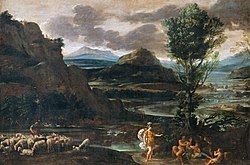
Erminia among the Shepherds
Domenichino, 1620s
Overview
About This Work
Painted in the 1620s, Erminia among the Shepherds is an oil on canvas by Domenichino (Domenico Zampieri, 1581–1641), measuring approximately 123 x 181 cm, now housed in the Galleria Doria Pamphilj in Rome. The painting depicts a scene from Torquato Tasso's celebrated Renaissance epic poem Jerusalem Delivered (1581): the moment when Erminia, a princess of Antioch who has fallen hopelessly in love with the Christian knight Tancred, flees the city disguised in the armour of Clorinda (the warrior-maiden whom Tancred loves), intending to seek him out. Attacked by Christian soldiers who mistake her for Clorinda, she flees into the forest and discovers a family of humble shepherds—an old man engaged in basket-weaving, his daughter, and other members of the pastoral household—who offer her refuge and comfort. Domenichino's interpretation emphasizes the moment of Erminia's discovery and integration into pastoral community: she sits among the shepherds, her armour discarded, her golden hair now visible, her expression registering relief and a kind of tentative acceptance of her exile from courtly life. The composition creates what art historian Michael Levey termed "an idyllic mood that departs from the arid classicism of his frescoes"—a synthesis of Baroque naturalism (the convincing depiction of landscape, light, and domestic activity) with classical order and restraint. The work exemplifies Domenichino's profound influence on the development of classical landscape painting: his careful integration of narrative figures into expansive landscape settings, his establishment of spatial recession through atmospheric perspective, and his harmonization of human action with natural environment all became foundational to the classical landscape tradition that would dominate European painting through the eighteenth century, profoundly influencing Nicolas Poussin and Claude Lorrain.