History of (tagg)Art...
HomeNatureIdentityRenaissanceBaroque

Nature

  • All Nature artworks
  • Landscape or Seascape in 2D
  • Animals in 2D or 3D
  • The Elements (Fire, Water, Wind or Earth) in 2D or 3D
  • +3 more topics

Identity

  • All Identity artworks
  • The Divine in 2D or 3D Works
  • Portraits in 2D Works
  • Portraits in 3D Works
  • +3 more topics

Renaissance

  • All Renaissance artworks
  • Religious Painting
  • Religious Sculpture
  • Mythological in 2D or 3D
  • +3 more topics

Baroque

  • All Baroque artworks
  • Religious Painting
  • Religious Sculpture
  • Mythological Painting
  • +6 more topics

About

A comprehensive study resource for Pearson Edexcel History of Art A-Level.

NatureIdentityRenaissanceBaroque

History of (tagg)Art... - A-Level Study Resource

Pearson Edexcel Specification

Admin
  1. Home
  2. Baroque
  3. The Four Philosophers

The Four Philosophers

Pieter Paul Rubens, 1611
BaroquePortrait Painting or SculptureNon-Italian Artists
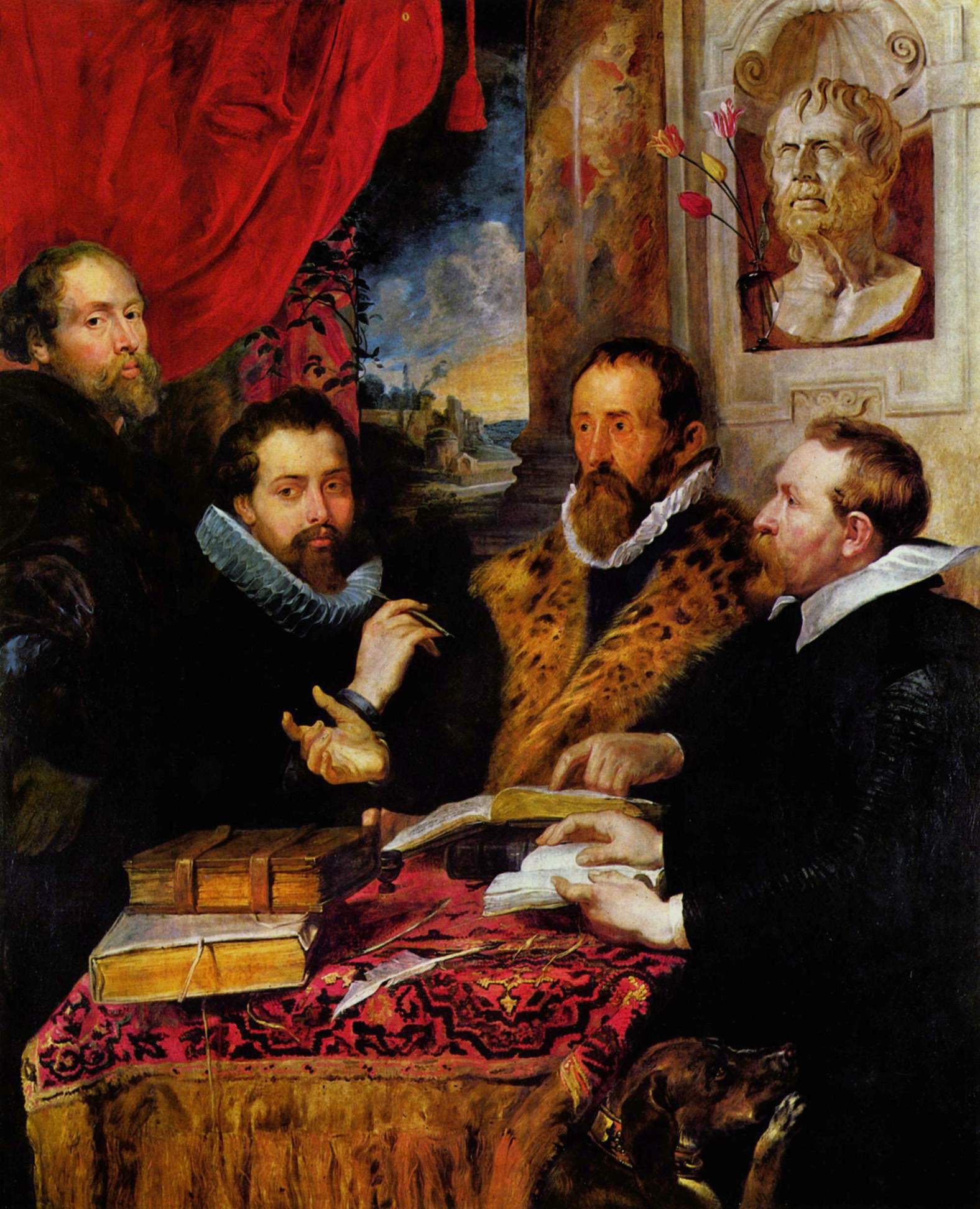
The Four Philosophers by Pieter Paul Rubens
Peter Paul Rubens, The Four Philosophers, 1611-1612. Oil on panel, 167 x 143 cm. Galleria Palatina, Palazzo Pitti, Florence.

Overview

About This Work

Painted in 1611–1612, The Four Philosophers is an oil on panel by Peter Paul Rubens (1577–1640), measuring 167 x 143 cm, now housed in the Galleria Palatina of the Palazzo Pitti, Florence. The painting presents a memorial portrait of four intellectual figures gathered in scholarly discussion: Justus Lipsius (1547–1606), the legendary Flemish humanist and founder of Neo-Stoicism, seated at the centre in a fur-trimmed robe; to his left, Philip Rubens (the artist's younger brother, 1574–1611), depicted holding a quill pen as if in the act of recording philosophical discourse; next to Philip, Peter Paul Rubens himself, the artist-painter; and to the right, Joannes Woverius (Jan Wover, 1574–1632), a classical philologist and devoted student of Lipsius. Behind them stands a marble bust, traditionally identified as Seneca but now understood as an imaginary Hellenistic portrait, symbolizing the classical learning that animated the circle. The painting functions simultaneously as portrait, memorial, intellectual manifesto, and self-fashioning statement. It celebrates the neo-stoic philosophy of Lipsius—a revival of ancient Stoic thought recast in forms compatible with Counter-Reformation Catholicism—while asserting Rubens's own participation in the humanist intellectual elite of Antwerp. The composition is extraordinary in its psychological complexity: each figure occupies a distinct spatial and psychological register; the relationships between them are carefully modulated; Rubens depicts himself slightly apart from the intimate circle of Lipsius and his direct students, suggesting both inclusion in and distance from this philosophical community. The painting was likely executed as a memorial after the deaths of both Lipsius (1606) and Philip Rubens (1611)—transforming it into a melancholic testament to lost mentorship and brotherhood. The work stands as a unique achievement in seventeenth-century painting: it is simultaneously a group portrait, an intellectual allegory, and a meditation on friendship, mortality, and the transmission of knowledge across generations.

Visual Analysis

Composition

The Triangular Grouping with Lateral Recession: The composition employs a carefully orchestrated spatial arrangement that creates distinct psychological registers for each figure. Lipsius occupies the apex and centre, his fur-trimmed robe and seated position establishing authority and centrality. Philip Rubens and Woverius flank him on either side, creating a base of the triangle and suggesting a hierarchical relationship: Lipsius at the top, his two principal students below. Peter Paul Rubens stands somewhat apart, to the left, his posture suggesting both inclusion and separation. This compositional strategy—what art historians term "lateral recession"—creates depth not through traditional linear perspective but rather through the psychological distancing of figures. We are not viewing a simple gathering of equals but rather a carefully graded hierarchy of intellectual authority. The Interaction of Gazes and Attention: The painting's psychological complexity derives partly from the direction of each figure's gaze and the resulting pattern of attention. Lipsius looks downward, his expression contemplative and withdrawn; Philip Rubens turns to look at the viewer (or at Rubens the painter), creating a bridge between the philosophical circle and the external world; Woverius gazes toward Lipsius, his attention focused on the master; Peter Paul Rubens looks outward and forward, his position liminal—engaged yet observant. These distinct gazes create a complex web of relationships: Lipsius is the object of devotion and study; Philip mediates between the philosophical realm and the viewer's reality; Woverius is the engaged student; Rubens is the observing documenter and retrospective interpreter. The Positioning of the Bust: The marble bust in the background—whether Seneca or Hesiod—occupies a crucial position. It is not merely decorative but rather central to the painting's meaning: it represents classical antiquity, the source of neo-stoic philosophy. The bust thus functions as a fourth presence in the painting, a ghostly reminder that the living figures are engaged in reviving and reinterpreting ancient thought. The positioning of the bust at the back-right creates a spatial recession that pulls the viewer's eye deeper into the composition, suggesting both temporal depth (looking back to antiquity) and philosophical profundity.

Colour & Light

The Rich, Sumptuous Palette: Rubens employs a characteristically Baroque palette of warm, saturated colours that contrasts with the more austere philosophies the subjects embody. The fur-trimmed robe of Lipsius is rendered in warm ochres and reds; the rich fabrics of the other figures display deep blues, warm browns, and golden tones. This chromatic abundance stands in paradoxical relationship to neo-stoic philosophy's emphasis on restraint and austerity. Yet the paradox is deliberate: Rubens asserts that intellectual and spiritual richness need not be expressed through visual asceticism but rather can be conveyed through the full sensory richness of painting. The Glowing Flesh Tones: The faces and hands are rendered with Rubens's characteristic luminosity: warm flesh tones achieved through careful glazing of translucent pigments (his celebrated "red and blue brushwork" that creates the effect of light passing through translucent skin). The faces glow with an inner vitality that contrasts with the thoughtful, withdrawn expressions. This creates a profound tension: the figures appear both intellectually absorbed (their expressions distant and contemplative) and physically present (their flesh glowing with life). The Background Darkness: Unlike Rubens's typical practice of employing bright, energetic backgrounds, the Four Philosophers employs a relatively dark background that throws the figures forward and concentrates attention on their faces and relationships. This restraint—unusual for Rubens—contributes to the painting's more serious, memorial tone. The background does not distract but rather deepens the psychological focus.

Materials & Technique

The Oil on Panel Medium: Rubens executed the painting on wood panel rather than canvas—a choice that suggests the importance of the work and its intended permanence. The panel (likely oak) provided a stable, durable support suitable for a work conceived as memorial and legacy. The smaller scale of the panel (compared to Rubens's monumental canvases) meant the work was likely destined for private viewing—an intimate display in a scholar's study rather than a public gallery. The Visible Brushwork and Glazing: The painting demonstrates Rubens's characteristic technique of visible, confident brushwork combined with transparent glazing. The initial composition was likely established through preliminary drawing (underdrawn on the primed panel); successive layers of translucent and opaque pigment built up the forms. The faces show particularly fine glazing—multiple transparent layers creating the luminosity of flesh. The fabrics and drapery employ broader brushwork, with paint applied in distinct strokes that catch light and create visual interest. The Palette of Pigments: Rubens employed costly pigments that demonstrate the painting's importance and the patron's wealth. The flesh tones likely employed lead white (the primary pigment for highlights), red lake pigments (creating the characteristic Rubens red), and earth pigments (for undertones). The deep blues in fabrics employed expensive ultramarine or indigo. The golden tones likely employed yellow ochre or lead-tin yellow. This palette of expensive, imported pigments testifies to the work's significance. The Temporal Dimension of Execution: Scholars note that the painting likely underwent considerable reworking during execution. The positioning of Lipsius—whose figure appears somewhat stilted compared to the others—suggests that Rubens may have struggled with representing a posthumous portrait (executed five years after Lipsius's death). The relative ease and vitality of the figures of Philip Rubens and Woverius (based on life models or fresh memory) contrast with the more formal, posed quality of Lipsius (based on portrait engravings and memory). This temporal layering of execution—the struggle to reconcile lived models with memorial portraits—is inscribed in the painting's surface.

Historical Context

Context

Justus Lipsius and Neo-Stoicism: Justus Lipsius (1547–1606) was the most influential humanist intellectual of the late sixteenth and early seventeenth centuries. A classicist of extraordinary learning, he published critical editions of classical texts (most importantly, Seneca and Tacitus) and authored original philosophical treatises. His De Constantia (1584) and Politica (1589) formulated Neo-Stoicism—a revival of ancient Stoic philosophy recast in forms compatible with Counter-Reformation Catholicism. Rather than the popular Stoicism of antiquity (which emphasized apathy and withdrawal from social life), Lipsius's Neo-Stoicism emphasized constancy and virtue as appropriate responses to life's inevitable sufferings—a philosophy particularly suited to the religious wars tearing apart sixteenth-century Europe. Lipsius taught at the University of Leiden (Protestant) and the University of Louvain (Catholic), moving between religious confessions while maintaining intellectual authority—a feat that made him uniquely respected across the religious divide of early modern Europe. Rubens's Intellectual Circle: Rubens returned to Antwerp in late 1608 after eight years in Italy (1600–1608). He almost immediately established himself as the leading painter of Antwerp and joined the city's humanist intellectual circle—a circle centred on the aging Justus Lipsius. Rubens was not merely influenced by Lipsius but rather was devoted to him: he purchased and collected classical texts, he adopted neo-stoic philosophy as a personal ethic, and he designed engravings (with classical subject matter) for Lipsius's publications. When Lipsius died in 1606, Rubens mourned the loss of his teacher and mentor; when Rubens's own brother Philip died in 1611, Rubens conceived the Four Philosophers partly as memorial to both losses—the death of the intellectual father (Lipsius) and the death of the beloved brother. The Composition and its Revisions: The painting underwent significant revision during execution. Early versions likely showed different spatial arrangements; the positioning of Rubens himself underwent reconsideration (in some accounts, he was to be depicted with greater prominence). The final composition, with Rubens standing somewhat apart from the intimate circle of Lipsius and his direct students, represents a considered statement about the artist's place within the intellectual hierarchy: he is present, he is engaged, yet he acknowledges that he is not the master but rather an admiring student and devoted follower. The Seneca Connection: The bust in the background—whether representing Seneca, the Roman philosopher whom Lipsius had edited and championed, or Hesiod, the classical poet—embodies the painting's intellectual project. Lipsius had published a monumental edition of Seneca's works (1605, with reprints in 1615 and beyond), and Rubens provided engravings after his own drawings for these editions. The inclusion of the bust thus references both Lipsius's scholarly achievements and Rubens's own participation in the dissemination of classical learning.

Key Themes

Connection to Baroque

Exam Focus Points

Critical Perspectives

The Spatial Ambiguity and Psychological Distance: Scholar Nils Büttner has argued that Rubens's positioning of himself slightly apart from the intimate circle of Lipsius and his students represents a deliberate assertion of distance—not rejection but rather acknowledgment of the artist's different role. Where Woverius is Lipsius's direct student, and Philip Rubens is the artist's brother (creating a familial bond), Rubens himself is the devoted follower and documenter—recording the scene, preserving it, transforming it into art. This interpretation complicates readings that see the painting as a simple assertion of artistic equality; rather, Rubens claims dignity through a distinct, observational role. The Posthumous Portrait Problem: The stilted quality of Lipsius's figure—which contemporary observers noted—derives from the fact that it is a posthumous reconstruction based on portrait engravings and memory rather than life study. This raises interesting questions about representation and authenticity: can a portrait be "true" if not based on direct observation? Rubens's answer seems to be that authenticity derives not from visual accuracy but rather from spiritual and intellectual understanding. His rendering of Lipsius may not be naturalistic, but it captures the philosophical essence of the man—the withdrawn contemplation, the central authority, the connection to classical learning. The Temporal Layering: The painting's composition suggests a temporal palimpsest: Rubens depicts a scene that never actually occurred—Lipsius (died 1606) could not have been present for a gathering with figures still living in 1611. Instead, Rubens reconstructs an imagined moment of intellectual fellowship, collapsing temporal distance to create a vision of eternal community. This temporal compression is analogous to the function of the bust—the past and present coexist in a single frame. Comparison with Rembrandt's Group Portraits: Compare Rubens's intellectual group portrait with Rembrandt's contemporary group portraits (such as The Anatomy Lesson of Dr. Tulp, 1632). Where Rembrandt emphasizes dramatic action and psychological interaction around a central event (the anatomy lesson), Rubens emphasizes intellectual contemplation and hierarchical relationship. The two artists embody different conceptions of community: Rembrandt's is functional and event-centred; Rubens's is philosophical and relation-centred.

On this page

OverviewVisual AnalysisHistorical ContextKey ThemesExam Focus Points