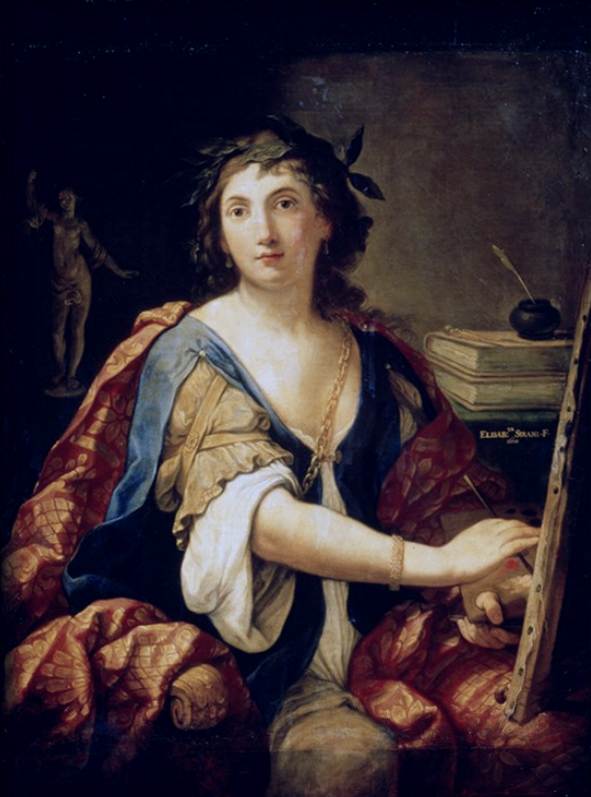
Self-Portrait as Pittura
Elisabetta Sirani, 1658
Overview
About This Work
Painted in 1658, when Elisabetta Sirani was merely twenty years old, Self-Portrait as an Allegory of Painting (Italian: Autoritratto come Allegoria della Pittura) is an oil on canvas by one of the most remarkable artists of the seventeenth century. The painting presents Sirani herself as the personification of Pittura (Painting), a female allegorical figure traditionally depicted with specific symbolic attributes: a golden chain of connected masks (representing the imitative nature of painting), a veil partially covering her face (signifying the mystery of artistic creation), and references to classical learning (books, sculptural fragments). Yet Sirani's innovation lies in her radical conflation of biography and allegory: she paints herself not merely as depicting Pittura but rather as being Pittura, embodying the artistic principle itself. The work exists in multiple versions, each revealing subtle variations in composition and emphasis, suggesting Sirani's deliberate experimentation with the relationship between personal identity and allegorical representation. What distinguishes this self-portrait from contemporary male artists' representations of themselves is the profound ambiguity Sirani introduces: the viewer cannot determine whether we are witnessing a portrait of Elisabetta Sirani, a depiction of the Allegory of Painting, or a performative fusion of both simultaneously. The painting functioned as a strategic assertion of artistic authority in an era when women's artistic claims were routinely questioned and when critical attribution of their works to fathers, brothers, or husbands remained endemic. By painting herself as Pittura, Sirani asserted not merely that she was an artist but that she embodied Painting itself—a claim to creative genius that transcended gender. The work stands as a watershed in the history of women artists: it established a visual language through which subsequent generations of women painters would negotiate their artistic identity.