History of (tagg)Art...
HomeNatureIdentityRenaissanceBaroque

Nature

  • All Nature artworks
  • Landscape or Seascape in 2D
  • Animals in 2D or 3D
  • The Elements (Fire, Water, Wind or Earth) in 2D or 3D
  • +3 more topics

Identity

  • All Identity artworks
  • The Divine in 2D or 3D Works
  • Portraits in 2D Works
  • Portraits in 3D Works
  • +3 more topics

Renaissance

  • All Renaissance artworks
  • Religious Painting
  • Religious Sculpture
  • Mythological in 2D or 3D
  • +3 more topics

Baroque

  • All Baroque artworks
  • Religious Painting
  • Religious Sculpture
  • Mythological Painting
  • +6 more topics

About

A comprehensive study resource for Pearson Edexcel History of Art A-Level.

NatureIdentityRenaissanceBaroque

History of (tagg)Art... - A-Level Study Resource

Pearson Edexcel Specification

Admin
  1. Home
  2. Baroque
  3. Samson and Delilah

Samson and Delilah

Pieter Paul Rubens, 1609
BaroqueReligious PaintingNon-Italian Artists
Samson and Delilah by Pieter Paul Rubens
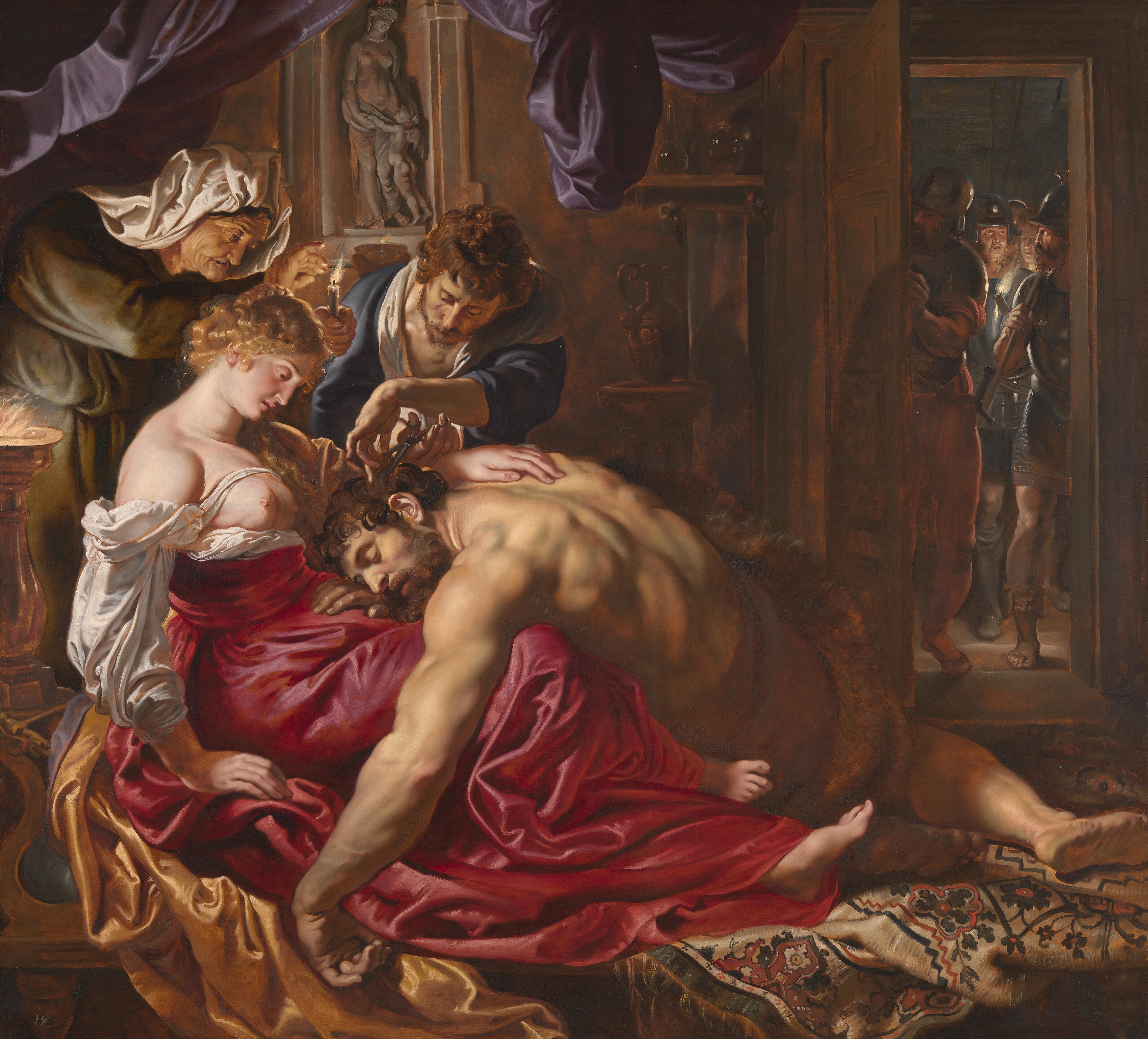
Peter Paul Rubens, Samson and Delilah, c. 1609–1611. Oil on oak panel, 185 × 205 cm. National Gallery, London.

Overview

About This Work

Painted circa 1609–1611, Samson and Delilah is an oil on oak panel (184.8 x 204 cm) by Peter Paul Rubens, now in the National Gallery, London. The painting depicts the biblical moment when Delilah, betraying Samson to the Philistines who have bribed her, orchestrates the cutting of his hair—the source of his supernatural strength—while he sleeps in her lap. Rubens shows the pregnant moment of tension before discovery: the barber's shears cross Samson's golden locks; Philistine soldiers wait in the shadows beyond the open door; an old servant holds a candle aloft. The work was commissioned or acquired by Nicolaas Rockox, the Burgomaster of Antwerp and a sophisticated patron of the arts, for whom it served as the schouwstuck (chimney piece or show piece) in his great reception room, hung above the fireplace. The painting exemplifies Rubens's early maturity following his return from Italy in late 1608, synthesizing Caravaggian tenebrism, Michelangelesque classicism, and Venetian sensuality into a composition of unprecedented psychological and formal sophistication. It stands as one of the most studied and technically masterful paintings of the Baroque.

Visual Analysis

Composition

The Sinister Diagonal: The composition is structured along a dominant left-to-right downward diagonal, often termed "sinister" in compositional analysis, which carries the viewer's eye from the upper left (where the old woman holds her candle) through Delilah's upper body, down Samson's muscular back and curved form, to rest at his feet in the lower right. This oblique thrust creates inherent instability and psychological tension—the viewer is propelled through the scene against a sense of gravitational weight. The diagonal is reinforced by a secondary upward counter-thrust along the barber's arm and the upright soldiers' silhouettes. Interlocking Triangles: Within this primary diagonal, Rubens constructs a complex lattice of interlocking triangles. The old woman, Delilah, and the barber form one triangle; Samson's body and the bed form another; the waiting soldiers create additional triangular intervals in the background. These overlapping geometric forms create visual continuity without monotony, pulling the eye in a continuous rotational path around the canvas. Spatial Recession: Unlike Renaissance compositions with perspectival illusionism, Rubens compresses the space. The bedchamber is shallow and confined—a room without distant vistas. The foreground figures occupy nearly the entire picture plane, their bodies overlapping and massed together. The Philistine soldiers in the background are diminished by atmospheric perspective and formal distance but remain visually prominent through the bright armor and the open doorway. This compression intensifies the claustrophobic intimacy of the betrayal. The Moment of Betrayal: The composition crystallizes a single psychological instant—the scissors have begun their cut, but Samson remains asleep, unaware. The barber's hands are crossed in a gesture of deliberate care (not to disturb the sleeper) but also suggesting the crossed hands of deceit. Delilah's hand rests maternally on Samson's shoulder, a gesture of false tenderness masking her treachery. The waiting soldiers lean toward the open door, ready to surge forward once the deed is done.

Colour & Light

Caravaggesque Illumination: Rubens employs a candlelit scene—a nocturne directly inspired by Adam Elsheimer's paintings and the broader vogue for night scenes popularized in Rome around 1605–1608. The single light source (the candle held by the old servant) casts warm, flickering illumination across the scene. This naturalistic nocturnal lighting represents a sharp departure from Rubens's earlier daytime compositions and demonstrates his engagement with Caravaggio's revolutionary use of light. The Crimson Dress: Delilah's magnificent satin dress is rendered in a rich, saturated crimson—the signature "Rubens red," achieved through cochineal-based pigment (a dyestuff derived from Dactylopius coccus insects, confirmed through modern pigment analysis). The dress dominates the middle register of the composition, its voluminous folds catching the candlelight in complex patterns of highlight and shadow. The paint is rendered with extraordinary virtuosity: deepest folds employ transparent red lake mixed with umber; midtones layer carmine with vermilion and lead white; highlights are built with opaque lead white, then glazed with red lake to achieve a luminous quality suggesting silk's lustrous surface. This technical command over the representation of fabric becomes a visual metaphor for feminine allure and deceptive beauty. Contrast of Flesh and Metal: Samson's pale, muscular back—rendered in warm flesh tones (lead white with red lake, vermilion, and earth pigments)—contrasts dramatically with the grey-blue armour of the barber and soldiers. The flesh tones glow with an almost vulnerable luminosity, emphasizing the hero's exposure. The grey-blue (remarkably, achieved without blue pigment, using only charcoal black, lead white, and red lake) appears almost drab and utilitarian by comparison, reinforcing the psychological opposition between intimate vulnerability and cold mechanical efficiency. The Candle Flame: The thickest impasto in the entire painting concentrates on the candle flame, rendered in pure lead-tin yellow. This technical emphasis transforms the small flame into a compositional anchor—a point of maximum light that radiates outward, sculpting the surrounding forms and casting shadows across the bedchamber wall. The flame is simultaneously the most mundane element (a servant's practical tool) and the most dramatic (the only witness to betrayal).

Materials & Technique

Support & Preparation: The painting is executed on seven boards of Baltic oak with horizontal grain, dowel-reinforced at the joins (dendrochronological analysis indicates the panels were in use from circa 1605). The ground is white chalk, bound with glue, topped by a thin yellow-brown priming (composed of dull yellow earth, lead white, and bone/ivory black), streakily applied diagonally and vertically. This yellow-brown priming was standard Rubens practice and remains partially visible at contours and between brushstrokes, particularly in Delilah's white drapery, where it creates warm undertones and a sense of atmospheric haze. Underdrawing & Pentimenti: X-radiography and infrared reflectography reveal a golden-brown and darker brown underdrawing containing yellow earth and umber, with occasional near-black strokes—Rubens's typical compositional lay-in. Remarkably few pentimenti appear, indicating the artist worked with considerable confidence and preplanning. Minor adjustments visible include: Delilah's breasts adjusted several times to be slightly smaller; her neck and back contour moved slightly outward; an additional fold added to the sleeve base; small refinements to her left hand and foot; the old woman's head-covering reduced in size; and significantly, a decorative finial (equine head) at the far end of the bed suppressed in the final version. Pigment Virtuosity: The painting demonstrates extraordinary technical command over pigment mixtures and application. For flesh shadows (e.g., on Samson's back and calf), Rubens employed transparent yellow earth thinly applied, with dark details in umber. The carpet (with Turkish pattern) employs complex mixtures—azurite and charcoal black for blues, vermilion and red earth for warm tones, red lake for darkest accents, and greens composed of azurite, lead white, yellow earth, and lead-tin yellow. The Modello System: Dendrochronological and documentary evidence indicates Rubens created multiple preparatory modelli (oil sketches) before the final composition: works in Madrid (Thyssen-Bornemisza, capture scene), Chicago (Art Institute, also capturing scene, painted over an Adoration of the Magi sketch), a pen drawing in private collection, and most importantly, a final modello in Cincinnati (closest to the National Gallery painting).

Historical Context

Context

The Artist: Peter Paul Rubens (1577–1640) returned to Antwerp in late autumn 1608 after eight transformative years in Italy (1600–1608). In Rome, he had studied classical antiquity intensively, made copies of the great Renaissance masters (Michelangelo, Raphael, Titian), and encountered Caravaggio's revolutionary use of light and shadow. He witnessed Adam Elsheimer's pioneering night scenes and absorbed the full visual vocabulary of the Roman Baroque. Upon his return to Antwerp, Rubens established the largest studio in Europe, rapidly acquiring commissions from the Archduke Albert and Archduchess Isabella (appointed Court Painter July 1609), the Jesuits, and the Antwerp patriciate. The Period: The painting dates to the immediate post-Italian years (circa 1609–1611), a period of extraordinary productivity for Rubens. The Council of Trent (1545–1563) had demanded religious art be emotionally engaging and accessible, but secular Baroque patronage equally valued sensuality, drama, and formal beauty. Rubens's mythological and biblical scenes satisfied Counter-Reformation piety while simultaneously celebrating the human body and the pleasures of colour and voluptuous form. The Patron: Nicolaas Rockox (1560–1640) was one of Antwerp's most prominent civic leaders. His estate inventory of 1640 lists Samson and Delilah in his great salon ("groote Saleth") of his house, Den Gulden Rinck, on the Keizerstraat, described as a painting "made by the master Rubens" hanging prominently above the fireplace. A capriccio view of this room, painted by Frans Francken II circa 1635 (Munich, Alte Pinakothek), confirms the painting's placement as the showpiece over the chimney. The Composition: Renaissance & Venetian Sources: The painting's compositional genealogy reveals Rubens's synthesis of diverse traditions. He drew directly from Jacopo Tintoretto's Samson and Delilah, using the grouping of protagonists as a "point of departure" but fundamentally transforming the subject. For Delilah's pose, Rubens recalled Michelangelo's Night from the Medici tomb and his designs for Leda and the Swan. Samson's massively muscled back and arm derive from the Torso Belvedere and Farnese Hercules. The nocturnal candlelit setting reflects Rubens's direct study of Adam Elsheimer's Roman paintings, particularly the Mocking of Ceres.

Key Themes

Connection to Baroque

Exam Focus Points

Critical Perspectives

Giambattista Marino's Paradox: Although scholarship has debated whether Marino's madrigal addressing the contradiction between beauty and violence referred specifically to Rubens's Samson or to another lost painting, the tension Marino articulates is central to Rubens's work: "Che fai, Guido, che fai? / La man, che forme angeliche dipigne, / Tratta hor opre sanguigne?" (What do you do? The hand that paints angelic forms now depicts bloody deeds?) This oxymoronic fusion—beautiful rendering of violent treachery—is not a contradiction to resolve but the painting's essential argument. Beauty and horror are not opposed but intertwined. The Body in Consumption (Lee Andrews): Modern critics, particularly those influenced by gender studies and consumption theory, read the painting as depicting the reduction of bodies to objects. Samson's hyperbolic musculature and Delilah's exaggerated breasts reduce the figures to archetypal types: the brute masculinity and the seductive femininity. Samson's slumped position suggests intoxication ("drunk in love"), a metaphor Rubens inherited from Renaissance poetry in which love is wine. Delilah's breasts become the locus of seduction—maternal and sexual simultaneously, a confusion that troubles the moral categories of the painting. Comparison with Caravaggio and Elsheimer: In exam answers, students should contrast Rubens's approach with Caravaggio's Martyrdom of St. Peter (1601, roughly contemporary). Where Caravaggio employs darkness, dirt, and brutal physicality, Rubens uses light, luxury, and sensuality. Where Caravaggio strips away all distraction to focus on physical labor, Rubens surrounds the scene with beautiful objects (the Turkish carpet, the Venus statue, the crimson dress). Yet both painters respond to the Counter-Reformation demand for emotionally engaging art. Rubens's choice is to seduce the viewer into witnessing betrayal; Caravaggio's is to confront the viewer with suffering. Composition as Psychology: The sinister diagonal and interlocking triangles are not merely formal games but psychological instruments. The destabilizing diagonal creates a sense of imminent collapse—the painting captures the moment before catastrophe, and the formal instability mirrors the narrative instability.

On this page

OverviewVisual AnalysisHistorical ContextKey ThemesExam Focus Points