History o' Phoeart
  • Home

Nature

  • Overview
  • Landscape or Seascape in 2D
  • Animals in 2D or 3D
  • The Elements (Fire, Water, Wind or Earth) in 2D or 3D
  • The Relationship between Man/Woman and Nature in 2D or 3D

Identity

  • Overview
  • The Divine in 2D or 3D Works
  • Portraits in 2D Works
  • Portraits in 3D Works
  • Gender Identity in 2D or 3D Works

Renaissance

  • Overview
  • Religious Painting
  • Religious Sculpture
  • Mythological in 2D or 3D
  • Portraits in 2D or 3D

Baroque

  • Overview
  • Religious Painting
  • Religious Sculpture
  • Mythological Painting
  • Mythological Sculpture

About

A comprehensive study resource for Pearson Edexcel History of Art A-Level.

NatureIdentityRenaissanceBaroque

History o' Phoeart - A-Level Study Resource

Pearson Edexcel Specification • Use ⌘K to search

  1. Home
  2. Paper 1
  3. Identity
  4. The Divine in 2D or 3D Works
  5. The Risen Christ
Paper 1Identity
Identity
The Divine in 2D or 3D Works
Pre-1850
Post-1850
The Risen Christ

The Risen Christ

Jacob Epstein

White Crucifixion

White Crucifixion

Marc Chagall

Portraits in 2D Works
Portraits in 3D Works
Gender Identity in 2D or 3D Works
Ethnic Identity in 2D or 3D Works
Identity in Architectural Works

6 scopes • 24 artworks

The Risen Christ

Jacob Epstein, 1917-1919
IdentityPost-1850
The Risen Christ by Jacob Epstein
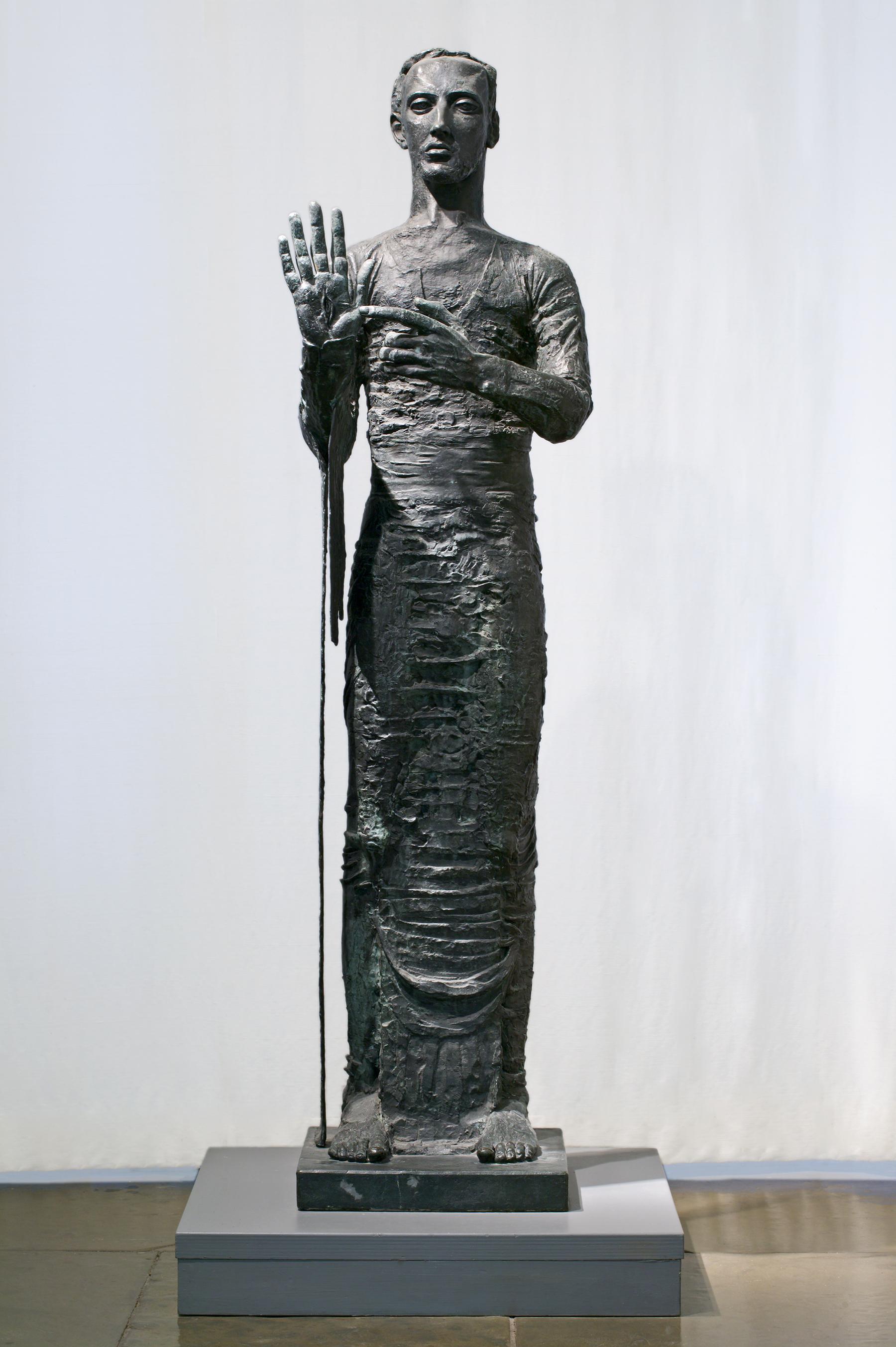
The Risen Christ, Jacob Epstein, 1917–1919, Bronze, National Galleries of Scotland, Edinburgh

Overview

About This Work

The Risen Christ (1917–1919) is a monumental bronze sculpture by the American-British sculptor Sir Jacob Epstein (1880–1959). Standing approximately 2.2 metres (7 feet 2 inches) high, it depicts Christ standing erect, wrapped in burial shrouds, pointing to the stigmata on his hand. The work is currently housed in the National Galleries of Scotland (Edinburgh). Begun during the darkest days of World War I and completed shortly after the Armistice, the sculpture represents a radical departure from traditional, sentimental Victorian depictions of Jesus. Epstein, a Jewish sculptor, sought to reclaim Christ from what he saw as "effeminate" and weak Christian art, presenting him instead as a powerful, accusing figure—a "Man of Sorrows" who confronts humanity with its own violence. When first exhibited at the Leicester Galleries in London in 1920, the work caused a sensation; crowds flocked to see it, and critics were divided between those who saw it as a spiritual masterpiece and those who attacked it as blasphemous and "ugly." It remains one of the most powerful artistic responses to the trauma of the First World War.

Visual Analysis

Composition

Columnar Verticality: The figure is strikingly vertical and columnar, reminiscent of Gothic portal statues (like those at Chartres Cathedral) or Romanesque carving. The body is wrapped tightly in burial cloths (shrouds) that emphasize this rigid, pillar-like form. This restriction suggests the constraints of the tomb from which he has just emerged, or perhaps the binding nature of death itself. Hieratic Stance: Christ stands completely frontal and rigid, commanding attention with an authoritative, almost accusatory presence. This is not a dynamic, moving figure but a static icon of judgment and suffering. The Gestures: The hands are disproportionately large—a hallmark of Epstein's expressionist style. The right hand is raised slightly, open and displaying the wound of the nail. The left hand points directly to this wound. This gesture forces the viewer to focus on the physical evidence of suffering and sacrifice. It is a demand for recognition: "Look what you have done." Face and Features - Non-Traditional Physiognomy: Epstein deliberately rejected the "Aryan" or Europeanized Christ common in Western art. Instead, he modelled the head based on his friend, the Dutch-Jewish composer Bernard van Dieren, who was ill at the time. The features are distinctly Semitic—high cheekbones, a strong nose, and a brooding expression. This asserts Christ's Jewish identity, challenging the anti-Semitism prevalent in 1920s Europe. Expression: The face is serene but stern, often described as "accusing" or "pitying" rather than triumphant. It lacks the halo or radiant glory of traditional Resurrection scenes.

Colour & Light

Materials & Technique

Bronze Casting: The work is cast in bronze using the lost-wax process, but it retains the textural quality of the clay from which it was modelled. The surface is not smoothed to a classical finish; instead, it is rough, pitted, and uneven. This tactile surface catches the light in fragmented ways, adding to the sense of raw emotion and vitality. Stylisation vs. Realism: The work combines realism (in the face and hands) with extreme stylisation (in the elongated body and drapery). The vertical folds of the robe are simplified into deep grooves, creating a rhythmic pattern that leads the eye upward to the head. This blend of the modern (expressionist texture) and the archaic (hieratic pose) creates a timeless quality.

Historical Context

Context

World War I (1914–1918): The sculpture was conceived and created during the Great War. Epstein faced a Conscription Tribunal in 1917, where he argued for exemption as an artist, but was eventually drafted into the Jewish 38th Battalion of the Royal Fusiliers. Although he never saw active combat (suffering a breakdown), the horror of the war profoundly affected him. The Risen Christ is widely interpreted as a war memorial—an indictment of a Christian civilization that had just slaughtered millions of its own youth. Epstein's Jewish Identity: As an outsider—an American-born Jew living in London—Epstein occupied a precarious social position. By choosing to sculpt the central figure of Christianity, he was trespassing on sacred ground. He wrote: "The Jew—the Galilean—condemns our wars, and warns us that Shalom, Shalom, must still be the watchword between man and man." He aimed to show that the Jewishness of Jesus was essential to his message of peace, a message the Christian nations of Europe had betrayed. The Vorticist Movement: Before the war, Epstein was associated with Vorticism (the British avant-garde movement embracing the machine age, e.g., his Rock Drill). However, the brutality of mechanized warfare turned Epstein away from machine aesthetics. The Risen Christ marks his return to figurative, humanist sculpture, rejecting the dehumanizing abstraction of the pre-war avant-garde.

Key Themes

War & Identities

War (Suffering, Accusation): The Accusing Christ: Unlike the traditional "Risen Christ" who triumphs over death with glory, Epstein's Christ stands as a witness to human cruelty. He points to his wounds not to offer salvation, but to accuse humanity of repeating the crucifixion daily in the trenches of Flanders. It is a political as well as religious statement. Sacrifice and Victimhood: The bandages/shrouds wrapping the figure visually echo the bandages of wounded soldiers returning from the Front. The figure connects the suffering of the divine with the suffering of the ordinary soldier. Identities (Jewishness, Outsider Status): The Jewish Jesus: By emphasizing Christ's Semitic features, Epstein reclaims Jesus for Judaism. This was a radical act in an era of rising anti-Semitism. It challenges the viewer to recognize the "other" in their own god. The Human Christ: Epstein stated, "I wished to see him as the man... weak and strong, tortured and triumphant." This is a Christology from below—emphasizing the humanity, pain, and psychological depth of the figure rather than remote divinity.

Exam Focus Points

Critical Perspectives

The Controversy: When exhibited in 1920, the work sparked a "torrent of abuse." Critics called it "ugly," "monstrous," and "a Bolshevist Christ." Father Bernard Vaughan (a prominent Jesuit priest) famously attacked it, saying Christ looked like "some emaciated Hindu or badly grown Egyptian." This reaction reveals the deep-seated racism and conservatism of the British establishment, who felt Epstein had "deformed" their national religious icon. Modernism vs. Tradition: A Level essays should discuss how Epstein bridges the gap between Modernism (rough surface, psychological intensity, rejection of ideal beauty) and Tradition (religious subject, bronze material, echoes of medieval art). He is often called a "Romantic Modernist." Comparison to Rock Drill: Compare this work to Epstein's earlier Rock Drill (1913–15). Rock Drill celebrated the machine; The Risen Christ mourns the machine's destruction of man. The shift from aggressive machine-man to vulnerable, suffering humanist figure perfectly tracks the cultural shift caused by the trauma of WWI.

On this page

OverviewVisual AnalysisHistorical ContextKey ThemesExam Focus Points