History o' Phoeart
  • Home

Nature

  • Overview
  • Landscape or Seascape in 2D
  • Animals in 2D or 3D
  • The Elements (Fire, Water, Wind or Earth) in 2D or 3D
  • The Relationship between Man/Woman and Nature in 2D or 3D

Identity

  • Overview
  • The Divine in 2D or 3D Works
  • Portraits in 2D Works
  • Portraits in 3D Works
  • Gender Identity in 2D or 3D Works

Renaissance

  • Overview
  • Religious Painting
  • Religious Sculpture
  • Mythological in 2D or 3D
  • Portraits in 2D or 3D

Baroque

  • Overview
  • Religious Painting
  • Religious Sculpture
  • Mythological Painting
  • Mythological Sculpture

About

A comprehensive study resource for Pearson Edexcel History of Art A-Level.

NatureIdentityRenaissanceBaroque

History o' Phoeart - A-Level Study Resource

Pearson Edexcel Specification • Use ⌘K to search

  1. Home
  2. Paper 1
  3. Identity
  4. The Divine in 2D or 3D Works
  5. White Crucifixion
Paper 1Identity
Identity
The Divine in 2D or 3D Works
Pre-1850
Post-1850
The Risen Christ

The Risen Christ

Jacob Epstein

White Crucifixion

White Crucifixion

Marc Chagall

Portraits in 2D Works
Portraits in 3D Works
Gender Identity in 2D or 3D Works
Ethnic Identity in 2D or 3D Works
Identity in Architectural Works

6 scopes • 24 artworks

White Crucifixion

Marc Chagall, 1938
IdentityPost-1850
White Crucifixion by Marc Chagall
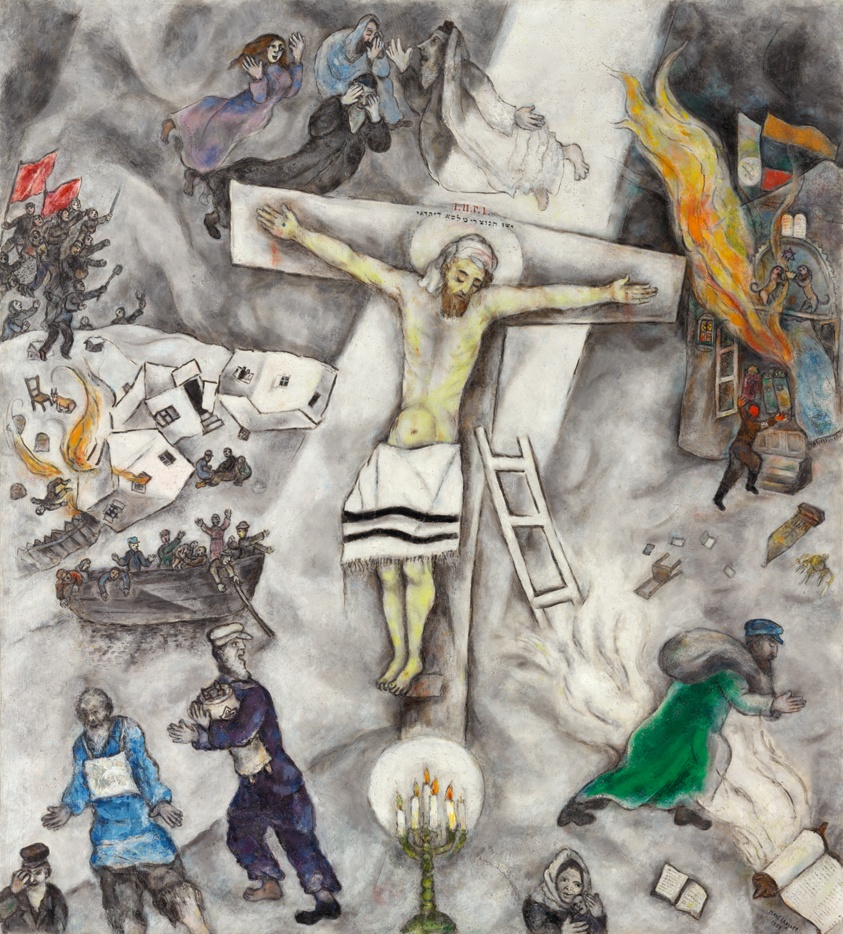
Marc Chagall, White Crucifixion, 1938, oil on canvas, 155 × 139.7 cm, Art Institute of Chicago

Overview

About This Work

White Crucifixion (1938) is one of the most powerful and historically significant paintings of the 20th century. Created by Marc Chagall (1887–1985), a Belarusian-French Jewish artist, the work measures 155 x 139.7 cm (oil on canvas) and is housed in the Art Institute of Chicago. Painted in the autumn of 1938—the year of Kristallnacht (November 9–10, when Nazi brownshirts destroyed Jewish businesses and synagogues across Germany)—the painting represents Chagall's first major artwork depicting Christ as an explicitly Jewish figure. Rather than the traditional loincloth, Christ is wrapped in a white prayer shawl (tallit); his crown of thorns is replaced with a simple headcloth. Surrounding this central crucifix are scenes of Jewish persecution: burning synagogues, fleeing refugees, destroyed Torah scrolls, and a menorah (Jewish candelabrum) glowing at the foot of the cross. Above the cross, Old Testament patriarchs and matriarchs weep and mourn. The painting is a direct condemnation of Nazi anti-Semitism and functions as a visual elegy for European Jewry on the eve of the Holocaust. It represents Chagall's most explicit assertion of Jewish identity and his most powerful statement about the identification of Jewish suffering with the suffering of Christ.

Visual Analysis

Composition

The Central Axis: The composition is organised around the vertical axis of the white cross, which dominates the canvas vertically while occupying only the centre horizontally. This creates a sense of both prominence and isolation—Christ is at the centre yet surrounded by chaos that ignores him. Concentric Rings of Suffering: The painting is structured in concentric layers radiating from the cross: • The Innermost: Christ alone on the cross, bathed in a pale spotlight. • The Immediate Surrounding: The menorah, the ladder (dissolving into smoke), and grieving biblical figures above. • The Middle Distance: Burning synagogues, fleeing families, and destroyed scrolls. • The Outer Edges: The landscape dissolving into pale vagueness, suggesting the vastness of Jewish dispersion. Spatial Collapse: Unlike Renaissance perspective (which creates ordered, rational space), Chagall collapses space. Multiple scenes of persecution occur simultaneously at different scales—a refugee boat is painted at the same scale as a figure on the ground; a burning synagogue towers above human figures. This disorientation reflects the psychological trauma of persecution and makes the viewer feel spatially disoriented, mirroring the experience of displacement. The Dissolving Ladder: The ladder next to the cross—traditionally used to remove Christ's body—dissolves into smoke and dissipates. This symbolizes both the destruction of the covenant (Jacob's ladder) and the abandonment of Christ. He will not be taken down; he will remain on the cross.

Colour & Light

The Dominant White: The painting is predominantly white and pale cream, creating an otherworldly, ethereal quality. Rather than using the traditional reds and golds of earlier crucifixion imagery, Chagall employs white to suggest both purity (the innocence of the victims) and the blankness of abandonment. The white also references the traditional Jewish colour of mourning in some Jewish traditions. The Halo of Light: A pale, glowing light surrounds the cross, but it is cold and ethereal rather than warm and divine. This ambiguous illumination suggests spiritual presence yet also absence—God's light is here yet somehow withdrawn. Touches of Red and Warmth: Scattered throughout are touches of red (in flames, clothing, and accents), creating emotional punctuation. The red flames of the burning synagogues are particularly urgent and horrifying against the pale background. The Menorah's Halo: At the base, the menorah (the seven-branched Jewish candelabrum) is surrounded by a halo of light that echoes Christ's halo. This visual equation makes explicit: the Jewish people and Jesus are one.

Materials & Technique

Oil on Canvas: Chagall uses traditional easel painting with oil, a technique associated with fine art and Western canonical practice. This choice is significant: Chagall uses the Western tradition to assert Jewish presence within it. Soft Brushwork and Dreamlike Quality: Rather than sharp, hard-edged forms, Chagall uses soft, feathery brushwork that creates a dreamlike, almost hallucinatory quality. This formal approach perfectly suits the painting's emotional content—it evokes the surreal horror of witnessing persecution. Collage-Like Composition: Although rendered in oil, the painting's structure resembles collage—disparate scenes of suffering are assembled and juxtaposed rather than seamlessly integrated. This fragmented approach emphasizes the painting's status as an urgent, constructed statement rather than a naturalistic window onto the world.

Historical Context

Context

Kristallnacht (November 1938): The painting was begun in autumn 1938, immediately after Kristallnacht—the coordinated Nazi attacks on Jewish synagogues, businesses, and homes across Germany and Austria. Approximately 1,000 synagogues were burned, and over 30,000 Jews were arrested. This marked a dramatic escalation in Nazi persecution and signalled the acceleration toward genocide. Chagall's Background: Born Moishe Segal in Vitebsk, Belarus (then the Russian Empire), Chagall grew up in a devout Hasidic Jewish community. His artistic identity was rooted in Jewish folk culture, religious imagery, and mystical traditions. However, his career unfolded in Paris (from 1910), where he participated in the European modernist avant-garde. White Crucifixion represents a pivotal moment where Chagall explicitly fused these two identities—the Jewish mystical tradition and Western modernism. Why the Crucifixion?: Chagall chose the crucifixion—Christianity's most sacred image—as his vehicle for depicting Jewish suffering. This was a deliberate rhetorical strategy. He aimed to communicate with Christian Europe in a language it would understand: by showing Christ as a Jewish victim, Chagall forced Christian viewers to confront the reality that their own martyred god was Jewish. If they persecuted Jews, they perpetuated the crucifixion itself. Exhibition History: The painting was exhibited at the Salon d'Automne in Paris in 1938, where it garnered international attention. As Nazi persecution intensified and France fell in 1940, Chagall fled to the United States, where he remained in exile from 1941 to 1948. The painting became iconic in articulating artistic witness to the Holocaust.

Key Themes

Identities (Jewish Identity, Religious Syncretism, Persecution)

The Jewishness of Jesus: By depicting Christ in a prayer shawl (tallit), with a covered head, and surrounded by Jewish suffering, Chagall asserts Christ's Jewish identity with unprecedented force. The inscription above the cross in Aramaic (not Latin) further emphasizes this. It is a radical reclamation of Jesus as a Jewish prophet, not a Christian saviour figure. The Equation of Jewish and Christian Suffering: The painting proposes that Christ's suffering is continuous with Jewish suffering. The Crucifixion is not a redemptive historical event but an ongoing condition of Jewish existence. Every pogrom, every burning synagogue, every scattered refugee is a repetition of Calvary. Isolation and Abandonment: Christ is utterly alone on the cross. The figures below are fleeing, not witnessing; the patriarchs above are weeping but cannot intervene; the ladder disintegrates. There is no comfort, no redemption, no resurrection promised. The painting embraces profound theological darkness. Witness and Accusation: By documenting the scenes of persecution with meticulous detail (the burning synagogue, the Torah scrolls, the fleeing families), Chagall functions as a witness and recorder. The painting is an accusation directed at Christian Europe: "Look what you are doing. Look at what you have done."

Exam Focus Points

Critical Perspectives

Religious Blasphemy vs. Prophetic Witness: Some Christian viewers found the painting deeply offensive—depicting their saviour in Jewish garments appeared to desecrate the sacred image. Yet Chagall was not attempting blasphemy; he was attempting to reclaim Christ for Judaism and to use Christianity's most recognizable image to communicate Jewish suffering to Christian audiences. Pope Francis I later called it his favourite painting, recognizing it as profound religious art rather than blasphemy. Modernism and Identity: The painting exemplifies how modernist formal techniques (spatial collapse, distortion, colour non-naturalism) can serve political and religious purposes. Chagall uses modernism not to escape the world but to bear witness to it. This challenges the idea of modernism as necessarily abstracted or apolitical. The Ladder as Symbol: The dissolving ladder carries multiple meanings: • The Jacob's Ladder of the Bible (representing God's covenant)—its dissolution suggests God's abandonment. • The ladder used to remove bodies from the cross—its dissolution means Christ will not be taken down. • Failure of rescue—it cannot function to save anyone. This richness of meaning shows how Chagall layers symbolism into every formal element. Comparison to Epstein's Risen Christ: Both Epstein and Chagall created traumatic Christs in response to violence—Epstein's Christ in response to World War I, Chagall's in response to Nazi anti-Semitism. Yet they represent different theological positions: Epstein's Christ accuses humanity; Chagall's Christ suffers silently while humanity destroys itself. Epstein emphasizes Christ's humanity; Chagall emphasizes Christ's Jewishness. Pre-Holocaust Prophecy: The painting is often read as a prophetic warning of the Holocaust, painted before the full horrors became known. Yet this can be problematic; it risks making the painting about prediction rather than witnessing to ongoing persecution. The painting documents real violence occurring in 1938, not imagined future genocide.

On this page

OverviewVisual AnalysisHistorical ContextKey ThemesExam Focus Points