History o' Phoeart
  • Home

Nature

  • Overview
  • Landscape or Seascape in 2D
  • Animals in 2D or 3D
  • The Elements (Fire, Water, Wind or Earth) in 2D or 3D
  • The Relationship between Man/Woman and Nature in 2D or 3D

Identity

  • Overview
  • The Divine in 2D or 3D Works
  • Portraits in 2D Works
  • Portraits in 3D Works
  • Gender Identity in 2D or 3D Works

Renaissance

  • Overview
  • Religious Painting
  • Religious Sculpture
  • Mythological in 2D or 3D
  • Portraits in 2D or 3D

Baroque

  • Overview
  • Religious Painting
  • Religious Sculpture
  • Mythological Painting
  • Mythological Sculpture

About

A comprehensive study resource for Pearson Edexcel History of Art A-Level.

NatureIdentityRenaissanceBaroque

History o' Phoeart - A-Level Study Resource

Pearson Edexcel Specification • Use ⌘K to search

  1. Home
  2. Paper 1
  3. Nature
  4. Animals in 2D or 3D
  5. Balloon Dog
Paper 1Nature
Nature
Landscape or Seascape in 2D
Animals in 2D or 3D
Pre-1850
Post-1850
Balloon Dog

Balloon Dog

Jeff Koons

Puppy

Puppy

Jeff Koons

Non-Western
The Elements (Fire, Water, Wind or Earth) in 2D or 3D
The Relationship between Man/Woman and Nature in 2D or 3D
Plants in 2D or 3D
Architecture

6 scopes • 24 artworks

Balloon Dog

Jeff Koons, 1994-2000
NaturePost-1850
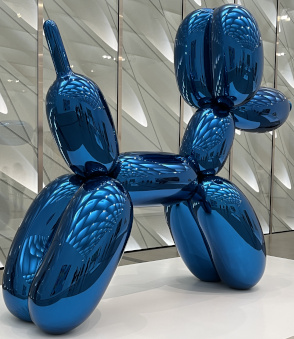
Balloon Dog by Jeff Koons
Balloon Dog by Jeff Koons, 1994–2000. Mirror-polished stainless steel with transparent colour coating.

Overview

About This Work

Balloon Dog (1994–2000) is a series of five unique monumental sculptures by American artist Jeff Koons, created as part of his Celebration series. Each sculpture stands over 3 metres tall and weighs approximately one tonne. They exist in five versions, each finished in a different vivid colour: blue, magenta, orange, red, and yellow. The sculptures are fabricated from mirror-polished stainless steel with a translucent colour coating and represent one of the most recognizable and controversial artworks of the late 20th and early 21st centuries. Originally conceived to premiere at the Guggenheim Museum in New York in the mid-1990s, the technical complexity of their fabrication stretched the completion timeline across more than a decade. Balloon Dog (Orange) achieved particular fame when it sold at Christie's auction in November 2013 for $58.4 million, making it one of the most expensive artworks ever sold by a living artist at that time. The work exemplifies Appropriation Art and Pop Art, transforming a disposable, ephemeral children's party novelty into an ultra-luxurious, permanent fine art object. It provocatively asks: What defines art? What is the relationship between commerce, kitsch, and aesthetic value? Is irony a legitimate artistic strategy?

Visual Analysis

Composition

Balloon Morphology: The sculpture replicates the exact form of a balloon twisted into a dog shape—precisely the kind of animal a street performer or entertainer might create at a birthday party. The form comprises four cylindrical legs, a slightly curved torso, an elongated neck, and a head with pointed ears. The dog's posture is friendly and welcoming, with front paws slightly raised. Gestalt Simplicity: The form is geometrically simplified, reducible to basic volumes (cylinders, spheres, cones). This reductionism mirrors the simplifying process a performer uses when twisting a balloon into recognizable form. There are no anatomical details—no eyes, no mouth, no individuating features—making the sculpture universally recognizable yet deliberately generic. Monumentality and Scale Inversion: The work's power derives from its vast scale. A balloon dog at life-size is a charming party trick; inflated to 3+ metres, it becomes overwhelming, unsettling, and grandly absurd. This scale inversion transforms the quotidian into the monumental, echoing the Pop Art strategy of Andy Warhol and others who enlarged mass-produced commercial images. The Seams: Visible seams and joints run across the sculpture's surface, betraying the construction method. Rather than concealing these fabrication marks (as traditional sculptors would), Koons emphasizes them. The seams reference the twisted joints visible in an actual balloon animal and paradoxically emphasize the sculpture's artificiality despite its seeming simplicity.

Colour & Light

Chromatic Intensity: Each colour version (blue, magenta, orange, red, yellow) is rendered in vivid, highly saturated hues—primary and secondary colours evocative of children's toys, commercial products, and Pop culture. The colours are applied as translucent coatings over the stainless steel base, creating a subtle depth: light appears to float above the metal surface rather than embedded within it. Mirror Polishing and Reflectivity: The stainless steel surface is polished to a mirror finish (0.02 micrometres), creating highly reflective surfaces that capture and distort the surrounding environment. Viewers see themselves reflected in the sculpture's surface, making the work fundamentally interactive. This reflectivity has philosophical implications: the artwork becomes a mirror of its viewers' consciousness and the viewer becomes part of the artwork's meaning. Luminosity and Illusion: The mirror-polished surface and translucent colour create the optical illusion of buoyancy and lightness despite the sculpture's substantial mass (approximately 1 tonne). The sculpture appears to float or breathe—paradoxically, the heaviest material (steel) is made to appear weightless and inflatable.

Materials & Technique

Stainless Steel Fabrication: The sculpture is fabricated from 316L stainless steel using precision engineering. Each dog comprises approximately 60 separate parts welded together with extraordinary precision. The joints are invisible at normal viewing distances, creating seamless contours. Lost-Wax Casting Methodology: Individual components were created using lost-wax casting, a technique centuries old but here deployed with contemporary precision engineering. This ancient method is deliberately juxtaposed with industrial-scale production, collapsing historical boundaries. Mirror-Polishing Process: After welding, each component undergoes meticulous polishing to achieve mirror-finish reflectivity. This is labour-intensive and requires specialist knowledge. The polishing process transforms industrial stainless steel—typically associated with utilitarian kitchens and hospitals—into a luxurious, precious material. Colour Application: The colour coating is applied using a multi-stage process, with translucent pigments suspended in a clear medium. This creates optical depth; the colour appears to float above the steel surface. The process required years of experimentation to achieve Koons' desired effect. Industrial Production vs. Artisanal Craft: The fabrication involved collaboration between Koons and specialist foundries (particularly Carlson & Co. in California). This partnership between artist and industrial manufacturer blurs conventional distinctions between art production and mass manufacturing. The work is simultaneously a unique artwork (only 5 versions exist) and a "production-line" item.

Historical Context

Context

The Celebration Series (1991–ongoing): Koons conceived the Celebration series as an explicitly joyful response to contemporary art's tendency toward irony, cynicism, and pessimism. Works in the series include Puppy (a dog-shaped topiary and floral installation), Play-Doh, Pink Panther, and inflatable pool toys. All share a commitment to kitsch, commercial culture, and childhood nostalgia as legitimate subjects for fine art. Appropriation and Pop Art: Balloon Dog continues strategies pioneered by Pop artists (Warhol, Lichtenstein, Rosenquist) who transformed mass-produced images and consumer goods into fine art. Yet Koons extends this: rather than appropriating an existing commercial image, he creates an original artwork that merely looks like a commercial product. This is appropriation of form rather than content. Post-Modern Irony and Sincerity: Balloon Dog emerged during the height of Postmodernism, a period when irony was the dominant artistic mode. Koons, however, claims that his Celebration series is genuinely sincere in its celebration of joy, pleasure, and beauty. He rejects the notion that art must be intellectually rigorous or politically oppositional. This assertion of sincerity within an ironical framework creates productive ambiguity. Market and Commerce: Koons has been explicitly engaged with art market economics. His works are deliberately conceived as commodities—produced in limited editions, marketed aggressively, and designed to accrue value. This transparency about commercialism is both celebrated (as honest acknowledgment of art's market function) and criticized (as crass commodification of artistic practice). Technological Innovation in Art: The 1990s witnessed increasing artist engagement with digital design, fabrication technologies, and industrial manufacturing. Koons' collaboration with foundries and engineers represents art's embrace of technological and industrial modernity, in contrast to the artisanal hand-craftsmanship traditionally prized in fine art.

Key Themes

Connection to Nature and Identities (Childhood, Consumer Culture)

Innocence and Nostalgia: Balloon Dog evokes childhood—the joy of parties, entertainments, and simple pleasures. Yet it simultaneously commodifies this innocence. The transformation of a balloon (ephemeral, disposable, cheap) into a permanent, expensive artwork parallels the commodification of childhood itself in consumer capitalism. The Ephemeral and the Eternal: A balloon dog is inherently ephemeral—it can deflate, deteriorate, or be discarded. By translating it into stainless steel, Koons confers permanence and immortality. This paradoxically makes the ephemeral "eternal," suggesting that contemporary consumer culture and childhood play are worthy of permanent artistic commemoration. High Art vs. Low Art: The sculpture challenges the hierarchy separating "high" fine art from "low" mass culture. By elevating a children's party novelty to monumental scale and presenting it in museums and galleries, Koons asserts that the boundary between high and low is artificial and contingent. Narcissism and Reflection: The reflective surface implicates viewers in the artwork's meaning. One cannot view Balloon Dog without seeing oneself reflected. This enforces a recognition of self-consciousness and spectatorship. The work suggests contemporary culture's narcissism—our obsession with consumption, self-image, and reflective surfaces (mirrors, screens, social media).

Exam Focus Points

Critical Perspectives

Critics of Kitsch and Appropriation: Prominent art critics (notably Clement Greenberg's intellectual heirs) have argued that Koons' work lacks originality and is merely an exploitation of kitsch and consumerism. They contend that appropriating commercial forms without transformation or critique amounts to celebration of the very consumer capitalism that might be interrogated. These critics see Balloon Dog as emblematic of late-capitalism's co-optation of artistic practice. Defenders of Sincerity: Other scholars (notably curator Bob Colacello) defend Koons as genuinely committed to joy, beauty, and pleasure as legitimate artistic values. They argue that his transparency about market mechanisms and commercial production is itself a form of honesty and critique. His assertion that beauty and celebration matter in contemporary art represents a philosophical position, not merely an artistic gesture. Craftsmanship and Authenticity: The fabrication process raises questions about artistic authenticity. Koons does not personally execute the work; instead, he designs and oversees industrial fabrication. This challenges the Romantic notion that art requires the artist's hand. Is Balloon Dog Koons' artwork, or is it a product designed by Koons and executed by engineers and craftspeople? Market Excess and Value: The $58.4 million auction price has become notorious as evidence of art market inflation and speculation. Critics cite Balloon Dog (Orange) as emblematic of the art market's detachment from aesthetic or cultural value, driven instead by investment speculation and ultra-wealthy collectors' vanity. Yet others argue that the market price is irrelevant to the artwork's aesthetic or conceptual achievement. Comparison to Historical Precedents: A Level essays should situate Balloon Dog within art history by comparing it to Pop Art predecessors (Warhol's Brillo Boxes, Lichtenstein's comic panels) and to postmodern appropriation (Sherrie Levine, Richard Prince). Such comparisons illuminate both Balloon Dog's innovations and its debts. Gender and Sentimentality: Some feminist critics have interrogated Koons' celebration of kitsch and infantilism, arguing that it perpetuates associations between femininity and sentimentality. The valorization of "cute" and "pretty" aesthetics, traditionally coded as feminine and dismissed, is recuperated as legitimate. This raises interesting questions about how gender shapes aesthetic valuation.

On this page

OverviewVisual AnalysisHistorical ContextKey ThemesExam Focus Points