History o' Phoeart
  • Home

Nature

  • Overview
  • Landscape or Seascape in 2D
  • Animals in 2D or 3D
  • The Elements (Fire, Water, Wind or Earth) in 2D or 3D
  • The Relationship between Man/Woman and Nature in 2D or 3D

Identity

  • Overview
  • The Divine in 2D or 3D Works
  • Portraits in 2D Works
  • Portraits in 3D Works
  • Gender Identity in 2D or 3D Works

Renaissance

  • Overview
  • Religious Painting
  • Religious Sculpture
  • Mythological in 2D or 3D
  • Portraits in 2D or 3D

Baroque

  • Overview
  • Religious Painting
  • Religious Sculpture
  • Mythological Painting
  • Mythological Sculpture

About

A comprehensive study resource for Pearson Edexcel History of Art A-Level.

NatureIdentityRenaissanceBaroque

History o' Phoeart - A-Level Study Resource

Pearson Edexcel Specification • Use ⌘K to search

  1. Home
  2. Paper 1
  3. Nature
  4. Architecture
  5. Falling Water
Paper 1Nature
Nature
Landscape or Seascape in 2D
Animals in 2D or 3D
The Elements (Fire, Water, Wind or Earth) in 2D or 3D
The Relationship between Man/Woman and Nature in 2D or 3D
Plants in 2D or 3D
Architecture
Pre-1850
Post-1850
Guggenheim Museum

Guggenheim Museum

Frank Lloyd Wright

Falling Water

Falling Water

Frank Lloyd Wright

Non-Western

6 scopes • 24 artworks

Falling Water

Frank Lloyd Wright, 1936-9
NaturePost-1850
Falling Water by Frank Lloyd Wright
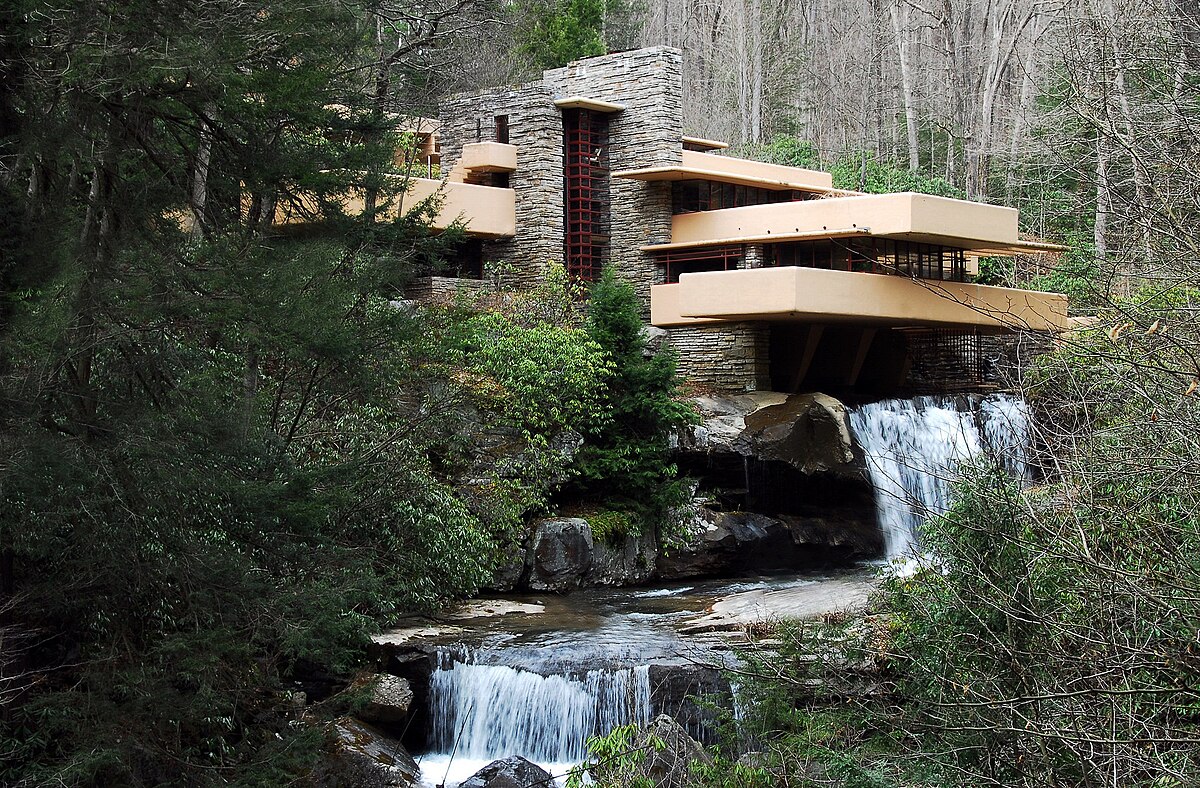
Frank Lloyd Wright, Fallingwater (Kaufmann House), 1936-1939, Bear Run, Pennsylvania

Overview

About This Work

Fallingwater (1936-1939) is arguably the most famous private residence of the 20th century and the definitive masterpiece of American architect Frank Lloyd Wright (1867-1959). Located in the wooded hills of the Bear Run Nature Reserve in rural Pennsylvania, the house was commissioned by Edgar J. Kaufmann, a wealthy Pittsburgh department store owner, as a weekend retreat for his family. The house is celebrated for its audacious integration with its site: rather than building the house facing the waterfall (as the clients expected), Wright built it directly over the waterfall, so that the water flows beneath the living spaces. The design consists of a series of monumental cantilevered concrete terraces anchored to a central stone chimney, hovering above the stream like layers of sedimentary rock. The house exemplifies Wright's philosophy of Organic Architecture - the belief that buildings should grow naturally from their environment, integrating landscape, materials, and human life into a unified whole. It revitalized Wright's career at age 69, reasserting his relevance against the rising tide of European Modernism (International Style), and was declared the best all-time work of American architecture by the American Institute of Architects.

Visual Analysis

Composition

Horizontal and Vertical Contrast: The composition is built on the interplay between strong horizontal planes (the floating concrete terraces) and vertical anchors (the stone chimney mass). This mirrors the landscape itself: the horizontal ledges of the rock strata and the vertical trunks of the surrounding trees. The Cantilever System: The house's defining feature is its structural daring. Wright employed cantilevers - beams supported at only one end - to project the terraces out over the waterfall without visible support columns below. This creates a sensation of weightlessness and suspension, as if the house is floating. Asymmetrical Balance: The composition is dynamically asymmetrical. The terraces extend in different directions and lengths, creating a pinwheel effect around the central chimney core. This refusal of symmetry rejects classical European traditions in favour of a freer, more natural sense of balance. Interpenetration of Exterior and Interior: There is no clear boundary between inside and outside. The stone floors of the interior extend seamlessly onto the exterior terraces; glass walls dissolve the visual barrier; the sound of the waterfall permeates the house. The terraces act as outdoor rooms, doubling the living space.

Colour & Light

Limited Palette: Wright strictly limited the materials to create harmony: Reinforced Concrete: Painted a warm light ochre (Wright called it apricot) to complement the fallen leaves. Pottsville Sandstone: Quarried directly from the site, this rough, grey-gold stone forms the vertical walls and chimney. It is laid in irregular, shifting strata to mimic the natural rock formations. Glass: Used for walls and corners. Steel: Painted in Cherokee Red (Wright's signature colour) for the window frames (sashes). Structural Materials: The trays (terraces) are reinforced concrete; the vertical piers are native stone. This material distinction clarifies the structural logic: stone anchors to the earth, concrete flies toward the sky. Glass Curtains: Wright eliminated traditional window frames where possible. Most famously, where glass meets stone, the glass is caulked directly into the rough masonry recess, making it appear as if the rock itself is penetrating the window. At the corners, glass meets glass without a mullion (vertical support), dissolving the box-like enclosure.

Materials & Technique

Interior Spatial Experience The Hearth: The psychological centre of the home is the fireplace. Wright built the hearth directly upon a natural boulder found on the site (the very rock the Kaufmanns used to picnic on). The rock protrudes through the living room floor, literally grounding the domestic ritual in the primal landscape. Compression and Release: Wright manipulates space to control the visitor's experience. Entryways and corridors are often low, dark, and compressed (creating a sense of shelter or cave), which then open up into bright, expansive living areas with panoramic views. This dramatic expansion is known as compression and release. The Hatch: In the living room, a sliding glass hatch opens to a suspended staircase that drops down directly to the stream below. This feature serves no utilitarian purpose other than to intimately connect the inhabitants with the water - allowing cool air, sound, and the ability to dip a toe into the stream.

Historical Context

Context

The Client (Edgar Kaufmann): Edgar Kaufmann Sr. was a cultivated merchant prince who admired modern art and architecture. His son, Edgar Kaufmann Jr., was an apprentice at Wright's Taliesin Fellowship, which led to the commission. The relationship between Wright and Kaufmann was fraught with tension, particularly regarding engineering; Kaufmann secretly hired engineers who warned the cantilevers would fail, leading to heated arguments with Wright (who threatened to quit). The Depression Era: Built during the Great Depression, the house was an extraordinarily expensive luxury (costing $155,000 in 1939 - equivalent to roughly $3 million today). It represented a vision of optimistic modernity and technological mastery during a period of economic despair. Response to International Style: In the 1930s, European architects (Le Corbusier, Mies van der Rohe) were promoting the International Style - white, machine-like, geometric boxes detached from nature (e.g., Villa Savoye). Wright despised this cardboard box architecture. Fallingwater was his retort: a modern building that used concrete and steel but remained deeply romantic, site-specific, and organic rather than sterile and universal. Technological Innovation: The use of reinforced concrete for domestic architecture was avant-garde. However, the technology was pushed to its limit. The contractors (and Kaufmann's engineers) added extra steel reinforcement without Wright's permission, fearing collapse. History proved them right; the terraces began sagging immediately upon removal of the formwork and required major post-tensioning repair in 2002 to prevent catastrophic failure.

Key Themes

Connection to Nature (Organic Architecture, Immersion)

Shelter vs. Exposure: The house provides a profound sense of shelter (low ceilings, heavy stone walls, the cave-like hearth) while simultaneously exposing inhabitants to the raw power of nature (the roar of the falls, the vertiginous drops from terraces). It balances the primal human need for protection with the romantic desire for communion with the wild. Music of the Stream: Wright famously said, I want you to live with the waterfall, not just to look at it, but for it to become an integral part of your lives. By placing the house over the falls, the sound becomes omnipresent - a background music that defines the home's atmosphere. Site Specificity: Unlike International Style buildings which could be placed anywhere, Fallingwater is specific to this rock, this stream, and this forest. It cannot be replicated elsewhere. It grows out of the site conditions. Biomimicry: The house mimics the horizontal stratification of the surrounding sedimentary rock. It does not look like a tree or a rock, but it follows their structural logic - anchored roots/foundations and spreading branches/cantilevers.

Exam Focus Points

Critical Perspectives

Structural Failure vs. Artistic Triumph: A key debate concerns the balance between engineering and aesthetics. The house failed structurally (sagging terraces, leaks, mold). Does this failure undermine its architectural greatness? Or is the ambition to defy gravity worth the technical cost? Wright prioritized the idea and the experience over technical permanence. Man vs. Nature: Is Fallingwater a harmonious integration with nature, or a domination of it? By imposing a massive concrete structure over a pristine waterfall, Wright arguably conquers the landscape rather than merely respecting it. It is a highly interventionist form of organic architecture. The Genius Myth: Wright cultivated the myth that he conceived the entire design in a single two-hour burst of inspiration while Kaufmann was driving to see him. While the drawings were indeed produced rapidly, the ideas had been percolating for months. This story reinforces the Romantic idea of the architect as solitary genius. Comparison to Villa Savoye: Fallingwater is frequently compared to Le Corbusier's Villa Savoye (1929). Both are weekend retreats for wealthy clients using modern materials. But where Savoye sits on the landscape like a machine (a machine for living in), detached and distinct, Fallingwater digs into the landscape, blurring the line between built and natural. Interior vs. Exterior: While famous for its exterior silhouette, the interior is equally significant for its open plan (breaking the box), its built-in furniture (unity of design), and its manipulation of light and view.

On this page

OverviewVisual AnalysisHistorical ContextKey ThemesExam Focus Points