History o' Phoeart
  • Home

Nature

  • Overview
  • Landscape or Seascape in 2D
  • Animals in 2D or 3D
  • The Elements (Fire, Water, Wind or Earth) in 2D or 3D
  • The Relationship between Man/Woman and Nature in 2D or 3D

Identity

  • Overview
  • The Divine in 2D or 3D Works
  • Portraits in 2D Works
  • Portraits in 3D Works
  • Gender Identity in 2D or 3D Works

Renaissance

  • Overview
  • Religious Painting
  • Religious Sculpture
  • Mythological in 2D or 3D
  • Portraits in 2D or 3D

Baroque

  • Overview
  • Religious Painting
  • Religious Sculpture
  • Mythological Painting
  • Mythological Sculpture

About

A comprehensive study resource for Pearson Edexcel History of Art A-Level.

NatureIdentityRenaissanceBaroque

History o' Phoeart - A-Level Study Resource

Pearson Edexcel Specification • Use ⌘K to search

  1. Home
  2. Paper 1
  3. Nature
  4. Architecture
  5. Guggenheim Museum
Paper 1Nature
Nature
Landscape or Seascape in 2D
Animals in 2D or 3D
The Elements (Fire, Water, Wind or Earth) in 2D or 3D
The Relationship between Man/Woman and Nature in 2D or 3D
Plants in 2D or 3D
Architecture
Pre-1850
Post-1850
Guggenheim Museum

Guggenheim Museum

Frank Lloyd Wright

Falling Water

Falling Water

Frank Lloyd Wright

Non-Western

6 scopes • 24 artworks

Guggenheim Museum

Frank Lloyd Wright, 1943-59
NaturePost-1850
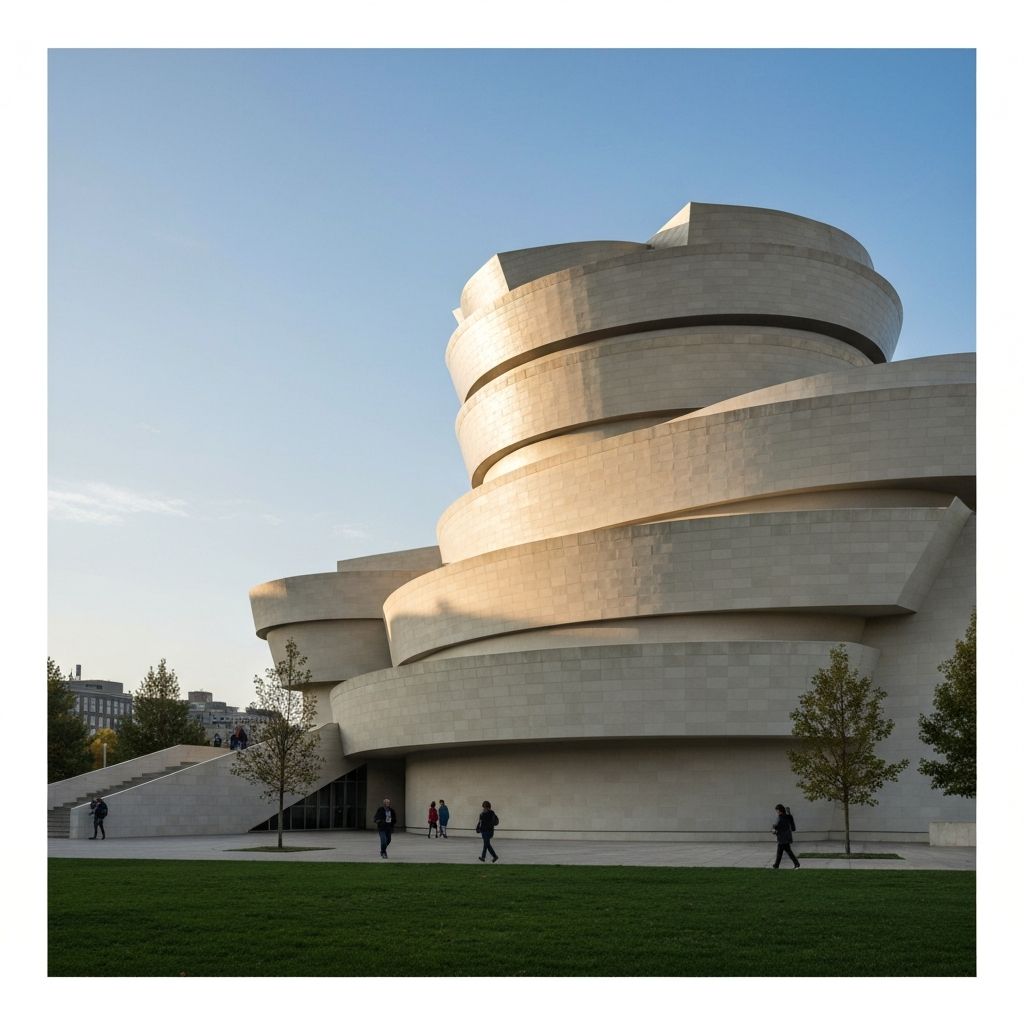
Guggenheim Museum by Frank Lloyd Wright
The Solomon R. Guggenheim Museum, New York, designed by Frank Lloyd Wright (designed 1943, completed 1959)

Overview

About This Work

The Solomon R. Guggenheim Museum (1943–1959) is Frank Lloyd Wright's only major public building in New York City and stands as one of the most revolutionary museum designs in architectural history. Located at 1071 Fifth Avenue on Manhattan's Upper East Side, opposite Central Park, the museum opened to the public on October 21, 1959—six months after Wright's death at age 91. The building measures approximately 108 meters (354 feet) in height and comprises a continuous spiral ramp ascending the interior of a cylindrical white concrete structure, crowned by a 58-foot-wide glass oculus (circular opening). The museum was commissioned by the industrialist Solomon R. Guggenheim to house his collection of non-objective (abstract) art. It stands as the culminating achievement of Wright's "organic architecture" philosophy—a design integrating form, function, materials, and human experience into a seamless whole. The spiral ramp itself is the primary exhibition space, with artworks displayed along its continuously ascending wall. The building fundamentally redefined the relationship between architecture and art display, challenging conventions of how museums should function. It remains one of the most recognizable and controversial buildings of the 20th century.

Visual Analysis

Composition

The Inverted Ziggurat: The building's distinctive profile is often compared to an inverted ziggurat or a nautilus shell—it expands as it rises, wider at the top than the base. This unconventional proportioning was controversial (many critics claimed it would overshadow neighbouring buildings and was unsuitable for Fifth Avenue), yet it creates a sense of dynamic growth and counteracts the visual heaviness of a large cylinder. Pure Geometry and Natural Forms: The form is simultaneously geometric (composed of smooth curves mathematically derived) and organic (inspired by natural spirals found in shells, DNA helixes, and galaxies). This synthesis of mathematics and nature embodies Wright's philosophy that nature and geometry are inseparable. Contrast with Urban Context: The smooth, cylindrical form stands in stark contrast to the orthogonal (right-angled) grid of Manhattan's street plan and the rectilinear facades of surrounding buildings. Rather than conforming to the city's geometric logic, the museum asserts an alternative vision of organic form within the rigid urban matrix. The Monumental Presence: At approximately 108 metres tall and with a base diameter of roughly 55 metres, the building dominates its site. Its gleaming white concrete exterior (created using a specially formulated concrete mix) reflects light, making it appear almost ethereal despite its massive material weight. Interior Spatial Experience: The Spiral Ramp: The interior is dominated by a continuous spiral ramp that serves as the primary circulation path. Rather than traditional museum galleries with discrete rooms, visitors experience a single, unbroken path. Elevators ascend visitors to the top; they then gradually descend along the gently sloping ramp (approximately 3% gradient, preventing discomfort), viewing artworks hung on the outer wall. The Central Rotunda: At the core is a vast, naturally lit central space—the rotunda—visible in its entirety from any point on the spiral. This creates constant visual orientation; visitors always know their position relative to the whole. The rotunda functions as what Wright called a "temple to non-objective art"—a sacred space dedicated to pure abstraction. Sight Lines and Perspective: The spiral creates constantly shifting vantage points. As visitors ascend, their viewpoint changes; they see artworks from different angles and distances. Simultaneously, they observe other visitors at different levels of the spiral, creating a complex spatial choreography where human movement becomes part of the aesthetic experience.

Colour & Light

Natural Light: The glass oculus at the summit allows daylight to flood into the interior, creating a dynamic interplay of light and shadow throughout the day. The varying angles of the ramp and the curved surfaces modulate this light, ensuring no harsh glare damages the artworks while creating a luminous, almost spiritual atmosphere. Surface Treatment: The exterior concrete is left largely unadorned, relying on the purity of form and the subtle play of light and shadow on the curved surface. This restraint is characteristic of modernism and contrasts sharply with ornamental traditions.

Materials & Technique

Reinforced Concrete: The primary material is white reinforced concrete, chosen for its plasticity (ability to achieve curved forms) and its relative economy. Wright developed special concrete mixes to achieve the desired colour and finish, consulting with engineers to solve unprecedented structural challenges (the spiral ramp required novel structural engineering). Geometric Spirals and Load Distribution: The spiral is not arbitrary; it is a logarithmic spiral (found in nature) that creates a gradually increasing rotation. This geometry serves both aesthetic and structural purposes: it efficiently distributes weight and allows the ramp to rise with minimal incline, improving visitor comfort. Steel Reinforcement and Engineering Innovation: The building required unprecedented structural engineering. The spiral ramp is supported by a complex internal steel framework hidden within the concrete. The design required multiple prototypes and engineering consultations to ensure stability and visitor safety.

Historical Context

Context

The Guggenheim Collection and Non-Objective Art: Solomon Guggenheim, a wealthy industrialist and art collector, became obsessed with abstract, non-objective art (particularly the work of Wassily Kandinsky) through the influence of artist Hilla Rebay. In 1939, Guggenheim founded the Museum of Non-Objective Art in a temporary space; he commissioned Wright in 1943 to design a permanent home for this collection. Wright's Long Design Process: The design occupied Wright for 16 years (1943–1959). Multiple design iterations were developed, each refining the spatial concept. The long gestation period reflected both Wright's perfectionism and the revolutionary nature of the design—it required solving unprecedented structural and programmatic challenges. Controversy and Opposition: The design faced fierce opposition. City officials objected to the unconventional form violating building codes; artists (including Willem de Kooning and Robert Motherwell) petitioned against the design, fearing the building would overwhelm rather than serve the art. The New York architectural establishment was skeptical, viewing the building as self-aggrandizing rather than functional. Wright's Late Modernism: The Guggenheim represents Wright's mature synthesis of organic architecture with International Style modernism. It demonstrates that organic form—derived from nature and human experience—could coexist with modernist reduction and geometric purity. Post-War American Optimism: The building opened during the height of Cold War American cultural confidence. Abstract art was promoted by American institutions (CIA-backed cultural initiatives) as evidence of American freedom and creativity contrasted with Soviet conformity. The Guggenheim's avant-garde design embodied this assertion of American cultural superiority.

Key Themes

Connection to Nature (Organic Architecture, Growth, Transformation)

Natural Forms in Urban Space: Wright's fundamental principle was that architecture should be organic—arising naturally from the site, materials, and human use. The spiral form, derived from natural structures (shells, galaxies, DNA), asserts that nature's logic can transcend the imposed geometric rationality of the urban grid. Movement and Process: Unlike static, monumental architecture (e.g., classical temples, Baroque palaces), the Guggenheim emphasizes movement and process. The spiral embodies growth, transformation, and the dynamic experience of human consciousness. Visitors are not stationary viewers but moving bodies experiencing art kinesthetically. Light as Element: Natural light is treated as a fundamental material, not merely a functional requirement. The oculus and continuous fenestration create a living, changing interior that transforms throughout the day. This integration of light as an architectural element reflects Wright's belief that nature (through light) should penetrate human spaces. Harmony of Form and Function: The spiral is not merely decorative; it fundamentally serves the museum's function. The continuous ramp eliminates jarring transitions between galleries; artworks are experienced as a cohesive journey. Form and function are unified, embodying Wright's maxim: "Form and function are one."

Exam Focus Points

Critical Perspectives

Architecture vs. Art (The Artist's Petition): In 1957, prominent artists (de Kooning, Motherwell, Avery) petitioned the museum trustees, objecting that the building's bold form would dominate rather than serve the art. They feared the architecture would become the spectacle, subordinating artworks. This raises fundamental questions: Should museum architecture be neutral container or active participant in the aesthetic experience? Critics have argued the Guggenheim's overpowering presence proves the artists' point; the building itself is the primary attraction, with artworks secondary. Functionality and Visitor Experience: The spiral ramp, while spatially innovative, presents practical challenges. The constantly sloping floor can cause visitor fatigue; the radial display wall means artworks at the perimeter are seen from oblique angles; the open rotunda creates acoustical challenges; the continuous flow prevents lingering or backtracking. Some curators and conservators have questioned whether the innovative design actually serves art display effectively. Urban Intervention: The building boldly asserts an alternative architectural vision within the rigid Manhattan grid. It is simultaneously harmonious (the organic curves contrast beneficially with orthogonal surroundings) and disruptive (it refuses to conform to neighbouring building types). This tension—between integration and assertion—characterizes Wright's urban interventions. The Spiral as Symbol: The spiral is simultaneously progressive (ascending, moving forward) and cyclical (returning, revising). It can represent evolutionary development or eternal return. As a symbol for a museum (a place of preservation and memory), the spiral suggests both progress and continuity—fitting for an institution engaged with both historical preservation and contemporary innovation. Aging and Renovation: The building has required significant conservation efforts. The concrete has deteriorated; the interiors have been modified (a ten-story tower was added in 1992, controversial because many argue it violates Wright's intentions). These challenges raise questions about how to preserve modernist buildings designed with revolutionary structural systems and unconventional materials. Comparison to Historical Precedents: The spiral form references classical and Renaissance prototypes (the Colosseum, Renaissance rotundas like the Pantheon), yet transforms them utterly. By understanding these historical references, students can discuss how modernism simultaneously breaks with and builds upon historical traditions.

On this page

OverviewVisual AnalysisHistorical ContextKey ThemesExam Focus Points