History o' Phoeart
  • Home

Nature

  • Overview
  • Landscape or Seascape in 2D
  • Animals in 2D or 3D
  • The Elements (Fire, Water, Wind or Earth) in 2D or 3D
  • The Relationship between Man/Woman and Nature in 2D or 3D

Identity

  • Overview
  • The Divine in 2D or 3D Works
  • Portraits in 2D Works
  • Portraits in 3D Works
  • Gender Identity in 2D or 3D Works

Renaissance

  • Overview
  • Religious Painting
  • Religious Sculpture
  • Mythological in 2D or 3D
  • Portraits in 2D or 3D

Baroque

  • Overview
  • Religious Painting
  • Religious Sculpture
  • Mythological Painting
  • Mythological Sculpture

About

A comprehensive study resource for Pearson Edexcel History of Art A-Level.

NatureIdentityRenaissanceBaroque

History o' Phoeart - A-Level Study Resource

Pearson Edexcel Specification • Use ⌘K to search

  1. Home
  2. Paper 1
  3. Nature
  4. The Elements (Fire, Water, Wind or Earth) in 2D or 3D
  5. The Fighting Temeraire
Paper 1Nature
Nature
Landscape or Seascape in 2D
Animals in 2D or 3D
The Elements (Fire, Water, Wind or Earth) in 2D or 3D
Pre-1850
Rain, Steam and Speed

Rain, Steam and Speed

JMW Turner

The Fighting Temeraire

The Fighting Temeraire

JMW Turner

Post-1850
Non-Western
The Relationship between Man/Woman and Nature in 2D or 3D
Plants in 2D or 3D
Architecture

6 scopes • 24 artworks

The Fighting Temeraire

JMW Turner, 1839
NaturePre-1850
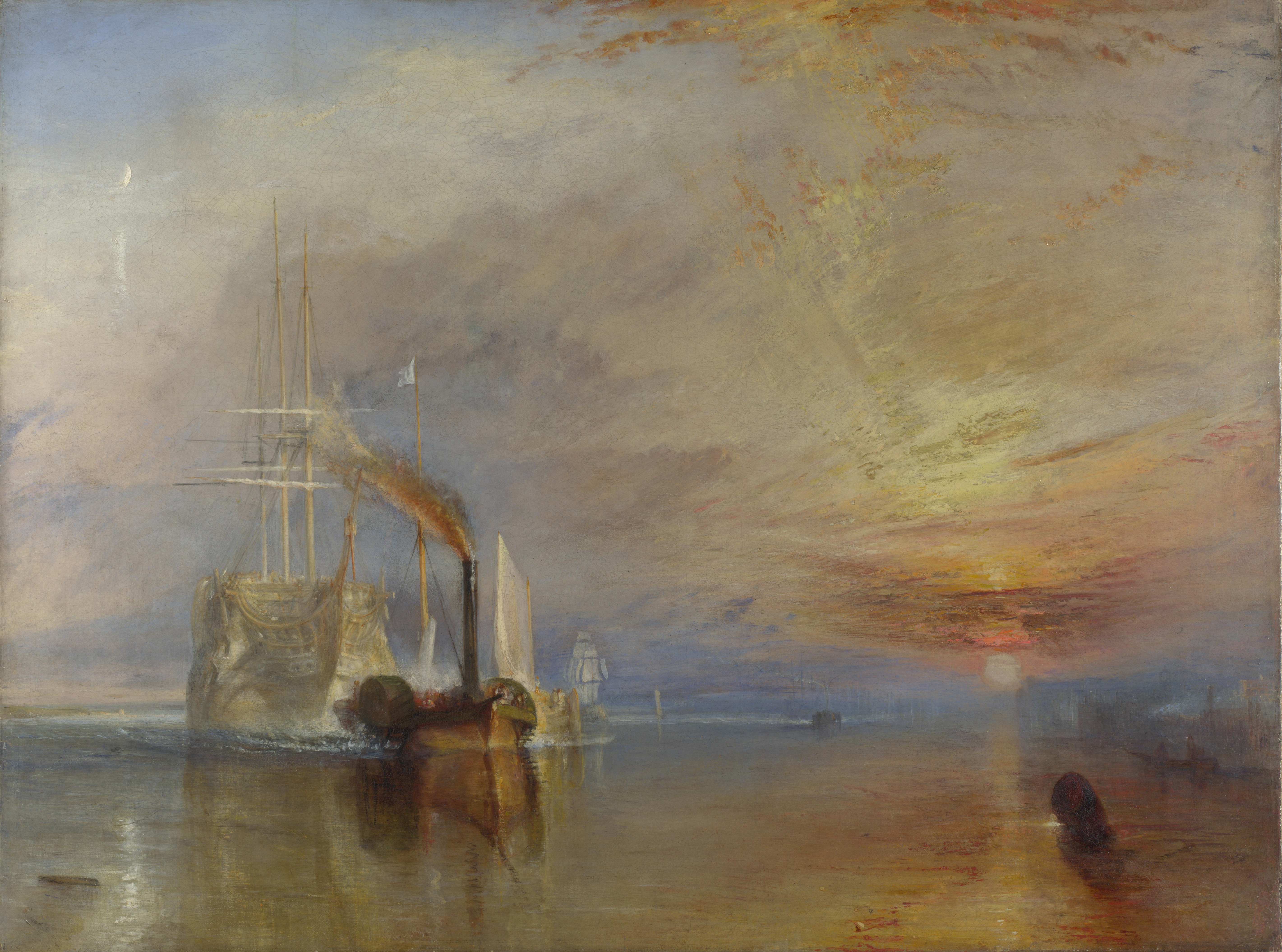
The Fighting Temeraire by JMW Turner
J.M.W. Turner, The Fighting Temeraire, 1839, oil on canvas, 90.7 x 121.6 cm, National Gallery, London

Overview

About This Work

The Fighting Temeraire, Tugged to Her Last Berth to be Broken Up, 1838 (exhibited 1839) is one of J.M.W. Turner's most celebrated and emotionally resonant paintings. Measuring 90.7 x 121.6 cm (oil on canvas), it hangs in the National Gallery in London and has become iconic in British visual culture. The painting depicts the final journey of HMS Temeraire, a legendary 98-gun warship that fought with distinguished valour at the Battle of Trafalgar (1805), where she came to the rescue of Admiral Nelson's flagship Victory. Now over 40 years old and obsolete, the ship is being towed up the River Thames by a paddle-wheel steam tugboat to Rotherhithe in southeast London, where she will be dismantled and broken up for scrap. Turner exercised considerable artistic licence in composing the scene, which was accompanied at its Royal Academy exhibition by lines adapted from Thomas Campbell's poem Ye Mariners of England: "The flag which braved the battle and the breeze, / No longer owns her." The work encapsulates the Romantic era's complex, elegiac response to industrialization and modernity—simultaneously celebrating technological progress while mourning the loss of an heroic past. It represents Turner's most profound meditation on time, mortality, and the relentless march of history.

Visual Analysis

Composition

Unusual Focal Point Placement: The Temeraire—ostensibly the painting's subject—is positioned in the left foreground rather than centred. This unconventional compositional strategy subordinates the ship to the surrounding landscape and atmospheric effects. The ship is visually dominant yet compositionally decentred, creating psychological tension between historical importance and present obsolescence. Triangular Armature: The composition is organized around subtle triangles. The apex of one triangle is formed by distant blue sky and clouds; the base is formed by the river below. A second inverted triangle is created by the horizon line and the positioning of the sunset. These geometric structures provide compositional stability while the emotional content is elegy and loss. Contrast of Scale: The grand, three-masted Temeraire—once a symbol of British naval power—is dwarfed by the surrounding landscape and subordinated to a small, utilitarian steam tug. This scale inversion symbolizes the supersession of the old by the new, the grand by the practical. Spatial Recession: Turner employs atmospheric perspective, with distant ships rendered hazily and indistinctly, while the Temeraire is painted with greater clarity. Small sailing vessels are visible in the distance—a fleet of ships still under sail, creating a visual elegy for the disappearing age of wind power. The Tugboat's Aggressive Position: The small black tugboat dominates the foreground and compositional centre, with its sooty smokestack actively belching orange-red smoke. This industrial machine, not the Temeraire, is given visual prominence, asserting the triumph of steam over sail.

Colour & Light

The Sunset as Symbolic Light: The dominant feature is a blazing golden-orange sunset positioned in the lower right quadrant. This sunset bathes the entire composition in warm, glowing light. The sunset is Turner's most profound symbolic device: as the sun descends, so too does the age of sail decline. The sun's setting literally and figuratively illuminates the Temeraire's final voyage. The Temeraire as Ghostly Apparition: The Temeraire is rendered in ethereal, pale colours—predominantly white, pale grey, and translucent ochre. This spectral colouring makes the ship appear almost unreal, ghostly, already belonging to the past. The contrast between the ghostly Temeraire and the substantial, dark tugboat emphasizes the former's dematerialization. Chromatic Duality: The painting employs strong colour temperature contrast. Warm oranges, yellows, and golds (the sunset, the tug's smoke) dominate the right side; cool blues, purples, and greys dominate the left and upper portions. This creates a visual metaphor for the clash of old (cool, receding) and new (warm, advancing). The Moon as Counterpoint: A slender crescent moon appears in the left sky, casting a pale beam across the water. This moon symbolizes the commencement of a new era—night (industrial age) replacing day (age of sail). The simultaneous visibility of sunset and moon—day and night coexisting—captures the transitional moment. Luminous Smoke: The tugboat's smokestack emits fiery orange-red smoke that plumes backward, drifting across the Temeraire's masts. This smoke is rendered with extraordinary visual intensity, paradoxically beautiful despite its association with industrial pollution. Turner finds aesthetic value in industrial smoke—a radical assertion that modernity is not inherently ugly.

Materials & Technique

Oil Glazing and Atmospheric Depth: Turner employed multiple transparent glazes to achieve the painting's luminous, atmospheric quality. Layers of thin, semi-transparent paint create the sense of light filtering through mist and atmosphere. Visible Brushwork: In the foreground (the tugboat, the Temeraire's rigging), brushwork is more detailed and directional; in the background, brushwork dissolves into atmospheric abstraction. This variation creates visual focus while maintaining overall coherence. Impasto in the Sunset: The sunset's golden hues are applied with heavier impasto, creating texture and suggesting the sun's physical presence and heat. The thick paint captures light, creating actual luminosity on the canvas surface. Deliberate Inaccuracy: Turner deliberately altered nautical accuracy for symbolic effect. Most notably, he positioned the tugboat's smokestack forward of its mast (an impossible design) so that smoke would plume backward across the Temeraire's masts, creating a visual metaphor for industrial smoke consuming the old ship. When the painting was engraved in 1845, the engraver "corrected" this inaccuracy without Turner's knowledge, returning the funnel to proper position—a decision Turner apparently resented.

Historical Context

Context

The Temeraire's Legacy: HMS Temeraire was not merely a ship; it was a national legend. At the Battle of Trafalgar (21 October 1805), under Captain Eliab Harvey, the Temeraire came to the rescue of Nelson's flagship Victory, captured two French vessels (Santísima Trinidad and Redoutable), and was the only ship specifically commended by Admiral Collingwood's despatch. British sailors and the public venerated the Temeraire as exemplifying naval courage and national glory. The Sale and Public Reaction: In 1838, the Admiralty sold the aging Temeraire to a private scrap merchant. The decision provoked public outcry and press coverage expressing nostalgia for Britain's heroic naval past and concern about the disposal of national heritage. Turner likely encountered this discourse and was moved by the ship's fate. The Transition from Sail to Steam: The painting captures a pivotal historical moment—the transition from wooden sailing ships to steam-powered iron vessels. By 1838, steam power was becoming dominant in the Royal Navy, yet many still romanticized the age of sail as an era of greater courage, skill, and heroism. The Temeraire's scrapping symbolized the obsolescence of an entire naval and historical era. Industrial Modernity and British Identity: The 1830s–1840s saw Britain's unprecedented industrial expansion. The Great Western Railway (which Turner also painted) and steam shipping transformed commerce and travel. Yet this progress provoked anxiety and nostalgia—a sense that something noble and irreplaceable was being lost. The Temeraire embodies this ambivalence. Patriotic Sentiment: Turner, who had "a strong patriotic streak," painted the work during a period of British imperial confidence. Yet the painting is not triumphalist; it mourns even as it acknowledges inevitability. This nuanced patriotism—celebrating Britain's past glory while accepting historical change—resonates with Romantic philosophy.

Key Themes

Connection to Nature and War (Heroism, Historical Time, Industrial Progress)

Nature vs. Civilization: The painting positions the natural world (the river, sky, weather) as witness to historical change. The timeless river receives the Temeraire for her final voyage, suggesting nature's indifference to human historical dramas. The Sublime Transformed: Unlike the terrible, overwhelming sublime of Turner's earlier seascapes, The Fighting Temeraire presents a melancholic, elegiac sublime. The beauty of the sunset does not inspire terror but sadness—beauty intertwined with loss. Heroism and Obsolescence: The Temeraire embodies martial heroism and national glory, yet both are rendered obsolete by technological change. The painting asks: Can heroism survive industrialization? Or must the old be sacrificed to progress? Mortality and Impermanence: The ship's final voyage mirrors human mortality—even great, celebrated beings must eventually decline and perish. Some scholars interpret the Temeraire as a self-portrait of the aging Turner contemplating his own mortality and artistic legacy.

Exam Focus Points

Critical Perspectives

Nostalgia vs. Progress: The dominant historical interpretation reads The Fighting Temeraire as elegiac—mourning the loss of an heroic age superseded by industrial modernity. Yet art historian Matt Wilson has challenged this reading, arguing that Turner was celebrating modernity and progress, finding beauty in steam power and mechanical achievement. Wilson contends that Turner deliberately rejected traditional artistic values in favour of embracing "the beauty and grandeur of modern experience." This interpretive debate is crucial for A Level essays: is Turner nostalgic or progressive? The Tugboat as Villain or Hero: Conventional interpretation casts the tugboat as a menacing intruder, the agent of obsolescence. Yet the tugboat is also beautiful—rendered in warm, glowing light by the sunset, suggesting the artist's aesthetic regard for industrial technology. Turner suggests that the tugboat will itself eventually be superseded, implying an endless cycle of replacement and obsolescence. Artistic Licence and Truth: Turner dramatically altered historical and geographical accuracy—the sun sets in the wrong direction; the tugboat's funnel is impossibly positioned; the ship's masts may not have been intact when towed. Does this artistic licence undermine the painting's truth-value? Or does it serve a higher poetic truth? This raises philosophical questions about the relationship between aesthetic and factual truth. Literary Allusion and Meaning: The accompanying lines from Campbell's poem establish a nationalistic, elegiac framework. The phrase "no longer owns her" emphasizes loss of ownership, control, and dignity. Yet Turner himself transformed the painting into something more complex than a simple elegy. Comparison to Industrial Culture: The painting stands alongside contemporary industrial imagery (Gustave Doré's engravings, early photographs of industrial sites) as attempts to aestheticize industrial modernity. Turner, like these other artists, struggled to reconcile 19th-century faith in progress with emotional attachment to the pre-industrial past. Gender and the Ship: The Temeraire is gendered feminine ("she," "her")—a common convention for ships. Some feminist scholars note that the feminized ship is rendered passive, vulnerable, and subject to masculine technological power (the tugboat). This gendered dimension merits critical consideration.

On this page

OverviewVisual AnalysisHistorical ContextKey ThemesExam Focus Points