History o' Phoeart
  • Home

Nature

  • Overview
  • Landscape or Seascape in 2D
  • Animals in 2D or 3D
  • The Elements (Fire, Water, Wind or Earth) in 2D or 3D
  • The Relationship between Man/Woman and Nature in 2D or 3D

Identity

  • Overview
  • The Divine in 2D or 3D Works
  • Portraits in 2D Works
  • Portraits in 3D Works
  • Gender Identity in 2D or 3D Works

Renaissance

  • Overview
  • Religious Painting
  • Religious Sculpture
  • Mythological in 2D or 3D
  • Portraits in 2D or 3D

Baroque

  • Overview
  • Religious Painting
  • Religious Sculpture
  • Mythological Painting
  • Mythological Sculpture

About

A comprehensive study resource for Pearson Edexcel History of Art A-Level.

NatureIdentityRenaissanceBaroque

History o' Phoeart - A-Level Study Resource

Pearson Edexcel Specification • Use ⌘K to search

  1. Home
  2. Paper 1
  3. Nature
  4. The Elements (Fire, Water, Wind or Earth) in 2D or 3D
  5. Rain, Steam and Speed
Paper 1Nature
Nature
Landscape or Seascape in 2D
Animals in 2D or 3D
The Elements (Fire, Water, Wind or Earth) in 2D or 3D
Pre-1850
Rain, Steam and Speed

Rain, Steam and Speed

JMW Turner

The Fighting Temeraire

The Fighting Temeraire

JMW Turner

Post-1850
Non-Western
The Relationship between Man/Woman and Nature in 2D or 3D
Plants in 2D or 3D
Architecture

6 scopes • 24 artworks

Rain, Steam and Speed

JMW Turner, 1844
NaturePre-1850
Rain, Steam and Speed by JMW Turner
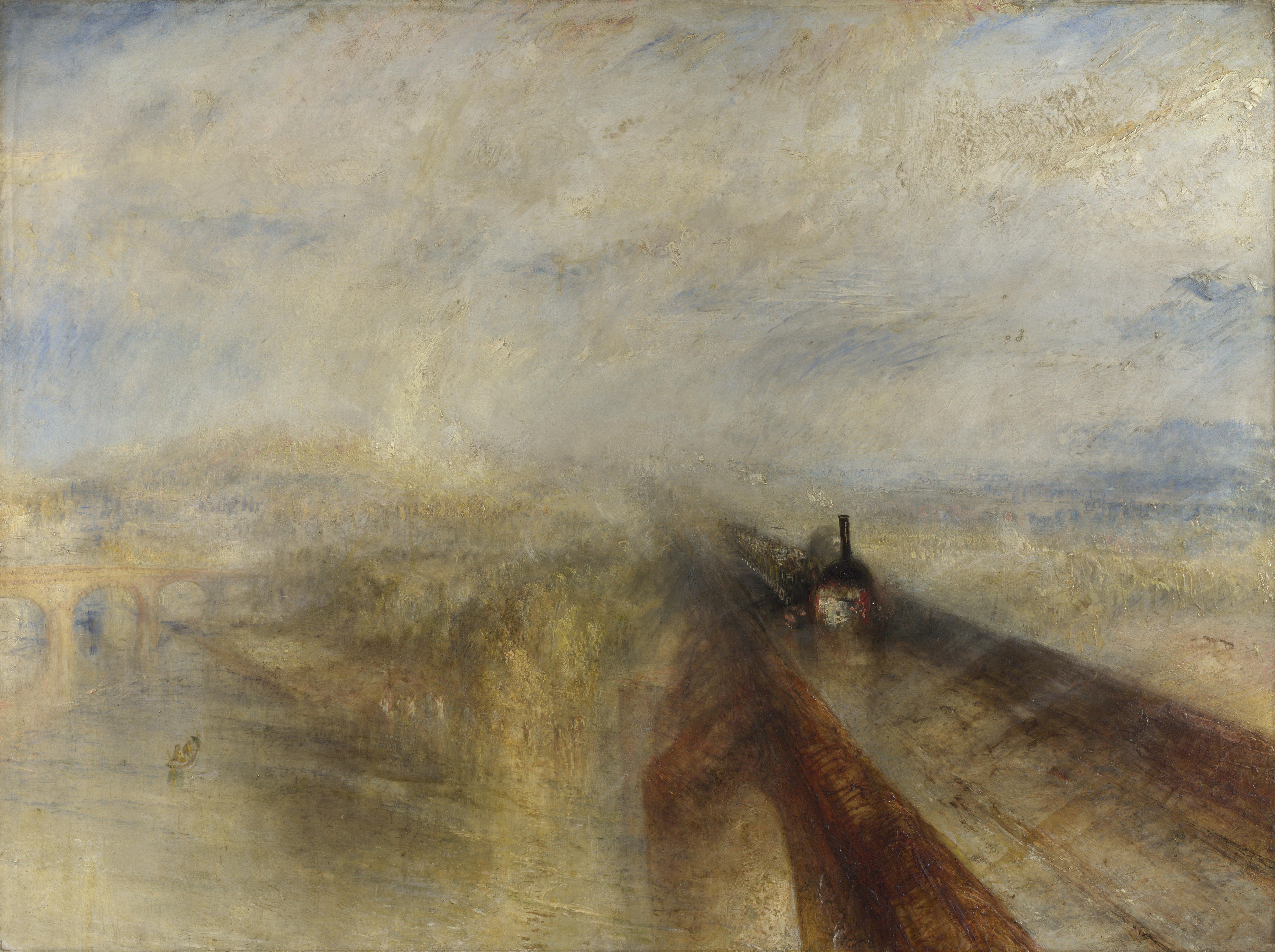
J.M.W. Turner, Rain, Steam and Speed—The Great Western Railway, 1844, Oil on canvas, 91 × 121.8 cm, National Gallery, London

Overview

About This Work

Rain, Steam and Speed—The Great Western Railway (1844) is a monumental expression of Turner's late-career engagement with modernity, industrialization, and the sublime. Painted when Turner was 69 years old, it measures 91 × 121.8 cm (oil on canvas) and hangs in the National Gallery in London. The painting depicts a steam locomotive of the Great Western Railway emerging through rain and mist as it crosses the Maidenhead Railway Viaduct, an engineering marvel designed by the legendary engineer Isambard Kingdom Brunel (completed in 1839). The viaduct spans the River Thames between Taplow and Maidenhead, and the viewer's perspective is positioned as if standing on the viaduct, watching the train approach at extraordinary speed. Turner includes a hare on the track—an animal traditionally symbolic of swiftness—racing to escape the oncoming train, creating an implicit commentary on the contest between natural and mechanical speed. The painting exemplifies Turner's mature Romantic vision, where the Sublime is transferred from untamed nature to industrial technology. It represents Turner's complex, ambivalent response to technological progress: the train is both terrifying and magnificent, a demonstration of human ingenuity that paradoxically dissolves form into atmosphere.

Visual Analysis

Composition

Mathematical One-Point Perspective: The composition employs exaggerated linear perspective, with orthogonal lines (the rails, the edges of the viaduct) converging toward a vanishing point in the distance. This mathematical construction creates a sense of inexorable forward motion and forces the viewer's eye to follow the train's trajectory into the receding landscape. Steep Foreshortening: The viaduct is rendered with extreme foreshortening, compressing spatial distance and creating the impression of the train erupting into view with violent velocity. The exaggeration of perspective heightens the sensation of speed and danger. The Train as Focal Point: The steam engine is positioned slightly left of centre, rendered in small red spots and dark lines barely distinguishable from the surrounding atmospheric haze. This apparent "incompleteness" paradoxically intensifies the train's presence—it dominates the composition despite its minimal definition, suggesting its overwhelming power. The Hare: A small hare (now nearly invisible due to paint transparency with age) was sketched midway along the track, positioned as though fleeing the oncoming train. This anecdotal detail introduces narrative tension: will natural speed (the hare) outrun mechanical speed (the train)? The answer is implicit—it will not. Layered Atmospheric Zones: The composition creates distinct atmospheric layers: the foreground (with the bridges and track rendered in dark browns), the middle ground (where rain obscures form), and the distant background (where sky and water merge indistinguishably). Each zone exhibits different degrees of atmospheric dissolution.

Colour & Light

The Gold, Blue, and Brown Triad: Turner employs his signature late palette of golden yellows (suggesting sunlight breaking through clouds), ultramarine and cobalt blues (the dark stormy sky), and browns and ochres (the solid viaduct and industrial architecture). This restricted palette unifies the composition while creating dramatic tonal and chromatic contrast. Luminous Dissolution: The upper two-thirds of the canvas is dominated by atmospheric effects—rain, mist, and light—rendered in pale yellows, greys, and translucent whites. Form dissolves into colour and atmosphere; the boundary between sky, rain, and steam becomes indeterminate. This optical effect suggests the eye's inability to focus clearly during intense atmospheric turbulence. Chromatic Contrast: The dark, substantial bridge and the surrounding rain create strong contrast with the luminous yellows and whites of the breaking sunlight. This contrast between solidity and ephemerality, darkness and light, mirrors the thematic tension between mechanical industrial power and natural atmospheric forces. The Red Engine: The engine is suggested by small spots of red paint, creating a demonic quality. The red pierces the surrounding pallid greys and whites, drawing the eye and emphasizing the train's aggressive penetration through the landscape.

Materials & Technique

Palette Knife Application: Turner applied paint with extraordinary directional energy using a palette knife, creating thick impasto in the central areas (the viaduct, the train) and thinner, more translucent applications in atmospheric zones. The palette knife technique produces broad, slashing strokes that suggest movement and urgency. Visible Brushwork and Process: The painting's surface is deliberately visible and unfinished in appearance. Thick, smeary lumps of chrome yellow create the scintillating light; dabs of putty-coloured paint suggest rain; broad sweeps of translucent colour evoke atmosphere. This visibility of process demonstrates Turner's late-career embrace of painterly abstraction—the painting is as much about the application of paint as about the depicted subject. Layered Transparency: Turner employed multiple transparent glazes, allowing underlying colours to show through thin applications. This creates optical colour mixing and suggests the eye's perception of light filtering through rain and mist. Industrial Materials: Turner used modern synthetic pigments—chrome yellow (recently developed), Prussian blue, and other industrial colours—reflecting his engagement with contemporary technological innovation. The painting's material composition thus mirrors its thematic content (industrial progress).

Historical Context

Context

The Railway Age: Painted in 1844, when railways were rapidly transforming the British landscape, Rain, Steam and Speed captures a moment of dramatic social and technological change. The Great Western Railway opened in 1838; by the 1840s, railways were revolutionizing transport, commerce, and human experience. Travel that once took days by horse now took hours by train. Brunel's Engineering Marvel: The Maidenhead Viaduct, designed by Isambard Kingdom Brunel, was an engineering sensation. Built with only two arches spanning nearly 130 metres—at the time, the widest and flattest arches ever constructed—it was controversial. Critics predicted it would collapse; the engineer left wooden scaffolding (eventually removed) to reassure doubters. Turner's emphasis on this bridge signals recognition of its technological achievement. Public Fear of Railways: Despite their promise, railways provoked anxiety and terror in the public imagination. Passengers travelled in open-air carriages exposed to the elements; train crashes resulted in horrific deaths; speeds of 40–50 mph seemed unnatural and dangerous. Turner's painting captures this ambivalence—the train is sublime and terrifying simultaneously. Turner's Personal Engagement: Anecdotes (recorded by Ruskin) suggest Turner witnessed a train in a rainstorm firsthand. Mrs. Simon reported that "a kind-looking old gentleman" (Turner) put his head out of the window of a moving train during a torrential downpour for nearly nine minutes to experience the sensation. Turner was not rejecting modernity but celebrating it with characteristic intensity. Turner as Shareholder: Turner was a small shareholder in the Great Western Railway, demonstrating his financial engagement with industrial progress rather than nostalgic opposition to it.

Key Themes

Connection to Nature and War (Human Power vs. Natural Forces)

The Sublime Transferred to Industry: Edmund Burke and other 18th-century theorists associated the Sublime with overwhelming natural phenomena—storms, mountains, vast empty spaces. Turner transfers this Sublime to industrial technology. The train, belching steam and hurtling through rain, becomes a force of nature—powerful, dangerous, and awe-inspiring. Speed as Transcendence: The painting celebrates speed as a form of human transcendence—the ability to move through space with unprecedented rapidity, to overcome natural distance and time. Yet speed also threatens to dissolve the self; at extreme velocities, perception becomes difficult, form dissolves, and individual identity merges with atmospheric forces. Nature and Machine Analogized: Turner's use of atmospheric abstraction creates a visual analogy between natural forces (rain, wind, mist) and mechanical forces (steam, motion, industrial power). The boundary between natural and mechanical becomes indistinguishable; both are manifestations of sublime energy. Progress and Loss: The painting is ambivalent about industrialization. The train is magnificent but also monstrous. The hare fleeing the oncoming engine suggests the "natural" world dispossessed and destroyed by mechanical progress. There is nostalgia for what is being lost even as the painting celebrates what is being gained.

Exam Focus Points

Critical Perspectives

The Hare as Symbolic Resistance: The hare's presence introduces narrative ambiguity. Is it a symbol of natural world destroyed by industrialization? Or a celebration of natural speed being superseded by mechanical speed? The painting accommodates both readings, creating productive interpretive tension. Abstraction and Modernity: Art historian Michael Fried argues that Turner's late work anticipates modernist abstraction. By dissolving form into colour and atmosphere, Turner suggests that the painting's primary subject is not the depicted landscape but the artist's subjective perception and the paint itself. This self-reflexivity is fundamentally modernist. Sublimity and Terror: Critic John Gage notes that Turner's title explicitly names three terms—rain, steam, speed—but does not impose hierarchy or moral judgment. The painting presents these forces as equivalent and coequal. The ambiguous relationship between these three suggests that technological progress and natural turbulence are inseparable. Comparison to Constable: This painting offers striking contrast to Constable's Hay Wain. Where Constable celebrates rural labour and agricultural continuity, Turner embraces industrial transformation. Where Constable privileges naturalistic observation, Turner privileges atmospheric abstraction. These represent two fundamentally different Romantic visions. Marxist Interpretation: Some critics (following art historian T.J. Clark) interpret the hare and the dissolving landscape as expressions of industrial alienation—the destruction of traditional rural England and the dispossession of labour by mechanical power. The painting's visual dissolution reflects this social dissolution. Turner's Late Style and Reception: Contemporary critics were bewildered by Turner's late work. The Royal Academician reputedly left a painting with nearly blank canvas (except for a sunset), prompting critic to ask if Turner intended the canvas to be left unpainted. Rain, Steam and Speed was regarded as unfinished, yet Turner's abstraction was deliberately conceived. This raises questions about how aesthetic standards change across time.

On this page

OverviewVisual AnalysisHistorical ContextKey ThemesExam Focus Points