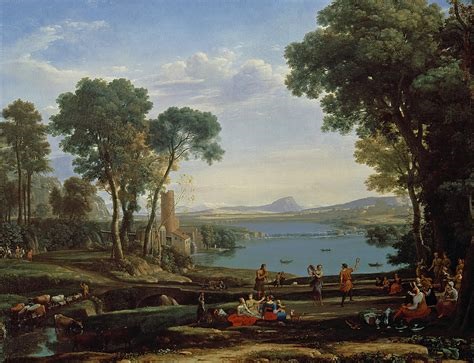
Landscape with Marriage of Isaac and Rebecca
Claude Lorrain, 1648
NaturePre-1850
Overview
About This Work
Also known as "The Mill" (Il Mulino), this painting (1648) is a quintessential example of Classical Landscape or "Ideal Landscape." While the title references a biblical story from Genesis 24 (the wedding of Isaac and Rebekah), the narrative is secondary to the celebration of the natural world. The figures are diminutive, serving primarily to populate a vast, poetic vision of the Roman Campagna. It was commissioned by the Duc de Bouillon, a general in the Papal army, and is one of the most famous pairings in art history, created alongside Seaport with the Embarkation of the Queen of Sheba.
Visual Analysis
Composition
Claude utilises a formulaic but highly effective "coulisse" composition (theatre wings). Dark, framing trees on the left and right act as repoussoir elements, pushing the viewer's eye into the illuminated central distance.
Geometry: The composition is stabilized by the "Golden Section." The horizon line is placed roughly two-thirds down the canvas, giving dominance to the sky.
The S-Curve: A winding river leads the eye in a meandering path (a serpentine line) from the foreground through the middle ground (the mill) to the distant mountains, creating a deep sense of recession.
Balance: The mass of trees on the left is balanced by the solid architecture of the watermill on the right.
Colour & Light
Claude is the master of aerial perspective.
Palette: He uses a restricted palette of earth tones (greens, browns, ochres) in the foreground, transitioning to cool blues and silvers in the background to suggest vast distance.
Unifying Light: The painting is bathed in a warm, golden, morning light (unlike its pendant, the Seaport, which depicts evening). The sun is not directly visible but its presence unifies the entire scene, dissolving sharp outlines in the distance—a technique known as sfumato applied to landscape.
Tonal Values: The foreground is dark (shadowed by trees) to contrast with the luminous background, enhancing the illusion of depth.
Materials & Technique
Medium: Oil on canvas. Claude used thin, semi-transparent layers of paint (glazes) to achieve his characteristic luminosity and the glowing effects of the sky.
Process: Unusually for his time, Claude sketched outdoors (en plein air) in the Roman countryside using pen and wash to capture lighting effects, but the final oil painting was composed in the studio.
Liber Veritatis: Claude recorded this composition as drawing No. 113 in his Liber Veritatis (Book of Truth), a sketchbook he kept to track his works and protect against forgeries—a key evidence of his commercial success and methodical practice.
Historical Context
Context
The Artist: Claude Lorrain (c. 1600–1682) was a French Baroque artist who spent most of his life in Rome. He elevated the status of landscape painting, which was previously considered a "lesser" genre than history painting. By adding biblical or mythological titles, he gave his landscapes the intellectual weight required by 17th-century patrons.
The Period: Created in 1648, a time of political turbulence (the end of the Thirty Years' War), this image offers a vision of peace and harmony. It reflects the 17th-century yearning for a "Golden Age" of antiquity.
Commission: Originally intended for Cardinal Camillo Pamphili (who scandalously resigned his cardinalship to marry), it was eventually completed for the Duc de Bouillon.
Key Themes
Connection to Nature
This work defines the "Ideal Landscape" (Arcadia).
Benevolent Nature: Nature is depicted not as wild or threatening (as in the Romantic sublime), but as tamed, habitable, and harmonious. It is a garden-like paradise where humans coexist peacefully with their environment.
Constructed Reality: The landscape is "improved" upon; Claude selects the most beautiful elements of the real world (a tree from here, a rock from there) and reassembles them into a perfect whole. It is conceptual nature rather than topographical nature.
The Watermill: The mill itself represents the harnessing of nature (water) for human benefit, reinforcing the theme of harmony between man and the land.
Exam Focus Points
Critical Perspectives
The Turner Connection: J.M.W. Turner admired Claude so intensely that in his will (the Turner Bequest), he stipulated that two of his own paintings must hang permanently alongside two of Claude's (including this one) in the National Gallery, inviting a direct comparison of their mastery of light.
John Ruskin: The Victorian critic Ruskin was critical of Claude, arguing that his "idealisation" led to botanical inaccuracies and a lack of specific "truth to nature." He famously compared Claude's generalized foliage unfavourably to the specific realism of the Pre-Raphaelites.
Narrative vs. Genre: Critics often argue the biblical title is merely a "pretext." The inscription is on a tree stump, but the "marriage" itself is hard to locate among the dancing figures. This signals a shift in Art History where the mood of the landscape becomes more important than the story it tells.