History o' Phoeart
  • Home

Nature

  • Overview
  • Landscape or Seascape in 2D
  • Animals in 2D or 3D
  • The Elements (Fire, Water, Wind or Earth) in 2D or 3D
  • The Relationship between Man/Woman and Nature in 2D or 3D

Identity

  • Overview
  • The Divine in 2D or 3D Works
  • Portraits in 2D Works
  • Portraits in 3D Works
  • Gender Identity in 2D or 3D Works

Renaissance

  • Overview
  • Religious Painting
  • Religious Sculpture
  • Mythological in 2D or 3D
  • Portraits in 2D or 3D

Baroque

  • Overview
  • Religious Painting
  • Religious Sculpture
  • Mythological Painting
  • Mythological Sculpture

About

A comprehensive study resource for Pearson Edexcel History of Art A-Level.

NatureIdentityRenaissanceBaroque

History o' Phoeart - A-Level Study Resource

Pearson Edexcel Specification • Use ⌘K to search

  1. Home
  2. Paper 1
  3. Nature
  4. Landscape or Seascape in 2D
  5. Seaport with Embarkation of Queen of Sheba
Paper 1Nature
Nature
Landscape or Seascape in 2D
Pre-1850
Landscape with Marriage of Isaac and Rebecca

Landscape with Marriage of Isaac and Rebecca

Claude Lorrain

Seaport with Embarkation of Queen of Sheba

Seaport with Embarkation of Queen of Sheba

Claude Lorrain

Slavers Throwing Overboard the Dead and the Dying – Typhoon Coming On

Slavers Throwing Overboard the Dead and the Dying – Typhoon Coming On

JMW Turner

The Haywain

The Haywain

John Constable

Post-1850
Non-Western
Animals in 2D or 3D
The Elements (Fire, Water, Wind or Earth) in 2D or 3D
The Relationship between Man/Woman and Nature in 2D or 3D
Plants in 2D or 3D
Architecture

6 scopes • 24 artworks

Seaport with Embarkation of Queen of Sheba

Claude Lorrain, 1648
NaturePre-1850
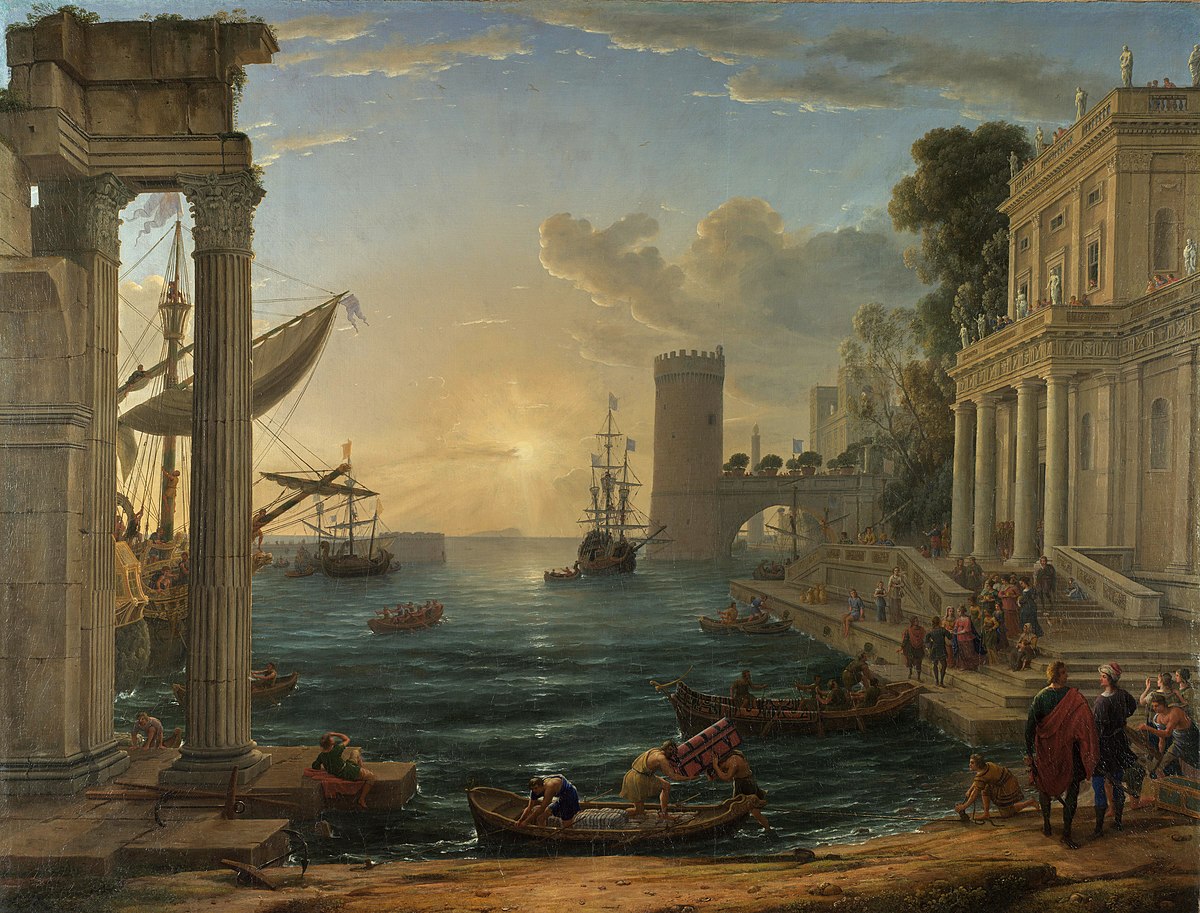
Seaport with Embarkation of Queen of Sheba by Claude Lorrain
Seaport with the Embarkation of the Queen of Sheba, 1648. Oil on canvas, 149.1 × 196.7 cm. National Gallery, London.

Overview

About This Work

This painting (1648) depicts the departure of the Queen of Sheba to visit King Solomon in Jerusalem, as recounted in the Old Testament (1 Kings 10:1–2). However, Claude has fundamentally transformed the biblical account: the Queen originally travelled overland by camel; here, she departs by sea from a classical port city. This reimagining exemplifies Claude's method of subordinating historical accuracy to poetic vision. Commissioned by the Duc de Bouillon alongside Landscape with the Marriage of Isaac and Rebecca, this painting was acquired by the National Gallery in 1824 as one of its founding purchases from the prestigious Angerstein collection. At approximately 1.94 x 1.49 metres, it is one of Claude's grandest seaport compositions and stands as a masterwork of his maturity.

Visual Analysis

Composition

Claude employs a radically different compositional strategy from its companion piece, yet both share underlying architectural principles. The Vertical Division: The canvas is divided by a strong vertical line of perspective—the left colonnade of the classical palace—which intersects with a horizontal line (the embarkation steps) on the right. This creates a dynamic tension rather than the gentle recession of the Marriage painting. The Sun as Compositional Centre: The sun itself (positioned at the exact mathematical centre of the canvas, halfway up) functions as the primary compositional anchor. All receding lines of the quays, steps, and vessels direct the eye toward this solar focal point on the horizon. Layered Depth: The composition operates in distinct planes: foreground (architectural steps and figures), middle ground (the busy harbour with vessels), and background (the open sea and horizon). Each layer is meticulously rendered to suggest vast spatial recession. Symmetry and Balance: Unlike the asymmetrical wilderness of the Marriage painting, this composition is deliberately balanced—classical palaces frame both left and right, creating a sense of civic order and human civilisation.

Colour & Light

This painting represents Claude's most sophisticated mastery of light as subject matter. Sunrise Light: Unlike the Marriage painting's warm afternoon glow, this depicts early morning light—a horizon sun with sharp, pencil-like rays that penetrate the atmosphere. The light is cooler, clearer, and more directional than the diffused glow of evening. Atmospheric Perspective: The foreground uses warmer ochres and browns; the middle distance transitions to cool silvers and greys; the far distance becomes almost monochromatic blue. This creates a convincing illusion of vast distance. Reflection and Refraction: The sun's rays are reflected as a shimmering pathway across the water toward the viewer, and each ripple catches the light. Claude's fingerprints are visible in the sky where he personally smoothed paint transitions—an unusually intimate detail revealing his technical process. Chiaroscuro: The buildings are rendered in strong light and shadow. The columned palace on the left is partially illuminated, with deep shadows on its unlit side. This creates sculptural volume and architectural grandeur.

Materials & Technique

Canvas Scale: The large format (c. 194 x 149 cm) allowed Claude to achieve his characteristic combination of precision and atmospheric poetry. Half the canvas is devoted to the sky—a signature device. Glazing Method: Claude built his luminosity through multiple transparent layers of paint (oils mixed with varnish). The sky and water appear to glow from within, not merely reflect external light. Liber Veritatis: This painting is documented as entry LV 114 in Claude's Liber Veritatis, his hand-drawn registry. Scholars note that the painting is "more masterly in atmospheric subtleties, spatial arrangement, and simplification of forms" compared to his earlier seaports (c. 1638). Impasto and Detail: While the distant sky is thinly glazed, the architectural details in the foreground show visible brushwork and heavier paint application, drawing the eye to the human narrative.

Historical Context

Context

Commissioning: The Duc de Bouillon (1605–1652), a French general in the Papal army, commissioned both paintings as a matched pair. Notably, his name is inscribed on the embarkation steps (bottom right corner), and his personal emblem—a round tower—appears on the right palace, asserting his proprietary connection to the image. The Seventeenth-Century Imagination: In 1648, Europe was emerging from the Thirty Years' War. This painting offers a vision of orderly, peaceful civilization—a harbour humming with commerce and courtly ceremony. It reflects aristocratic fantasies of an idealized antiquity where order, beauty, and prosperity coexist. Rome as Model: Claude had lived in Rome since childhood and drew extensively from classical ruins, Italian harbours (particularly Naples), and the Roman countryside. While this composition is imaginative, its classical vocabulary is grounded in his intimate knowledge of antique architecture. Narrative Innovation: Most depictions of the Queen of Sheba showed her meeting Solomon. Claude's choice to paint her departure is unusual and reveals his prioritization of poetic atmosphere over narrative completeness.

Key Themes

Connection to Nature

This work extends the "Ideal Landscape" into the realm of maritime civilization. Controlled Water: Unlike the untamed seas of later Romantic painters (e.g., Turner, whose seascapes show turbulent oceans), Claude's sea is calm, navigable, and hospitable. Water is depicted as a connector of cultures, not a barrier. Architecture as Second Nature: The classical buildings are rendered with the same luminous beauty as natural features. They suggest that human civilization—when ordered by classical proportion—harmonises with rather than dominates nature. Harmony of Human and Environment: The figures are busy yet unhurured. Goods are loaded, the Queen awaits her vessel, sailors work—all within a framework of tranquility. This is Arcadian commerce: labour without toil.

Exam Focus Points

Critical Perspectives

The Turner Rivalry: J.M.W. Turner so admired this painting that he requested two of his own seascapes hang permanently beside Claude's works in the National Gallery. Turner's Ulysses Deriding Polyphemus (1829) directly references this composition, using similar golden light but infusing it with Romantic drama. Examiners often set "compare and contrast" questions on Claude and Turner, making this pairing essential knowledge. The Question of "Idealisation": John Ruskin famously criticized Claude for "falsifying" nature through excessive beautification. He argued that the Queen of Sheba travelled by land with camels, not by sea—thus Claude's transformation was historically dishonest. Ruskin championed Pre-Raphaelite "truth to nature" over Claude's poetic licence. This debate remains central to A Level assessment, asking students to consider: Is artistic beauty achieved through selective imagination permissible, or is fidelity to factual detail essential? Figural Subordination: While this painting includes more human figures than the Marriage painting, they remain subordinate to the landscape and architecture. The Queen—supposedly the subject—is difficult to locate without close study. Critics debate whether this reflects misogyny, or whether it exemplifies Claude's philosophy that individual human narratives matter less than the universal beauty of the created world. Colonial Reading: Modern scholars (such as K.D. Kriz) have revisited this painting through a postcolonial lens, noting that it depicts a non-European queen assimilated into a European (Roman) architectural and compositional framework. The historical Queen of Sheba (possibly from Ethiopia/Arabia) is erased and replaced by a Europeanized fantasy. This provides rich material for contemporary critical essays examining power, representation, and the gaze of Western art history.

On this page

OverviewVisual AnalysisHistorical ContextKey ThemesExam Focus Points