Birth of Venus
Botticelli, c.1485
Overview
About This Work
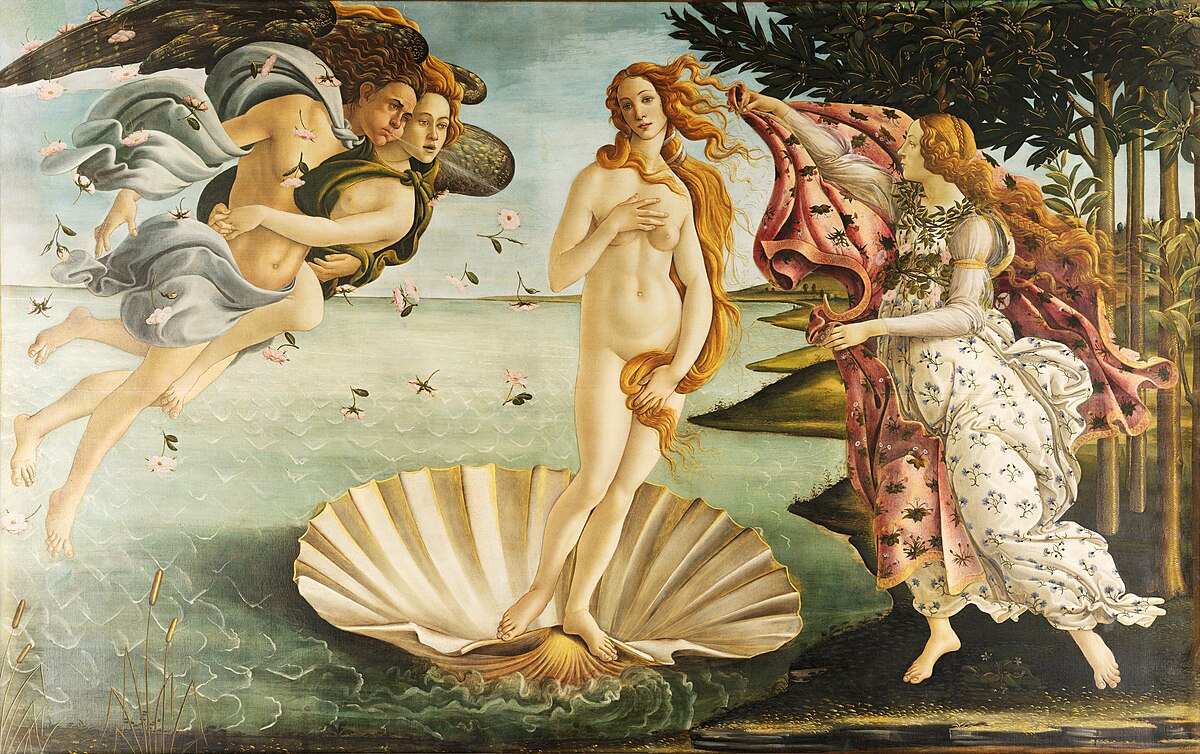
The Birth of Venus (Italian: La Nascita di Venere) is a monumental tempera on canvas painting by the Florentine master Sandro Botticelli (c. 1445–1510), created around 1485 and now housed in the Uffizi Gallery in Florence. Measuring 172.5 × 278.9 centimetres, it is a wide, horizontal composition—a format more commonly used for decorative panels destined for noble households than for tempera painting. The work depicts the moment when Venus, the goddess of love and beauty, arrives at the island of Cyprus after being born from sea foam and blown ashore by the wind god Zephyr. She stands in serene nakedness upon a giant golden scallop shell, her body modeled on classical sculpture yet rendered with an ethereal luminosity unique to Botticelli. The painting is a masterpiece of Renaissance synthesis: classical mythology, Neoplatonic philosophy, humanist learning, and technical virtuosity combine to create one of the most iconic and enigmatic images in Western art. It was commissioned by a young member of the Medici family, likely with the intellectual guidance of the humanist poet Angelo Poliziano. The work operates on multiple levels—as classical allegory, as theological statement about divine love arriving in the world, as celebration of feminine beauty, and as an image of spiritual awakening through love. Its influence on subsequent generations of artists, particularly the Venetian tradition of sensuous female nudes, was profound and lasting.