History of (tagg)Art...
HomeNatureIdentityRenaissanceBaroque

Nature

  • All Nature artworks
  • Landscape or Seascape in 2D
  • Animals in 2D or 3D
  • The Elements (Fire, Water, Wind or Earth) in 2D or 3D
  • +3 more topics

Identity

  • All Identity artworks
  • The Divine in 2D or 3D Works
  • Portraits in 2D Works
  • Portraits in 3D Works
  • +3 more topics

Renaissance

  • All Renaissance artworks
  • Religious Painting
  • Religious Sculpture
  • Mythological in 2D or 3D
  • +3 more topics

Baroque

  • All Baroque artworks
  • Religious Painting
  • Religious Sculpture
  • Mythological Painting
  • +6 more topics

About

A comprehensive study resource for Pearson Edexcel History of Art A-Level.

NatureIdentityRenaissanceBaroque

History of (tagg)Art... - A-Level Study Resource

Pearson Edexcel Specification

Admin
  1. Home
  2. Renaissance
  3. Mars and Venus

Mars and Venus

Botticelli, c.1485
RenaissanceMythological in 2D or 3DFlorence
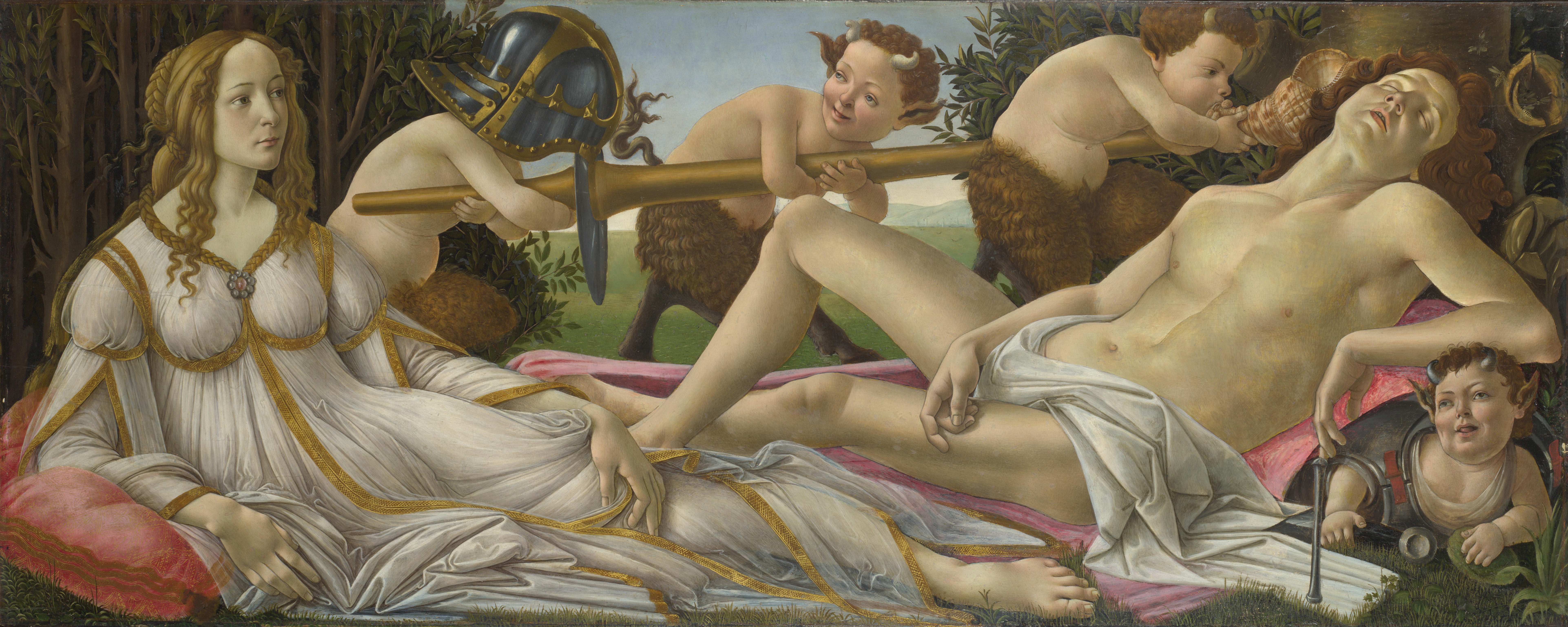
Mars and Venus by Botticelli
Venus and Mars, Sandro Botticelli, c. 1485, tempera and oil on poplar panel, 69 × 173 cm, National Gallery, London

Overview

About This Work

Venus and Mars (also called Mars and Venus) is a tempera and oil panel painting by the Florentine Renaissance master Sandro Botticelli (c. 1445–1510), created around 1485 and now housed in The National Gallery, London. The work measures 173 × 69 centimetres—a distinctly wide, horizontal format suggesting original placement as decoration for a wedding chamber or above a nuptial bed. The painting depicts the moment immediately after the goddess Venus and the god Mars have made love, with Venus alert and watchful while Mars lies in deep, unconscious sleep. Four playful satyrs cavort around the sleeping god, playing with his abandoned weapons and armor, creating a scene that is simultaneously erotic, humorous, and deeply allegorical. The work is a masterpiece of Florentine Renaissance sensibility, combining classical mythology with Neoplatonic philosophy, humanist learning, and wedding-chamber humor. It represents love triumphing over war, beauty conquering violence, and—more ambiguously—the emasculating power of female sexuality over male martial prowess.

Visual Analysis

Composition

The painting presents a remarkably simple yet sophisticated composition: two reclining figures opposite each other in a shallow, intimate space. Venus reclines on the left in an elegant, controlled pose, while Mars sprawls on the right in a state of complete unconsciousness. The horizontal format emphasizes the equality and intimacy of the two figures while allowing the wide landscape to extend behind them. **Venus:** Fully dressed in an elaborate white gown with gold trim and jewelry. Her hair is carefully braided and pinned with ornaments, emphasizing wealth and—crucially—modesty. Her body is turned to face Mars, yet her expression is alert and dignified. Her gaze rests upon the sleeping god with a calm, knowing look—the expression of one who understands the power she possesses. **Mars:** Nearly nude, covered only by a white loin cloth and a red cloak serving as a bed. His body is rendered with extraordinary anatomical precision—every muscle is defined, showing Botticelli's study of classical sculpture. Yet this perfect, idealized male form is utterly vulnerable. His mouth is slightly agape in what appears to be a snore; his eyes are closed in deep sleep. **The Four Satyrs:** Half-human, half-goat creatures surrounding Mars embody chaos and animal appetite. One wears Mars's helmet, another holds the lance, a third crawls inside his breastplate, and a fourth blows a conch shell into his ear—yet Mars remains utterly oblivious.

Colour & Light

The colors are bright and clear: blues, greens, whites, and golds typical of Renaissance tempera painting. Venus's white gown with gold trim contrasts with Mars's exposed flesh tones against the red cloak beneath him. The myrtle grove behind the figures—sacred to Venus in classical tradition—provides a dark green backdrop that frames the pale figures. Beyond, a pastoral landscape extends into the distance with soft atmospheric perspective. The lighting is even and clear, typical of Botticelli's style, emphasizing line and form over dramatic chiaroscuro. The color symbolism reinforces the narrative: Venus's white suggests purity despite the erotic context, while the red beneath Mars suggests passion now spent. The gold accents on Venus's dress indicate wealth and divine status.

Materials & Technique

Tempera and oil on poplar wood panel, measuring 69 × 173 cm. The unusual horizontal format (wider than it is tall) suggests the painting was designed for a specific architectural context—likely above a marriage bed or incorporated into furniture. Botticelli's characteristic graceful line is evident throughout, particularly in the flowing drapery of Venus's gown and the elegant curves of both figures. His technique combines the precision of Florentine disegno (drawing) with subtle sfumato in the flesh tones. The panel's excellent condition preserves Botticelli's original bright palette and delicate modeling, though some areas show age-related cracking typical of Renaissance panels.

Historical Context

Context

**The Wedding Gift Function:** The painting was almost certainly commissioned as a wedding gift. The horizontal format, intimate scale, and erotic yet playful subject matter all suggest placement as decoration for a marriage chamber. Wedding paintings of this period conveyed messages about the married couple's roles and values. **The Humanist Advisor:** Scholars widely agree that Botticelli collaborated with a humanist scholar—possibly Poliziano, the Medici court poet. The painting contains learned allusions from Homer's Odyssey (the affair and Vulcan's net), Ovid's Metamorphoses, and possibly Lucian's Ekphrasis. **Possible Historical Figures:** Art historians have proposed that Mars depicts Giuliano di Piero de' Medici and Venus represents Simonetta Vespucci, a celebrated beauty of Florence who died in 1476. Giuliano had chosen Simonetta as his "lady" in a grand joust organized by Lorenzo the Magnificent in 1475. If correct, this adds layers of meaning—Simonetta alive and powerful while Giuliano sleeps becomes a meditation on loss and mortality. **Neoplatonic Symbolism:** Under Marsilio Ficino's influence, the Medici circle understood classical myths as containing spiritual truths. Venus and Mars represent the triumph of harmony over discord—love subduing war through transformation, not violence.

Key Themes

Love Conquering War and Female Power

**The Central Allegory:** Venus, representing beauty, harmony, and love, has conquered Mars, representing war, aggression, and discord. Mars lies defenseless and unconscious, his weapons rendered powerless. The satyrs play with his armor as toys—a powerful metaphor for Florence, a wealthy merchant republic that aspired to cultural and diplomatic power rather than military conquest. **The Emasculation of Male Martial Power:** The painting also expresses male anxiety about female sexuality. Mars's warrior prowess, martial identity, and muscular strength have been rendered irrelevant. He lies helpless, disarmed, and asleep. Machiavelli complained that Florence relied on mercenaries because Florentine men were too distracted by women—the painting could embody these anxieties. **The Paradox of Venus's Chastity:** Despite committing adultery (she is married to Vulcan), Venus appears as the model of chastity: fully clothed, carefully coiffed, modestly posed. The painting reconciles the contradiction between sexual desirability and moral virtue—essential for a wedding context where the bride was expected to be both. **Domestic Humor:** The painting is also simply funny. The male falling asleep after intercourse was a common ribald joke in Renaissance wedding celebrations. The satyrs futilely attempting to wake Mars with a conch shell is comic. The humor defuses potential eroticism and transforms the scene into something intimate and playful.

Exam Focus Points

Critical Perspectives

**Gender Dynamics:** Analyze how the painting depicts female agency and power—unusual for the Renaissance. Venus's gaze is significant: she looks at Mars, not vice versa. Discuss the paradox of chastity and sensuality. **Classical Sources:** Homer's Odyssey, Ovid's Metamorphoses, Lucian's Ekphrasis. Evidence of collaboration with a humanist advisor demonstrates Renaissance aspiration to recreate lost ancient paintings. **Neoplatonic Interpretation:** How myths could be read allegorically on physical, moral, and spiritual levels. The harmony of opposites: Mars and Venus as complementary forces potentially reconciling pagan and Christian meanings. **Wedding Gift Context:** Why was this likely a wedding commission? What messages does it convey to a young married couple? The role of humor and playfulness in Renaissance marriage culture. **The Satyrs:** What do they represent mythologically and philosophically? Neoplatonic corruption of divine love into bestial lust, or possible demonic interpretation as incubi. **Political Implications:** How does this allegory reflect Renaissance humanist values (peace over violence)? The implications for Florence as a republic that sought peaceful cultural dominance.

On this page

OverviewVisual AnalysisHistorical ContextKey ThemesExam Focus Points