History of (tagg)Art...
HomeNatureIdentityRenaissanceBaroque

Nature

  • All Nature artworks
  • Landscape or Seascape in 2D
  • Animals in 2D or 3D
  • The Elements (Fire, Water, Wind or Earth) in 2D or 3D
  • +3 more topics

Identity

  • All Identity artworks
  • The Divine in 2D or 3D Works
  • Portraits in 2D Works
  • Portraits in 3D Works
  • +3 more topics

Renaissance

  • All Renaissance artworks
  • Religious Painting
  • Religious Sculpture
  • Mythological in 2D or 3D
  • +3 more topics

Baroque

  • All Baroque artworks
  • Religious Painting
  • Religious Sculpture
  • Mythological Painting
  • +6 more topics

About

A comprehensive study resource for Pearson Edexcel History of Art A-Level.

NatureIdentityRenaissanceBaroque

History of (tagg)Art... - A-Level Study Resource

Pearson Edexcel Specification

Admin
  1. Home
  2. Renaissance
  3. Christ giving the keys of the Kingdom to St Peter

Christ giving the keys of the Kingdom to St Peter

Perugino, 1481-82
RenaissanceReligious PaintingRome
Christ giving the keys of the Kingdom to St Peter by Perugino

Overview

About This Work

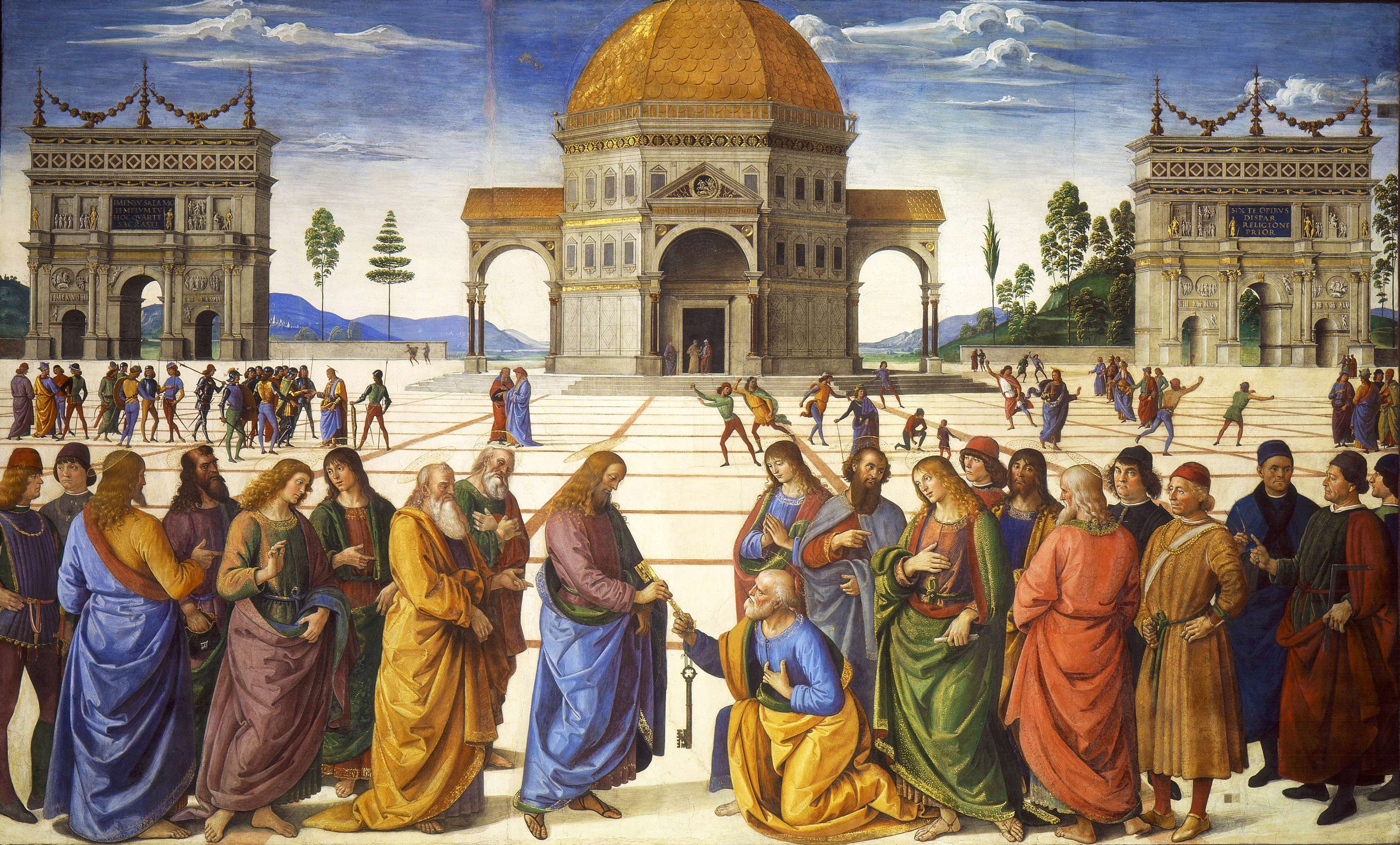
Christ Giving the Keys to St. Peter (often called The Delivery of the Keys) is a monumental fresco by the Umbrian master Pietro Perugino (c. 1446–1523). It is one of the most significant works of the Early Renaissance, painted between 1481 and 1482 as part of the original decoration of the Sistine Chapel in the Vatican. Commissioned by Pope Sixtus IV, the fresco is a visual manifesto of papal authority. It depicts the biblical moment from Matthew 16 where Jesus hands the keys of the kingdom to Peter, thereby establishing the authority of the Catholic Church and the line of papal succession. The work is celebrated for its masterful use of linear perspective, its idealized urban setting, and its profound influence on Perugino's most famous pupil, Raphael.

Visual Analysis

Composition

**Mathematical Grid:** This fresco is the quintessential textbook example of one-point linear perspective. The vast, open piazza is paved with a grid of white travertine and red stone, the orthogonal lines of which converge perfectly at a single vanishing point: the doorway of the central temple in the background. This grid creates a measurable, rational, and infinite space that reflects the Renaissance obsession with geometry and order. **Three Planes:** The composition is strictly divided into three distinct planes: - **Foreground:** The main narrative takes place here. Christ (left) hands the keys to the kneeling Peter (right). They are surrounded by a frieze-like row of apostles and contemporary figures. - **Middle Ground:** Two smaller scenes from the life of Christ are enacted here—the Tribute Money (left) and the Attempted Stoning of Christ (right). These figures are scaled down to enhance the sense of depth. - **Background:** Dominated by three monumental architectural structures and a landscape of rolling hills and feathery trees (a technique known as aerial perspective) that fade into the blue distance.

Colour & Light

**The Keys:** The focal point is the transfer of two large iron keys. The gold key represents spiritual power (power to bind and loose in Heaven), and the silver key represents temporal/earthly power. Peter kneels to receive them, acknowledging Christ's divine authority. **Isocephaly:** The figures in the foreground are arranged in an isocephalic line (their heads are all at approximately the same level), creating a sense of rhythm and stability. Their poses are elegant and almost dance-like, with complex drapery that falls in heavy, sculptural folds—a style Perugino learned from his training with Verrocchio. **Portraits:** Among the biblical figures, Perugino included portraits of his contemporaries. The fifth figure from the right edge, wearing a dark cap and looking directly at the viewer, is a self-portrait of the artist.

Materials & Technique

**The Temple:** The central octagonal building represents the Temple of Jerusalem (often associated by Renaissance pilgrims with the Dome of the Rock). It symbolizes the Church itself—Christ building his church "on this rock" (Peter). Its perfect symmetry and central dome reflect the Renaissance ideal of architectural perfection (influenced by Leon Battista Alberti). **Triumphal Arches:** Flanking the temple are two identical Roman Triumphal Arches, modeled closely on the Arch of Constantine in Rome. This is a deliberate fusion of Classical and Christian history, linking the new Christian Rome (the Papacy) with the imperial authority of ancient Rome.

Historical Context

Context

**Pope Sixtus IV:** The chapel was built by and named after Sixtus IV (reigned 1471–1484). He brought a "dream team" of Florentine and Umbrian artists (including Botticelli, Ghirlandaio, and Perugino) to Rome to decorate the walls. **Political Propaganda:** The papacy was under threat from both secular rulers and internal church councils (conciliarism) that challenged papal supremacy. Sixtus needed art that explicitly justified his power. By depicting Christ handing supreme authority directly to Peter (the first Pope), the fresco validates Sixtus IV's own claim to absolute power as Peter's successor. **Petrine Authority - "You are Peter":** The inscription on the triumphal arches compares Sixtus to Solomon, but the visual focus is entirely on the doctrine of Apostolic Succession. The placement of the keys along the central vertical axis (pointing directly to the vanishing point) underscores that the Church is the central pivot of human history.

Key Themes

Order, Rationality & Influence

**The Ideal City:** The piazza is not a real place but an ideal one—clean, spacious, symmetrical, and governed by mathematical laws. This reflects the Renaissance humanist belief that a well-ordered environment reflects a well-ordered mind and society. The chaos of the real medieval city is replaced by the harmony of the "City of God." **Teacher of Raphael:** Perugino was the teacher of Raphael, and the influence is undeniable. Raphael's famous "Marriage of the Virgin" (1504) is a direct homage to this fresco. Raphael copies the composition—the foreground frieze of figures, the grid-marked piazza, and the central temple—almost exactly, though he refines the spatial transition and makes the temple more circular.

Exam Focus Points

Critical Perspectives

**Perspective as Narrative:** Explain how Perugino uses perspective not just for realism, but to organize the narrative. The orthogonals lead the eye directly to the temple (the Church), reinforcing the message that the Church is the path to salvation. **Typology:** The Sistine Chapel walls compare the Life of Moses (Old Testament, South Wall) with the Life of Christ (New Testament, North Wall). This fresco parallels the Rebellion of Korah by Botticelli on the opposite wall (which deals with challenging Moses' authority), further emphasizing the sin of challenging the Pope. **Artificiality:** Critics sometimes note that the figures seem disconnected from the vast architectural background—like actors on a stage set rather than inhabitants of a real city. The scale difference between the foreground and background is dramatic.

On this page

OverviewVisual AnalysisHistorical ContextKey ThemesExam Focus Points