History of (tagg)Art...
HomeNatureIdentityRenaissanceBaroque

Nature

  • All Nature artworks
  • Landscape or Seascape in 2D
  • Animals in 2D or 3D
  • The Elements (Fire, Water, Wind or Earth) in 2D or 3D
  • +3 more topics

Identity

  • All Identity artworks
  • The Divine in 2D or 3D Works
  • Portraits in 2D Works
  • Portraits in 3D Works
  • +3 more topics

Renaissance

  • All Renaissance artworks
  • Religious Painting
  • Religious Sculpture
  • Mythological in 2D or 3D
  • +3 more topics

Baroque

  • All Baroque artworks
  • Religious Painting
  • Religious Sculpture
  • Mythological Painting
  • +6 more topics

About

A comprehensive study resource for Pearson Edexcel History of Art A-Level.

NatureIdentityRenaissanceBaroque

History of (tagg)Art... - A-Level Study Resource

Pearson Edexcel Specification

Admin
  1. Home
  2. Renaissance
  3. Expulsion of Adam + Eve

Expulsion of Adam + Eve

Masaccio, c.1425

RenaissanceReligious PaintingFlorence
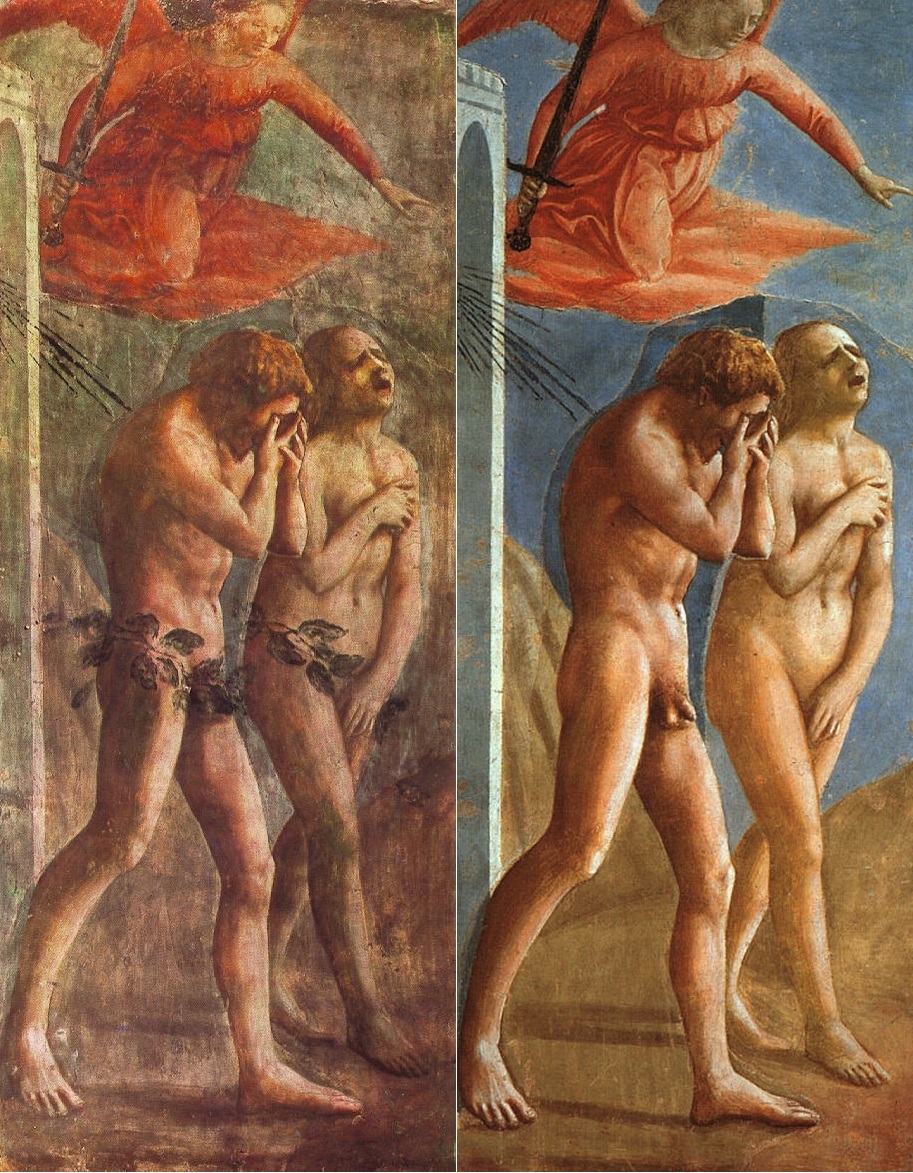
Expulsion of Adam + Eve by Masaccio

Overview

About This Work

The Expulsion of Adam and Eve from the Garden of Eden is a fresco by Masaccio (1401–1428) located in the Brancacci Chapel of the Church of Santa Maria del Carmine in Florence. Painted around 1425–1427 as part of a larger cycle on the life of St. Peter, it depicts the biblical moment when Adam and Eve are driven from paradise by a foreshortened angel wielding a sword. What distinguishes this fresco is not its subject matter—the expulsion had been painted countless times—but its unprecedented emotional intensity and psychological realism. Eve wails with open mouth, her body twisted in despair. Adam covers his face in shame, his muscular body rendered with anatomical precision previously unknown in European painting. This small fresco (approximately 2.14 by 1.43 metres) revolutionized how artists depicted the human form and, more importantly, human emotion. Masaccio proved that biblical narratives could move viewers not through decorative beauty or symbolic abstraction, but through visceral empathy with depicted suffering. For Michelangelo and generations of Renaissance masters, this fresco became a masterclass in how to render not just the body, but the soul.

Visual Analysis

Composition

A foreshortened angel hovers above the two expelled figures, its body rendered in sharply receding perspective to suggest three-dimensional space and divine authority. The angel's pose is dynamic—one arm outstretched with sword raised, pointing the couple away from paradise. Remarkably, the angel's face is serene and calm, even sympathetic. This is not a vengeful deity but an enforcer of divine law who seems to grieve the necessity of punishment. Eve is rendered on the left side of the composition. Her body twists forward in a kinetic spiral of motion and despair. Her face is upturned with her mouth open in a wail—a silent cry of anguish that seems to echo across time. Her eyes are closed or nearly closed, expressing an inward, self-directed anguish. Some scholars interpret her closed eyes and upturned face as a hopeless cry for redemption; others see it as anger at herself for being tricked by the serpent. Adam is rendered on the right side, walking forward with bent posture. His face is entirely buried in his hands—not covering his body (which remains exposed and vulnerable) but his face. This is the gesture of internal guilt and awareness of sin. As one scholar notes: "Adam is covering his face; it's a kind of shame and a real awareness of his sin." Both figures are moving—they walk forward despite their grief. This is crucial to understanding Masaccio's interpretation. They do not stand frozen in despair; they advance into the barren world. The diagonal movement of their bodies, suggested by the placement of their legs and the contrapuntal positioning of their arms, conveys a sense of motion and instability. They are "united in exile but separated by it"—moving in slightly different directions, grieving in different ways, yet condemned together. On the left stands a monumental arched gateway rendered in linear perspective. This architectural element represents the gates of paradise they are leaving. The archway is rendered classically (with pediment and decorative elements), creating a symbolic visual that paradise was a classically ordered, rationally constructed space. The fact that it remains vertical and stable while the figures are diagonal and falling suggests the eternal, unchanging nature of heaven contrasted with the tumultuous, transient nature of human earthly existence.

Colour & Light

The color scheme is remarkably restrained—muted earth tones, grays, and the single brilliant note of the angel's red robes. The angel wears brilliant red robes, symbolic of divine authority and (in Christian theology) the blood of Christ the Redeemer. Originally, the sword and rays of light emanating from the gates of paradise were painted in oxidized silver (now oxidized to black), creating a shimmering, otherworldly effect that has been lost over time. The angel is bathed in supernatural light, reinforcing divine authority. Adam and Eve are rendered in darker, more muted tones, symbolizing their fall into suffering and separation from divine illumination. Masaccio uses light symbolically: "Light whipping across the bodies of Adam and Eve...symbolizes the new earthly existence to which they are condemned, and the shadows of mankind's first steps on the endless road are stained on the hard soil behind their legs." This poetic use of light and shadow creates not just physical form but spiritual meaning. Light comes from the upper right, creating highlights on Eve's shoulders and upper torso while shadows pool beneath her breasts and in the recesses of her body. This careful modeling gives her a sculptural quality and physical presence unprecedented in earlier painting.

Materials & Technique

Her body is rendered with careful anatomical accuracy. Her form is not idealized or generalized (as in medieval art) but specific—what one scholar describes as "squarish and stubby," recalling late Romanesque-Gothic sculpture and drawing from classical sources like the Venus Pudica (modest Venus) type from Greco-Roman sculpture. Her nudity is deliberate and theologically significant: she is without the "clothing" that represents both protection and innocence lost. Masaccio models Eve's body through chiaroscuro—subtle gradations of light and shadow that create volume and three-dimensionality. Adam's muscular torso is rendered with extraordinary anatomical accuracy. His abdomen, chest, and shoulders are modeled with careful attention to the underlying musculature and bone structure. His body has weight and solidity; he appears to walk with difficulty, as if bearing a tremendous psychological burden. The musculature visible in his back, buttocks, and legs (rendered in shadow) creates a sense of physical substance and vulnerability. Unlike medieval depictions where Adam's genitals were often covered (by later restorers concerned with propriety), Masaccio's original work shows complete nudity—a detail that was recovered during recent restoration. This nakedness is not prurient but theologically essential: it represents the loss of innocence, the loss of divine protection, the vulnerability of human nature. The architectural setting is more symbolic than realistic. Masaccio uses architecture as a "stage set" or foil, a technique inherited from Giotto in the 14th century. The gate is just substantial enough to anchor the scene spatially without becoming a realistic, detailed environment. The sparseness of the setting focuses the viewer's attention entirely on the figures and their emotional state.

Historical Context

Context

The Brancacci Chapel was dedicated to the life of St. Peter, the founder of the Church. The chapel program tells a narrative of spiritual redemption: it begins with the Fall of Man (Adam and Eve's expulsion) and proceeds through the life of St. Peter, emphasizing his suffering, martyrdom, and role as the foundation of the Church. By placing the Expulsion next to scenes of St. Peter, Masaccio (or the theologian designing the program) established a clear theological narrative: humanity's fall from grace can be redeemed through the Church and its sacraments. St. Peter is traditionally understood as a "second Adam"—the figure through whom humanity gains restoration after the first Adam's transgression. This theological pairing was well-known to educated Florentines and would have informed how viewers understood the Expulsion. Santa Maria del Carmine was the principal church of the Dominican order in Florence. The Dominicans were schoolmen and theologians who valued rigorous intellectual thought and the reconciliation of faith with reason. The chapel program reflects Dominican theology: the Fall of Man is presented not as a distant, symbolic event but as a moment of profound human suffering requiring rational understanding and emotional empathy. In the medieval tradition, Adam and Eve were often depicted as stylized, expressionless figures or as symbols of abstract theological concepts. Masolino, Masaccio's colleague, painted the Temptation of Adam and Eve on the opposite wall of the chapel. Masolino's figures are ethereal, decorative, emotionally detached—floating in an undefined space, their faces blank and serene. Masaccio's figures, by contrast, are tormented, vulnerable, and deeply human. This represents a decisive break between medieval and Renaissance conceptions of religious art. Medieval art sought to transcend human emotion and celebrate the eternal and abstract. Renaissance art (as embodied by Masaccio) sought to ground the sacred in human experience, to make biblical narratives immediately relevant and emotionally moving. It is the difference between art as theology and art as empathy. Masaccio did not invent anatomical observation from scratch. He studied classical sculpture (both surviving ancient works and contemporary works by sculptors like Donatello). Eve's pose and form derive from the classical Venus Pudica type (the modest Venus, covering her pubic area but otherwise exposed). Adam's muscular torso shows the influence of Donatello's Crucifix in Santa Croce, a contemporary work by Masaccio's peer. The careful rendering of musculature and bone structure comes from studying classical statuary. However, Masaccio transforms these classical models. His figures are not idealized; they are emotionally specific and psychologically complex. The body becomes a vehicle for expressing internal emotional states.
Key Themes

The Fall of Man, Emotional Realism, and Art as Empathy

The fresco is, fundamentally, a meditation on human fallibility. Adam and Eve are not depicted as distant biblical figures but as vivid embodiments of human shame, regret, and loss. The scene invites the viewer to recognize their own potential for sin and the consequences that follow. This reflects the Renaissance interest in the human condition—not humanity in the abstract, but individual psychological and emotional experience. The fresco presents two distinct emotional responses to the same catastrophe. Adam's shame (covering his face, unable to look) represents a masculine sense of responsibility and culpability. He knew God's law and violated it; the burden of transgression falls on him. Eve's despair and wailing represent a more immediate emotional response—grief, loss, the pain of being expelled. The fresco does not moralize about which response is "correct"; instead, it acknowledges that human beings respond to tragedy in different ways. The angel is a complex figure. It enforces divine law with absolute authority (raised sword, pointing away), yet its face shows sorrow and compassion. This reconciles two theological concepts: divine justice (the punishment is deserved and necessary) and divine mercy (God grieves at having to punish His creatures). The angel becomes a symbol of the tragic necessity of moral consequence. The fresco's greatest innovation is its assertion that art can create empathy through realistic depiction of human suffering. By rendering Adam and Eve with anatomical accuracy and emotional authenticity, Masaccio invites the viewer to feel their pain, to recognize their own humanity in the depicted figures. This is a fundamentally Renaissance idea: that art's moral power lies not in abstraction but in the capacity to move human hearts through representation of human experience.

Exam Focus Points

Critical Perspectives

Emotional Realism: Revolutionary Representation - Explain that Masaccio was the first major artist to depict biblical figures with such emotional intensity and psychological depth. - Contrast this to medieval and contemporary examples (Masolino). Medieval figures were expressionless, ethereal, decorative. - Analyze the contrasting emotions: Eve's open-mouth wail and upturned face vs. Adam's face-covering shame. What do these gestures suggest about their inner states? - Discuss how emotional authenticity creates empathy and makes the scene universally relatable. Anatomical Accuracy and Naturalism - Masaccio was the first artist in centuries to paint the human body naturalistically and with careful anatomical observation. - Identify the specific anatomical details: Adam's abdomen and musculature, the bone structure and form of both figures. - Explain how the nude figures are theologically significant (representing loss of innocence) rather than merely decorative. - Discuss the influence of classical sculpture (Venus Pudica, Donatello's works) and how Masaccio transforms these sources with emotional and psychological depth. Chiaroscuro and Modeling - Light comes consistently from the upper right (mimicking actual chapel light). - Figures are modeled from light to dark, creating three-dimensional form and volume. - Explain how chiaroscuro creates both physical solidity and emotional atmosphere. - Contrast with medieval flat, decorative coloring. Composition and Movement - Both figures walk forward despite despair—movement suggests the permanence of expulsion and the finality of God's judgment. - Diagonal movement conveys instability and exile. - Discuss the architectural frame (gates of paradise) as symbolic rather than realistic. - Implied lines of movement created by the angel's gesture and the figures' poses. Theological Context - The Expulsion is paired with the life of St. Peter (redemption). Adam's fall is countered by Peter's role as founder of the Church. - The Dominican order valued both faith and reason; the fresco reflects this synthesis. - Discussion of medieval vs. Renaissance theological art: abstract symbols vs. human experience. Comparison to Masolino - Masolino's Temptation (opposite wall) shows expressionless, floating figures in a decorative medieval style. - Masaccio's Expulsion shows grounded, emotionally intense figures in a realistic Renaissance style. - This contrast exemplifies the Renaissance break from Gothic tradition. Influence and Historical Significance - Michelangelo admired this fresco and adopted its emotional depth and anatomical realism. - It established a new standard for how biblical narratives could be depicted. - The fresco became a pilgrimage site for Renaissance artists seeking to understand emotion, anatomy, and perspective.

On this page

OverviewVisual AnalysisHistorical ContextKey ThemesExam Focus Points