History of (tagg)Art...
HomeNatureIdentityRenaissanceBaroque

Nature

  • All Nature artworks
  • Landscape or Seascape in 2D
  • Animals in 2D or 3D
  • The Elements (Fire, Water, Wind or Earth) in 2D or 3D
  • +3 more topics

Identity

  • All Identity artworks
  • The Divine in 2D or 3D Works
  • Portraits in 2D Works
  • Portraits in 3D Works
  • +3 more topics

Renaissance

  • All Renaissance artworks
  • Religious Painting
  • Religious Sculpture
  • Mythological in 2D or 3D
  • +3 more topics

Baroque

  • All Baroque artworks
  • Religious Painting
  • Religious Sculpture
  • Mythological Painting
  • +6 more topics

About

A comprehensive study resource for Pearson Edexcel History of Art A-Level.

NatureIdentityRenaissanceBaroque

History of (tagg)Art... - A-Level Study Resource

Pearson Edexcel Specification

Admin
  1. Home
  2. Renaissance
  3. David

David

Michelangelo, 1501-1504
RenaissanceReligious SculptureFlorence
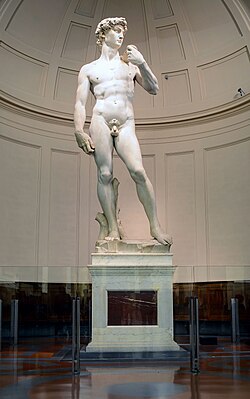
David by Michelangelo
Michelangelo, David, 1501–1504. Marble, 517 cm (17 ft). Galleria dell'Accademia, Florence.

Overview

About This Work

David is a monumental marble sculpture by Michelangelo Buonarroti (1475–1564), completed between 1501 and 1504. Standing 5.17 metres (17 feet) tall, it represents the biblical hero David as a colossal male nude figure in the moment before his battle with the giant Goliath. Originally commissioned as an architectural ornament for Florence Cathedral, it was deemed too magnificent for that purpose and was instead installed in front of the Palazzo Vecchio, the seat of Florence's government, where it became a symbol of the city's political independence and republican values. The David is recognized as one of the greatest sculptures ever created and a definitive masterpiece of the High Renaissance. It synthesizes classical ideals of beauty and heroism with humanist philosophy, creating a work that transcends its biblical origins to become a universal symbol of human potential and dignity. Michelangelo carved it from a single block of Carrara marble that had been damaged and abandoned by two previous sculptors, transforming what others considered a cursed stone into an immortal achievement.

Visual Analysis

Composition

The David stands in contrapposto, a technique inherited directly from classical antiquity, particularly from the Doryphoros (spear-bearer) by the Greek sculptor Polykleitos (c. 440 BC). The word "contrapposto" means "counter-balance" in Italian; it describes a pose in which the weight of the figure rests entirely on one leg (the "engaged leg"), while the other leg is relaxed and slightly bent. In David, the weight rests on the right leg, while the left leg steps forward and bends at the knee. This shift in weight creates an S-curve through the entire torso: the hips shift slightly to the right, while the shoulders shift slightly to the left, creating a gentle undulation that appears natural and unstrained despite the colossal size. The contrapposto pose conveys both stability and latent energy—the figure appears ready to move at any moment, yet perfectly balanced. David's proportions are heroic and idealized. Michelangelo deliberately made him taller, more handsome, and more muscular than historical accounts of the biblical David would suggest. However, these proportions are calculated with profound sophistication—he accounted for the viewer's perspective looking upward at the statue from the ground. The head and hands are proportionally large, ensuring they remain visually prominent despite the distance. The right hand is noticeably larger than anatomical proportions would dictate—likely a reference to a medieval epithet for David: "manu fortis" (strong of hand).

Colour & Light

The face is perhaps the most striking feature. David's gaze is directed into the distance, as if looking toward an unseen threat. His brow is furrowed in concentration. His expression conveys intense thought and deliberation—not anger or aggression, but profound focus. This is the face of someone contemplating a challenge, preparing mentally and spiritually for what lies ahead. Contemporaries marveled at this psychological depth. The face does not depict victorious triumph (as earlier Renaissance Davids by Donatello and Verrocchio had done); instead, it portrays the moment of greatest vulnerability—the moment before action, when success is uncertain. This was a radical reinterpretation of the biblical narrative. Art historians use the term "terribilità" (a form of "terrible" or "awe-inspiring power") to describe the quality of Michelangelo's art. In David, this manifests not as external action or dramatic movement, but as restrained inner energy. The statue does not move; it vibrates with potential.

Materials & Technique

The body demonstrates mastery of anatomy that was extraordinary even for Michelangelo. Every muscle group is rendered with precise accuracy: the pectoralis major, the rectus abdominis, the serratus anterior, the obliques. The legs show detailed musculature of the quadriceps, vastus medialis, tibialis anterior. Yet this anatomical accuracy is idealized—the musculature is enhanced, emphasized, and harmonized to create an image of perfect human form. Michelangelo achieved this through meticulous study. He was known to have studied human anatomy through dissection, understanding the interior structure of bone and muscle in unprecedented detail. One detail reveals the pragmatic limits of even genius: the right infraspinatus muscle is missing from the back of the statue. Michelangelo documented this in letters, explaining that a defect in the marble block prevented him from carving this anatomical detail. One of the most subtle yet profound details is the treatment of the weapon. David holds a sling draped over his left shoulder, and the stone is held invisibly in his right hand. The sling is rendered as small and inconsequential—barely noticeable. This minimizes the physical weapon to assert a Renaissance humanist ideal: victory is achieved through intellect, cunning, and confidence, not brute strength.

Historical Context

Context

In 1501, the Guild of Florence Cathedral commissioned Michelangelo to carve a colossal marble figure of David to crown the cathedral. However, the marble block assigned to him was problematic. It had been partially blocked out nearly 40 years earlier by the sculptor Antonio Rossellino and left exposed in the cathedral workshop. Two other sculptors had attempted to carve it and abandoned the project. The stone bore deep cuts and indentations from these failed attempts. It was damaged, weathered, and—by all contemporary accounts—cursed. Michelangelo, aged 26, was offered this "impossible" commission. Just two years earlier, he had completed the Pietà in Rome. His approach reflected his Neo-Platonic philosophy: "the sculpture is already complete within the marble block before I start my work. I just have to chisel away the superfluous material." The carving took approximately two and a half years. When it was completed in 1504, the response was astonishing. Vasari wrote that Michelangelo had performed "a miracle...able to raise up one who had died." The Florentine government decided it was too magnificent to be placed on the cathedral and installed it in front of the Palazzo Vecchio—the seat of Florence's government. Florence in 1504 was in a precarious political position, surrounded by larger, more powerful rivals: Milan, Rome (the Papal States), and Venice. The city saw itself as a vulnerable underdog surrounded by Goliaths. The placement of David transformed the statue into a civic emblem. Florence was David—small, intelligent, courageous, defending its independence against overwhelming odds.

Key Themes

The Moment Before Action and Humanist Ideals

Michelangelo's revolutionary decision was to depict David before the battle, not after. Every previous Renaissance representation showed David in the moment of or after victory—standing over the severed head of Goliath, triumphant. Michelangelo instead captured the moment of greatest psychological tension: the instant of decision, when the outcome is uncertain, when intellect must triumph over instinct. This narrative choice elevates the work from a mere illustration of a biblical story to a profound meditation on human agency and will. David's victory is not predetermined by the story; it flows from his courage, intelligence, and faith. The viewer witnesses not the accomplishment but the preparation—and in that preparation lies all the drama. The David embodies a Renaissance synthesis of Greek heroism and Christian virtue. The nudity, the contrapposto stance, the idealized beauty—these derive from classical Greek sculpture. Yet the subject is biblical, and the context is Christian Florence. Michelangelo proves that these traditions can be harmonized: the classical body becomes the vehicle for expressing Christian values of faith, courage, righteousness, and divine favor. The David is fundamentally a statement about human potential. The figure embodies the Renaissance humanist belief that through study, reason, and moral discipline, human beings can approach perfection. The body is not corrupt or shameful, but beautiful. The mind is not subservient to the flesh, but in command of it. The individual human being—young, alone, without armor or advantage—is capable of greatness.

Exam Focus Points

Critical Perspectives

Contrapposto and Classical Influence: Explain the contrapposto stance (weight on one leg, creating an S-curve through the torso). Trace the ancestry to Polykleitos' Doryphoros and discuss why Renaissance artists valued this classical technique. How does contrapposto create the impression of potential energy despite static pose? Narrative Innovation: Why is Michelangelo's choice to depict David before the battle (not after) revolutionary? What does this narrative choice communicate about Renaissance humanism and individual agency? How does the furrowed brow and distant gaze convey psychological intensity? Anatomical Mastery: Discuss how Michelangelo accounts for viewer perspective (looking upward). Explain intentional proportional adjustments (large hands, long left leg) as serving both aesthetic and theological purposes ("manu fortis"). Analyze how anatomical knowledge enhances rather than diminishes idealization. The Sling: Symbolic Minimization: Why is the weapon rendered so inconspicuously? What does this communicate about Renaissance ideals of victory through intellect rather than strength? Civic and Political Symbolism: How did Florence see itself as David surrounded by Goliaths? Discuss the placement in front of Palazzo Vecchio as a political statement about republican Florence and citizen defense. The Marble Block and Technical Achievement: Discuss the "cursed stone" previously abandoned by other sculptors. Explain Michelangelo's Neo-Platonic philosophy: the sculpture is already in the marble. Classical and Christian Synthesis: How does the statue harmonize Greek heroic tradition with Christian narrative? Discuss the controversy surrounding nudity and religious art.

On this page

OverviewVisual AnalysisHistorical ContextKey ThemesExam Focus Points