History of (tagg)Art...
HomeNatureIdentityRenaissanceBaroque

Nature

  • All Nature artworks
  • Landscape or Seascape in 2D
  • Animals in 2D or 3D
  • The Elements (Fire, Water, Wind or Earth) in 2D or 3D
  • +3 more topics

Identity

  • All Identity artworks
  • The Divine in 2D or 3D Works
  • Portraits in 2D Works
  • Portraits in 3D Works
  • +3 more topics

Renaissance

  • All Renaissance artworks
  • Religious Painting
  • Religious Sculpture
  • Mythological in 2D or 3D
  • +3 more topics

Baroque

  • All Baroque artworks
  • Religious Painting
  • Religious Sculpture
  • Mythological Painting
  • +6 more topics

About

A comprehensive study resource for Pearson Edexcel History of Art A-Level.

NatureIdentityRenaissanceBaroque

History of (tagg)Art... - A-Level Study Resource

Pearson Edexcel Specification

Admin
  1. Home
  2. Renaissance
  3. Pietà

Pietà

Michelangelo, 1498-1499
RenaissanceReligious SculptureRome
Pietà by Michelangelo
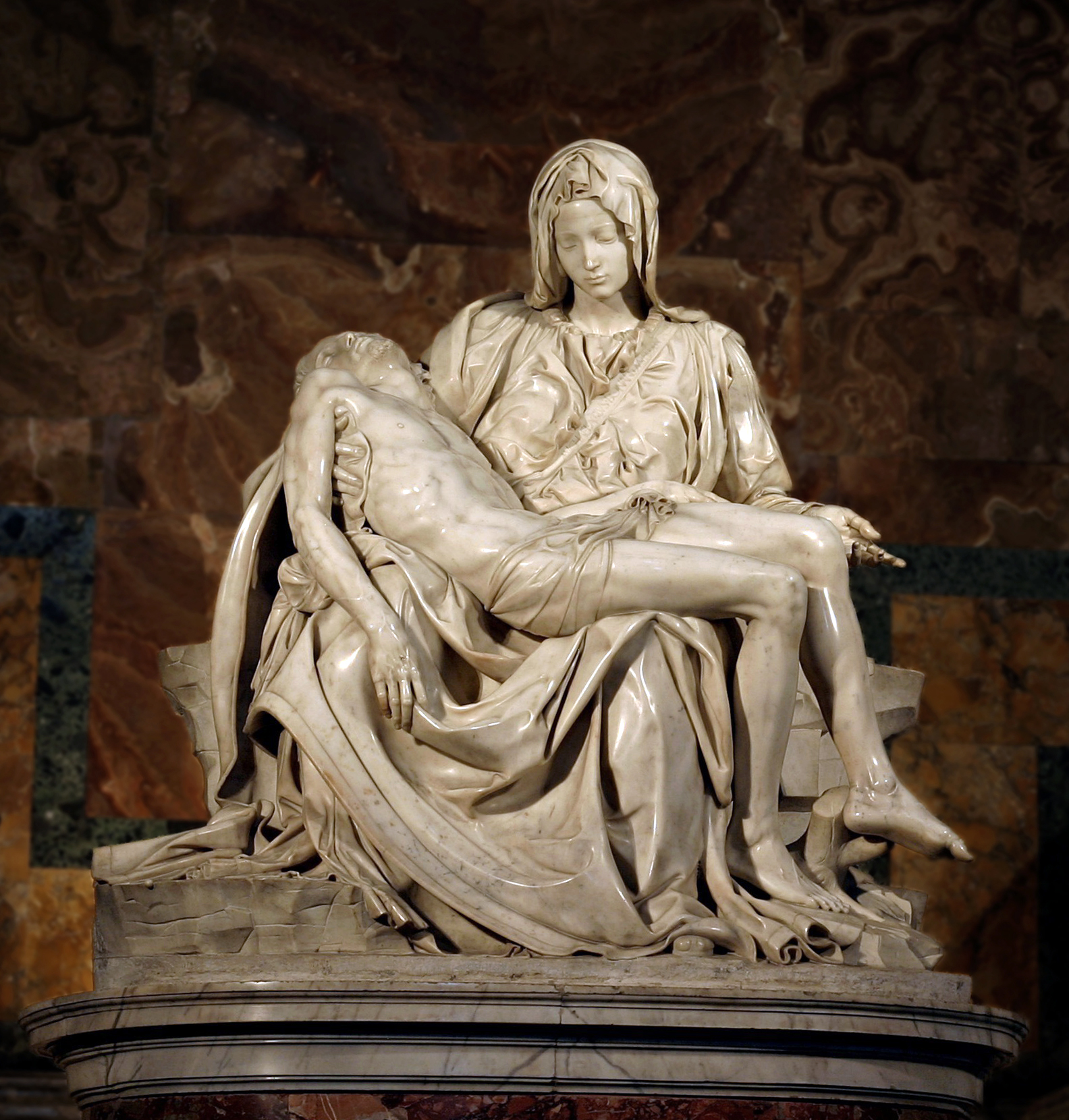
Pietà, Michelangelo, 1498-1499. Marble, 174 cm × 195 cm. St. Peter's Basilica, Vatican City.

Overview

About This Work

The Pietà (Italian: Madonna della Pietà, meaning "Our Lady of Pity") is a marble sculpture by the Florentine master Michelangelo Buonarroti, carved between 1498 and 1499 and installed in St. Peter's Basilica, Vatican City. The work depicts the Virgin Mary cradling the dead body of Christ after the crucifixion and descent from the cross—a scene from the Catholic devotional cycle known as the "Seven Sorrows of Mary." What distinguishes Michelangelo's interpretation is not the subject matter—the Pietà was a well-established theme in Northern European art—but his revolutionary artistic choices and technical mastery. He depicted Mary not as an aged woman (as tradition dictated) but as a young, beautiful, serene figure. He carved the work from a single block of Carrara marble in just nine months, at the age of 23. The sculpture became the work that launched Michelangelo's international reputation, completed before the famous David and decades before the Sistine Chapel. It remains one of the most moving representations of grief in Western art, combining idealized beauty with profound spiritual emotion. The work is also notable for bearing Michelangelo's signature—the only sculpture he ever signed—inscribed across Mary's sash, a testament to both his pride in the achievement and his later regret for that vanity.

Visual Analysis

Composition

The overall composition forms a pyramid, with the Virgin Mary's head at the apex and her broad lap and voluminous drapery forming the base. This pyramidal structure was a favored Renaissance device for creating visual and spiritual stability. The form draws the viewer's eye upward, emphasizing the transcendent and spiritual nature of the scene. The pyramid also suggests that all human grief and suffering are contained within and elevated by the Virgin's maternal presence and spiritual grace. Michelangelo achieved this pyramidal effect while carving two figures from a single block of marble. He did not separate the figures; instead, he treated them as "one dense and compact mass," allowing the heavy drapery of Mary's robes to anchor both figures and create a unified compositional unit. This was a profound technical solution to an extraordinarily difficult sculptural problem. Christ's body lies horizontally across Mary's lap, his head resting against her breast. One arm hangs limply from the lap, demonstrating perfect understanding of how flesh behaves under gravity. The other arm rests across his torso. Although carved from a single block and unified compositionally, Michelangelo differentiated the two figures through striking contrasts: Vertical (Mary) vs. Horizontal (Christ), Clothed vs. Naked, Living vs. Dead, and Spiritual vs. Physical expression.

Colour & Light

The most revolutionary aspect of the Pietà is the depiction of Mary as a young, beautiful woman rather than an aged mother. Tradition dictated that Mary, having borne Christ and endured his passion, should be portrayed as a woman in her late forties or early fifties. Yet Michelangelo rendered her as youthful, with a serene, almost otherworldly beauty. Her face is calm, her expression quiet and contemplative. She does not display anguish or despair; instead, her downcast eyes gaze upon her son's body with acceptance and spiritual resignation. When questioned about this unconventional portrayal, Michelangelo explained: "Do you not know that chaste women stay fresh much more than those who are not chaste?" This was a profound theological assertion. Mary's physical beauty reflects her spiritual virtue and grace. In the Renaissance humanist worldview, beauty was understood as the visible manifestation of spiritual perfection. Mary's expression is extraordinary in its emotional restraint. Unlike Northern European artists who depicted Mary in agony—mouth open, hands raised in despair—Michelangelo shows her in serenity. Her face displays grief, but grief transformed by spiritual acceptance. The power of the work lies in what is restrained, not in what is displayed.

Materials & Technique

One of the most technically astounding features is the treatment of Mary's drapery. The elaborate robes flow around her body in deep, naturalistic folds. One observer commented: "It looks less like marble and more like actual cloth because he's created natural looking folds and deep recesses." This was a revolutionary achievement. The heavy fabric appears to have weight and drape naturally over her lap, supported by her knees. The drapery serves multiple purposes simultaneously. Practically, it provides structural support and visual interest to what could otherwise be an awkward composition. Theologically, it transforms the scene: the deep folds create a kind of cavern or sanctuary around Christ's body—what one scholar poignantly described as an "empty womb," symbolizing both Christ's birth and his death, the beginning and end of earthly existence. Christ's body is idealized yet realistic, reflecting Michelangelo's study of human cadavers (he conducted dissections at the Convent of Santo Spirito between 1493 and 1494). Every muscle is precisely carved; the wounds of the crucifixion are present but not emphasized. Curiously, Michelangelo carved Christ with five front teeth instead of the customary four—in Renaissance tradition, an extra tooth was a prerogative of negative characters, suggesting Christ takes upon himself all the sins of the world.

Historical Context

Context

On August 27, 1498, Michelangelo signed a contract to provide a marble sculpture depicting the Virgin Mary cradling the dead Christ for the funeral monument of Cardinal Jean de Bilhères Lagraulas, a French papal legate in Rome. The patron promised the Cardinal that the work would be "the most beautiful work of marble in Rome, one that no living artist could better"—an extraordinary claim for a 23-year-old artist with limited monumental sculpture experience. Before beginning to carve, Michelangelo spent months in the marble quarries of Carrara, personally selecting the block. He later claimed it was "the most perfect marble I have ever seen." The significance of this choice cannot be overstated: in Michelangelo's philosophy, the marble block was not inert matter to be imposed upon; rather, it contained the ideal form that the artist's task was to reveal. The actual carving took approximately nine months. On August 6, 1499, the sculpture was installed in the Chapel of the King of France (Santa Petronilla) in the original St. Peter's. Tragically, Cardinal Bilhères died on the same day as the installation, never seeing his commission completed. The Pietà is the only sculpture Michelangelo ever signed. According to his biographer Giorgio Vasari, shortly after the sculpture was installed and drawing crowds of admirers, Michelangelo overheard someone attribute the work to Cristoforo Solari, a rival sculptor. Enraged by the misattribution, Michelangelo returned and carved his name across Mary's sash: "MICHELANGELO BUONARROTI, FLORENTINE, WAS MAKING THIS." He later came to regret this display of vanity and swore never to sign another work.

Key Themes

Beauty as Spiritual Virtue & Classical-Christian Synthesis

The most philosophically sophisticated aspect of the Pietà is the equation of physical beauty with spiritual grace. The Renaissance humanist worldview understood beauty not as superficial decoration but as the visible manifestation of inner virtue. A beautiful body reflected a virtuous soul; the divine created beauty as a mirror of spiritual perfection. By rendering Mary as young and beautiful, Michelangelo asserts her spiritual virtue and divine favor. This interpretation was inspired by Dante Alighieri's Divine Comedy, where the poet celebrates Mary's paradoxical status as simultaneously mother and daughter of Christ, transcendent and human, eternal and temporal. The sculpture rejects the excessive emotionalism of Northern European art in favor of Renaissance restraint. Michelangelo's Mary does not wail; she grieves with quiet dignity. This approach suggests that the deepest emotions are those most carefully controlled, that spiritual acceptance is more profound than despair. The restraint maintains the work's timelessness; excessive emotion would date the work to a particular moment, while restrained sorrow suggests eternal human experience. The Pietà embodies the Renaissance project of synthesizing classical idealism with Christian content. The nude male body, the idealized beauty, the pyramidal composition—these are classical devices. Yet they serve a Christian narrative of redemption and salvation. Michelangelo proves that these traditions need not be opposed; instead, they can be harmonized to express deeper truths.

Exam Focus Points

Critical Perspectives

Innovation in Depicting Mary: Explain why depicting Mary as young and beautiful was revolutionary in Italian sculpture. How does physical beauty function as a theological statement about spiritual virtue? Discuss the Dante connection and the concept of Mary as both mother and daughter of her son. Emotional Restraint and Spiritual Acceptance: Contrast Michelangelo's serene Mary to Northern European depictions of Pietà (anguished, despairing). How does restraint create greater emotional depth? Discuss the Renaissance ideal of dignified, controlled emotion. Technical Achievement: Carving two figures from one block of marble—the compositional problem and solution. The revolutionary rendering of drapery to appear like actual cloth rather than stone. Anatomical accuracy as a result of dissection studies. Symbolism of the Drapery: The deep folds as creating a "cavern" or "empty womb." Symbolism of birth and death, beginning and end. Drapery as both protective embrace and void created by death. The Signature: The only sculpture Michelangelo ever signed. The story of the misattribution and his prideful response. His later regret and the symbolic significance of his refusal to sign subsequent works. Compositional Structure: Pyramidal form creating visual and spiritual stability. How contrasts (vertical/horizontal, clothed/naked, living/dead) prevent monotony and create complexity. Unity achieved despite the dual figures. Influence and Historical Significance: The work that made Michelangelo's reputation. Completed before the David; established principles of High Renaissance sculpture. Introduced the Pietà theme to Italian Renaissance visual culture.

On this page

OverviewVisual AnalysisHistorical ContextKey ThemesExam Focus Points