History of (tagg)Art...
HomeNatureIdentityRenaissanceBaroque

Nature

  • All Nature artworks
  • Landscape or Seascape in 2D
  • Animals in 2D or 3D
  • The Elements (Fire, Water, Wind or Earth) in 2D or 3D
  • +3 more topics

Identity

  • All Identity artworks
  • The Divine in 2D or 3D Works
  • Portraits in 2D Works
  • Portraits in 3D Works
  • +3 more topics

Renaissance

  • All Renaissance artworks
  • Religious Painting
  • Religious Sculpture
  • Mythological in 2D or 3D
  • +3 more topics

Baroque

  • All Baroque artworks
  • Religious Painting
  • Religious Sculpture
  • Mythological Painting
  • +6 more topics

About

A comprehensive study resource for Pearson Edexcel History of Art A-Level.

NatureIdentityRenaissanceBaroque

History of (tagg)Art... - A-Level Study Resource

Pearson Edexcel Specification

Admin
  1. Home
  2. Renaissance
  3. Madonna of the Meadow

Madonna of the Meadow

Giovanni Bellini, c.1500
RenaissanceReligious PaintingVenice
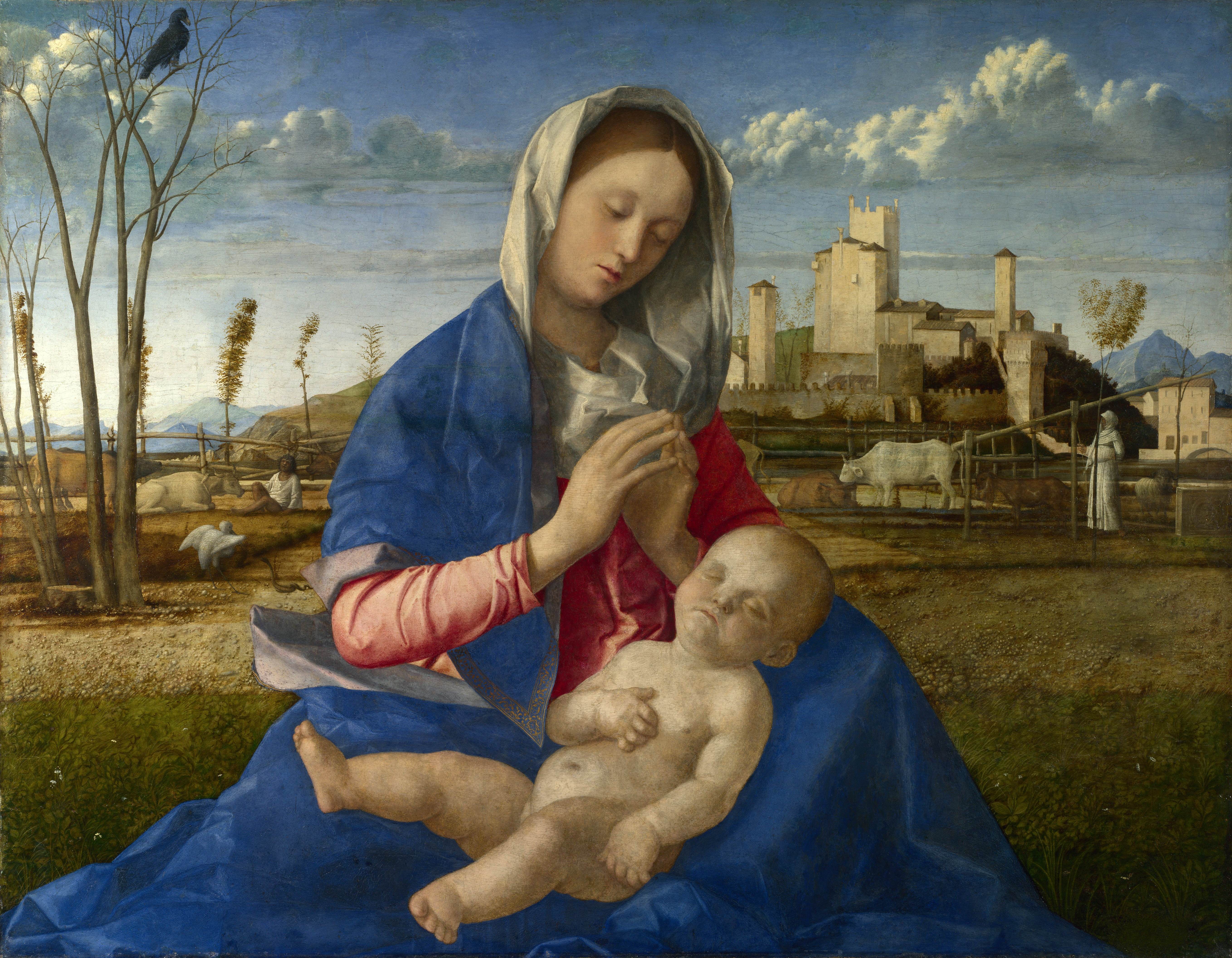
Madonna of the Meadow by Giovanni Bellini
Madonna of the Meadow, Giovanni Bellini, c. 1500-1505, National Gallery, London

Overview

About This Work

Madonna of the Meadow (Italian: Madonna del Prato) is a tempera and oil painting by Giovanni Bellini (c. 1433/1435–1516), the greatest master of the Venetian Renaissance. Painted around 1500–1505 when Bellini was in his seventies, it is one of his most celebrated masterpieces, now housed in the National Gallery, London. The painting depicts the Virgin Mary cradling the sleeping Christ Child in a lush Venetian meadow, with a vast, luminous landscape stretching to the distant horizon. What makes this modest-sized work (67 × 86 cm) so historically significant is that it synthesizes over five decades of Bellini's artistic innovation while simultaneously launching the High Renaissance in Venice. The painting revolutionized how artists understood the relationship between figures and landscape, between devotional intensity and natural observation, and between the ethereal language of Byzantine iconography and the tangible beauty of the visible world.

Visual Analysis

Composition

The Virgin Mary sits on a rocky outcrop in the middle of an emerald meadow. She wears the traditional Madonna garments: a brilliant ultramarine blue mantle (representing divine purity and her connection to heaven) draped over a red undergarment (symbolizing her humanity and warmth). Her face is serene and emotionally restrained, her gaze directed downward in contemplation. A white linen headdress frames her face, creating an almost halo-like effect. She cradles the sleeping Christ Child across her lap in a pose that is deeply poignant. The Child's body is pale and luminous, rendered with soft modeling that emphasizes his vulnerability and weight. His pose deliberately recalls a Pietà—the traditional representation of the dead Christ lying across his mother's lap after the crucifixion. This is a sophisticated theological choice: by depicting the sleeping Child in the pose of the dead Christ, Bellini invites the viewer to contemplate Christ's future passion and sacrifice even in this moment of maternal tenderness. The figures maintain a formal, iconic quality reminiscent of Byzantine iconography. They are isolated, monumental, and psychologically distant from the viewer. Their poses suggest eternal truths rather than momentary human interaction. The Virgin does not engage the viewer; she remains absorbed in her contemplation of the Child. Behind the Virgin, the landscape recedes into the far distance in a carefully constructed atmospheric perspective. The composition is structured as a series of horizontal bands: immediate foreground with rocky outcrop and lush green meadow; middle ground with paths, farmland, and small figures engaged in agricultural work; far distance with low-lying Venetian hills dotted with farmhouses and church steeples; and sky transitioning from deep blue overhead to paler blue near the horizon with softly modeled clouds.

Colour & Light

The painting is suffused with clear, brilliant spring light that appears to emanate from the upper left. This light is the painting's spiritual essence. It casts a pale glow on everything it touches—the Virgin's right sleeve, the distant castle walls, the clouds, the grass. There are no harsh contrasts, no deep shadows; instead, light gradually modulates into shadow with warm, transparent undertones. The painting's color scheme is rigorously organized around three primary color groups: Deep Ultramarine Blue: The Virgin's mantle and the sky. Blue traditionally symbolizes the divine realm, infinity, spiritual purity, and heaven. The deep blue of the mantle connects the Virgin to the blue sky above, creating visual and spiritual continuity. Rich Red: The Virgin's undergarment and accent colors throughout. Red symbolizes her humanity, warmth, life, and the incarnation (God becoming flesh). The red beneath the blue reminds viewers that the Virgin is both divine mother and earthly human. Golden Yellows: The flesh tones of the figures, the golden light catching the wheat fields and architecture, the glowing quality of the entire composition. Yellow/gold symbolizes divine light, resurrection, and spring renewal. These colors do not sit in isolation; they exist in harmonic relationship, like musical chords. The viewer perceives not individual colors but a unified, meditative atmosphere created through color harmony.

Materials & Technique

By 1500, Bellini had spent over forty years working primarily in tempera. His great innovation was the embrace of oil paint, a technique that Northern European artists had mastered but which Italian Renaissance painters adopted relatively late. Oil paint allowed for glazing—the building up of transparent layers that allowed light to pass through. This created the luminosity and soft transitions that characterize the Madonna of the Meadow. Bellini was among the first Italian painters to master oil techniques fully. He experimented with the medium over decades, gradually learning how to use it to achieve effects impossible in tempera. By this late work, he had achieved complete mastery, using oil to create luminous, translucent shadows and harmonious color relationships. In the figures themselves, Bellini demonstrates sophisticated chiaroscuro (modeling through light and shadow). The Virgin's face shows light on her right cheek and shadow on her left, creating form without hard outlines. The Child's body is modeled through subtle gradations that create three-dimensionality and volume. Even the drapery folds are rendered through tone rather than line, giving them a soft, almost translucent quality.

Historical Context

Context

The prominence given to landscape in the Madonna of the Meadow reflects the influence of Franciscan theology. The Franciscan movement taught that the sacred is not confined to churches or hieratic narratives, but manifest in all of creation. Creation itself is a manifestation of divine presence. This theological orientation justified the inclusion of landscapes not as mere setting but as equal partners in expressing the sacred. The painting embodies a characteristically Venetian tradition, influenced by the city's trade connections with the Eastern Mediterranean and Byzantine world. Yet it also reflects Northern Renaissance attitudes toward landscape (learned through Bellini's father, who had travelled northward). The synthesis is uniquely Venetian. The Madonna of the Meadow was painted when Bellini was in his seventies—one of his final and greatest works. It represents a synthesis of his entire artistic development. The formal, iconic quality of the figures derives from his early works; the mastery of light and atmosphere comes from decades of experimentation; the harmonious integration of landscape represents the culmination of a lifetime's reflection on how to connect the eternal and the temporal. The rocky ground beneath the Virgin is symbolically significant. In medieval Marian theology, the "Madonna of Humility" was depicted sitting on the ground rather than enthroned, asserting her spiritual humility despite her exalted status as the Mother of God. The lush meadow carries multiple meanings: it alludes to the hortus conclusus (enclosed garden) of medieval hymns—a symbol of the Virgin's virginity and spiritual garden that is sealed from the world.

Key Themes

The Sacred in Nature and Devotional Contemplation

By situating the Madonna in a carefully observed Venetian landscape, Bellini asserts that nature is not separate from the sacred but infused with it. The spring light, the growing grass, the farmland—these are manifestations of divine presence. This was revolutionary: it moved away from medieval thinking that opposed the spiritual realm (pure, eternal, abstract) to the material world (corrupted, temporary, illusory). Instead, it proposes that the sacred and the natural are interpenetrating. The Christ Child's pose, recalling the Pietà, adds an undertone of melancholy to the serene image. The viewer contemplating this Madonna does not see only a moment of maternal tenderness; they see also the future suffering and sacrifice. This double vision—present joy and future sorrow—creates profound spiritual depth. The spring light and clear atmosphere suggest renewal and hope. Winter has passed; spring (and Easter, the season of resurrection) is present. Although the Child's pose suggests death, the luminous light promises life beyond death. The painting balances sorrow and hope in a way that defines the Christian theological vision. The image is designed to invite contemplation rather than narrative drama. The Virgin gazes downward in devotion; the viewer gazes at the Virgin and is thereby encouraged to join in her prayer. The landscape surrounding them is rendered with such loving detail that it invites prolonged looking and meditation. This is devotional art in the highest sense—art designed to lead the soul toward spiritual understanding.

Exam Focus Points

Critical Perspectives

Oil Paint and Technical Innovation: Explain how Bellini mastered oil paint and how it enabled luminosity and glazing effects. Discuss how oil paint became the medium of choice for Venetian painting after Bellini's example. Compare the handling of paint in this work (soft, translucent) to earlier tempera techniques. Landscape as Spiritual Partner: Analyze how the landscape is integrated into the composition—it is not background but equal in importance. How does the recognizable Venetian landscape affect the meaning of a sacred narrative? Discuss Franciscan theology and the sacred in nature. Color Symbolism and Harmony: The three primary color groups (blue, red, yellow) and their symbolic meanings. How colors work together in "harmony" rather than individual "solos." Color as a form of spiritual expression, not mere optical representation. Light and Atmosphere: The consistent light source and its role in creating form and mood. Bellini's revolutionary approach to light as spiritualized rather than naturalistic. How light suggests divine presence filling all creation. Byzantine Icon Influence: The formal isolation and monumentality of the figures derive from Byzantine iconography. Yet Bellini fills this formal structure with contemporary light and atmosphere. This synthesis of eternal (icon) and temporal (contemporary landscape) is unique to Bellini. The Pietà Pose: The Christ Child's pose recalls the dead Christ in the mother's lap (Pietà). How does this foreshadowing of death affect the meaning of a tender Madonna scene? This creates "double vision"—present joy and future sorrow. Influence and Legacy: The Madonna of the Meadow initiated the High Renaissance in Venice. Giorgione and Titian were Bellini's pupils; they learned color and atmosphere from him. Yet both surpassed their master in achieving different aesthetic goals.

On this page

OverviewVisual AnalysisHistorical ContextKey ThemesExam Focus Points