History of (tagg)Art...
HomeNatureIdentityRenaissanceBaroque

Nature

  • All Nature artworks
  • Landscape or Seascape in 2D
  • Animals in 2D or 3D
  • The Elements (Fire, Water, Wind or Earth) in 2D or 3D
  • +3 more topics

Identity

  • All Identity artworks
  • The Divine in 2D or 3D Works
  • Portraits in 2D Works
  • Portraits in 3D Works
  • +3 more topics

Renaissance

  • All Renaissance artworks
  • Religious Painting
  • Religious Sculpture
  • Mythological in 2D or 3D
  • +3 more topics

Baroque

  • All Baroque artworks
  • Religious Painting
  • Religious Sculpture
  • Mythological Painting
  • +6 more topics

About

A comprehensive study resource for Pearson Edexcel History of Art A-Level.

NatureIdentityRenaissanceBaroque

History of (tagg)Art... - A-Level Study Resource

Pearson Edexcel Specification

Admin
  1. Home
  2. Renaissance
  3. Doge Loredan

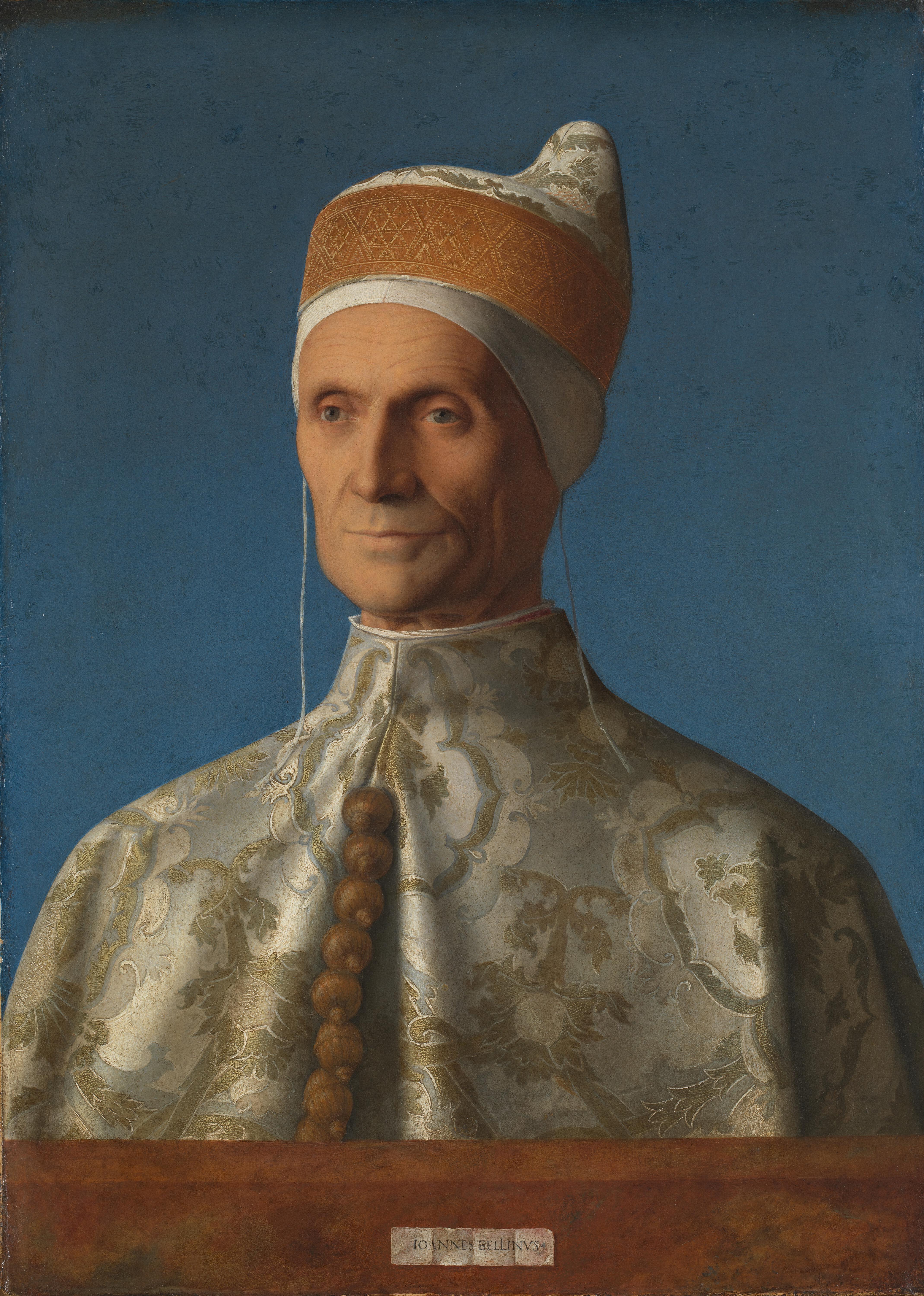
Doge Loredan

Giovanni Bellini, c.1501
RenaissancePortraits in 2D or 3DVenice
Doge Loredan by Giovanni Bellini
Giovanni Bellini, Portrait of Doge Leonardo Loredan, c. 1501–02, Oil on poplar wood panel, 61.4 × 44.5 cm, National Gallery, London

Overview

About This Work

Portrait of Doge Leonardo Loredan is an oil painting on poplar wood panel by the Venetian master Giovanni Bellini (c. 1435–1516), executed around 1501–1502. Now housed in the National Gallery in London (NG189), the work measures 61.4 × 44.5 centimetres—an intimate scale that is paradoxically both private and public in character. The painting depicts Leonardo Loredan, who had just been elected Doge (ruler) of Venice in 1501 at the age of 65, a position he would hold until his death in 1521. Bellini presents the newly inaugurated Doge in his formal ceremonial vestments—a magnificent white silk damask robe brocaded with gold and silver threads, adorned with spherical golden buttons (campanoni), and topped with the distinctive horn-shaped ducal cap (corno ducale). Yet despite the splendour of the office and regalia, Loredan's gaze is cast downward and inward, creating an impression of contemplation, wisdom, and psychological depth utterly unprecedented in official portraiture. The work represents the culmination of Giovanni Bellini's career as the official portraitist of Venetian doges and a masterpiece of Renaissance portraiture that synthesizes multiple artistic traditions. It demonstrates extraordinary technical mastery of oil painting—particularly in the rendering of aged flesh, luxurious fabrics, and subtle light effects. It merges the formal tradition of classical Roman portrait busts with the psychological realism pioneered by Leonardo da Vinci and Antonello da Messina. Most importantly, it proves that official portraiture need not be merely decorative or propagandistic; instead, it can embody profound psychological and spiritual depth while maintaining formal dignity. The portrait was virtually unknown until purchased for a pittance (thirteen guineas) in 1807 by the English collector William Thomas Beckford, who subsequently sold it to the National Gallery in 1844, where it has remained one of the institution's greatest treasures.

Visual Analysis

Composition

The Three-Quarter Pose: Classical and Modern Leonardo Loredan is depicted in three-quarter view—a compositional choice that represents a deliberate departure from established tradition. Medieval and Renaissance doges had been portrayed in profile, a formal and impersonal approach that emphasized official status without encouraging psychological engagement. By instead turning the sitter slightly toward the viewer, Bellini creates a more naturalistic, psychologically intimate representation while maintaining the formal dignity appropriate to the highest Venetian office. The composition directly recalls classical Roman portrait busts—the armless, half-length representation mounted on a stone parapet echoes the format of ancient imperial portraits. This visual reference asserts that the Venetian Doge inherits the authority of Roman emperors, that Venice itself is the successor to Rome's civilized order. Yet while recalling classical prototypes, Bellini surpasses them through the painterly effects impossible in stone: the subtle blending of color, the soft modeling of aged flesh, the luminosity of the white damask robe, the psychological depth conveyed through a single glance. The Downward Gaze: Contemplation and Authority Perhaps the most distinctive feature is Leonardo Loredan's gaze. His eyes are directed downward and inward, not toward the viewer. "Leonardo Loredan knows that he is being looked at, but he does not return our gaze." This refusal to meet the viewer's eyes is profoundly significant psychologically. Rather than the frontal stare that asserts direct authority or the profile that acknowledges the viewer's existence, Loredan appears lost in thought—contemplative, absorbed in private meditation. This gaze suggests multiple meanings simultaneously. It conveys spiritual introspection—the Doge contemplating his sacred responsibilities before God. It conveys temporal wisdom—a mind absorbed in the complex affairs of governing Venice. It conveys psychological distance—a remoteness that reinforces his elevated status. It conveys humility—the downward cast suggests a man aware of mortality and the weight of power. The effect is profoundly moving: rather than appearing imperious or unapproachable, Loredan appears vulnerable, contemplative, almost melancholic.

Colour & Light

The Face: Age, Experience, and Character The face is rendered with unflinching realism. At 65 years old, Loredan shows the accumulated effects of decades of life and service. His face is lined with wrinkles; his cheeks droop with age; his features are worn by experience. There is no idealization, no flattery. Yet paradoxically, this aged, lined face conveys not weakness but profound wisdom and measured authority. What makes the face so psychologically complex is the asymmetrical lighting. The right side of his face, illuminated by grazing light, shows pronounced wrinkles and shadows, emphasizing age and the marks of time's passage. This side conveys a certain severity and dignity earned through life experience. The left side of his face, more gently illuminated, appears softer and more kindly, suggesting warmth, mercy, and good nature. Bellini thus captures two contradictory aspects of character simultaneously: the hardness of authority and the softness of humanity; the weariness of age and the kindness of a mature conscience. The expression itself is subtly modeled. The mouth is closed with only the faintest hint of a smile—barely perceptible yet unmistakable to careful observation. This minimal gesture suggests both confidence and restraint. The eyes are described as "kind but shrewd"—a masterpiece of characterization achieved through the most delicate modeling. The Cerulean Background The background is a luminous cerulean blue—the color of Venice's Adriatic sky and waters. This pure blue serves multiple functions. Compositionally, it creates powerful contrast with the warm golds and whites of the Doge's robes, making those colors vibrate. Symbolically, it evokes Venice's identity as a maritime trading power—the Adriatic has made the Republic's fortune. Spiritually, the pure blue sky suggests heaven and divine sanction, elevating the Doge to an almost transcendent status. Yet the clarity and simplicity of the background also isolate the figure. There is no setting, no architectural context, no landscape. The Doge stands alone against infinite blue, suggesting both his isolation in his office and his elevation above ordinary human concerns. "He stands behind the ledge, inside yet outside, as if in Heaven."

Materials & Technique

The Vestments: Splendour and Symbolic Authority The Doge wears sumptuous ceremonial vestments reserved for the most solemn occasions. His robe is white silk damask woven with gold and silver metal threads, creating a luminous surface that catches and reflects light. Throughout the fabric is an intricate pattern of pomegranates embroidered in gold—a symbol of fertility, rebirth, and renewal. The white base suggests purity; the gold suggests Venice's vast wealth and the hope that prosperity will continue under Loredan's rule. Bellini renders this fabric with extraordinary virtuosity—showing its actual texture, weight, and the play of light across its surface. Over the robe is a short cape (mozzetta), and down the center front runs a vertical line of eight spherical golden buttons called "campanoni" (literally "big bells"). These buttons catch light brilliantly, their spherical surfaces reflecting illumination in a manner that demonstrates Bellini's absolute mastery of rendering metallic surfaces. Each button is rendered individually, yet collectively they create a visual axis drawing the eye downward. On his head, Loredan wears the distinctive "corno ducale"—the official horn-shaped ducal cap rendered in pale gold or white brocaded fabric. This extraordinary headpiece is one of the most recognizable symbols of Venetian authority. Oil Painting as Superior Medium One of the portrait's primary achievements is its demonstration of oil painting's superiority over tempera for portrait work. Bellini creates effects with oil that would be impossible in tempera. The subtle blending of colors, the soft transitions between light and shadow, the glazing that creates luminous depth—all depend on oil's slow-drying properties and capacity for layering. Most striking is the rendering of the aged, lined flesh. Bellini captures the transparency of thin, aged skin; the subtle modulations of tone; the delicate wrinkles that suggest a lifetime of expression. The white linen undercap is rendered with gossamer delicacy, appearing almost insubstantial. The golden damask robe seems to glow from within, its surface texture convincingly suggesting actual expensive fabric. Bellini demonstrates what he can achieve that a sculptor in stone cannot: the luminosity and softness that only painting can capture. The Stone Parapet and the Signature At the lower portion of the painting, a white stone parapet runs horizontally across the composition. This parapet creates visual separation between the viewer and the sitter—the Doge is elevated, positioned above the viewer's level. The parapet echoes the bases of classical portrait busts, reinforcing the comparison to Roman imperial portraiture. On this parapet is painted a small rectangular piece of paper—a cartellino—bearing the artist's signature: "IOANNES BELLINUS". The use of Latin signifies Bellini's classical learning and elevated status.

Historical Context

Context

Leonardo Loredan: The New Doge Leonardo Loredan was born in 1436 and had spent a lifetime in Venetian government before his election as Doge in 1501. His career exemplified the meritocratic character of the Venetian oligarchy: he had served on committees managing banking oversight (the "Giudici di Petizion" or Judges of Petitions), participated in foreign policy through the "Collegio dei Savi" (College of Wise Men), served as Podestà di Padova (governor of Padua, the major Venetian mainland city), and held Cabinet rank as Procuratore di San Marco. By the time of his election to the dogate at age 65, Loredan was an exceptionally experienced statesman. His election came at a moment of exceptional Venetian prosperity and power. Venice in 1501 was "almost certainly the richest city in the world" and the second-largest city in Europe after Paris. The Venetian Republic controlled an empire stretching across the Mediterranean and into the Balkans. Its maritime trading networks were unrivaled. Its wealthy merchant oligarchy had accumulated vast fortunes. The territory of the Republic covered approximately 27,000 square miles and had over 2 million inhabitants. The Tradition of Official Doge Portraiture Bellini had served as official portraitist for the doges of Venice from 1474 until his death in 1516—a tenure of over 40 years. In this role, he had painted official portraits of multiple doges. The portrait of Loredan was undoubtedly one of his most significant commissions: capturing the newly elected ruler in formal state dress, establishing his image for public memory and posterity. Bellini's Artistic Achievement At the time of painting this portrait (c. 1501–1502), Bellini was an old man—approximately 65–66 years old himself, the same age as his sitter. He had spent a lifetime perfecting the art of portraiture and had assimilated the technical innovations of his era. He had learned from Antonello da Messina, who had revolutionized Italian painting by introducing oil technique from the Netherlandish tradition. Bellini had synthesized this oil technique with Venetian light and color, creating a distinctive style characterized by luminosity, soft transitions, and psychological depth. The Loredan portrait represents the culmination of Bellini's career. It proves that official portraiture—portraiture constrained by the need to represent office, authority, and institutional power—need not be lifeless or merely decorative. Instead, through sensitivity to light, color, and psychology, Bellini created a portrait that is simultaneously formal and psychologically intimate, official and deeply human.

Key Themes

Official Portraiture with Psychological Depth

The Loredan portrait proves that official portraiture can embody psychological complexity without compromising formal dignity. John Pope-Hennessy, the great art historian, wrote: "By far the greatest fifteenth-century official portraitist" was Bellini, adding that "the tendency towards ideality that impairs his private portraits here stood him in good stead, and enabled him to codify, with unwavering conviction, the official personality." What Bellini achieves is a synthesis of office and individual. The magnificent vestments, the dignified pose, the elevated position behind the parapet—all assert official authority and institutional power. Yet the downward gaze, the subtle smile, the asymmetrical lighting revealing both severity and kindness—all reveal an individual human being with particular character. The portrait is simultaneously formal and intimate, public and private, official and personal. The Classical Reference Surpassed By organizing the portrait as a classical portrait bust—half-length, armless, mounted on a parapet—Bellini invokes the tradition of Roman imperial portraiture. Yet through painterly means, he creates effects that classical sculpture cannot achieve. The soft modeling through light and shadow, the luminosity of the fabrics, the subtle expression suggesting inner life—these are uniquely painterly effects. Bellini thus demonstrates that Renaissance painting can not merely equal but surpass the achievements of classical sculpture. The Pomegranate Symbolism The pomegranate motif woven throughout the robe carries profound meaning. In Christian tradition, pomegranates are often paired with images of the Virgin Mary, symbolizing fertility and renewal. When associated with a newly elected ruler, the pomegranate's symbolism transforms: it suggests that Loredan's election heralds "a new and prosperous era for Venice." The repetition of the motif throughout the fabric—pomegranates appearing and reappearing in regular pattern—also suggests unity (the pomegranate contains many seeds within a single fruit), appropriate to a Doge whose role is to unite the diverse interests of the Venetian state.

Exam Focus Points

Critical Perspectives

The Doge and Venetian Government: Explain the role of the Doge—elected for life, presided over oligarchic councils, both ceremonial figurehead and administrator. Leonardo Loredan's prior career demonstrated decades of service in various government positions before election. Venice's position in 1501 was as the wealthiest city in Europe, controlling a vast maritime empire. Three-Quarter Pose: Departure from Tradition: Explain why the profile pose was traditional for doges and why Bellini's three-quarter view was innovative. The pose creates psychological intimacy while maintaining formal dignity, connecting to classical Roman portrait busts yet surpassing them through painterly effects. The Downward Gaze: Psychological Meaning: Analyze why the sitter's refusal to meet the viewer's gaze is so significant. The gaze conveys contemplation, wisdom, spiritual introspection, and vulnerable humanity—a stark contrast to the frontal stare of traditional authority portraiture. Facial Expression and Asymmetrical Lighting: The right side (grazing light) shows wrinkles, severity, aged wisdom. The left side (softer light) appears kindly, gentle, merciful. Together they convey wisdom and authority combined with humanity and compassion. Balance of Official and Personal: The portrait achieves unprecedented intimacy within the formal portraiture tradition. It "encapsulates the community that the Doge represents in his own portrait." Formal vestments and pose are balanced by contemplative expression and downward gaze—neither purely official nor purely personal, but a synthesis of both.

On this page

OverviewVisual AnalysisHistorical ContextKey ThemesExam Focus Points