Santa Maria Novella (façade)
Alberti, 1456-70
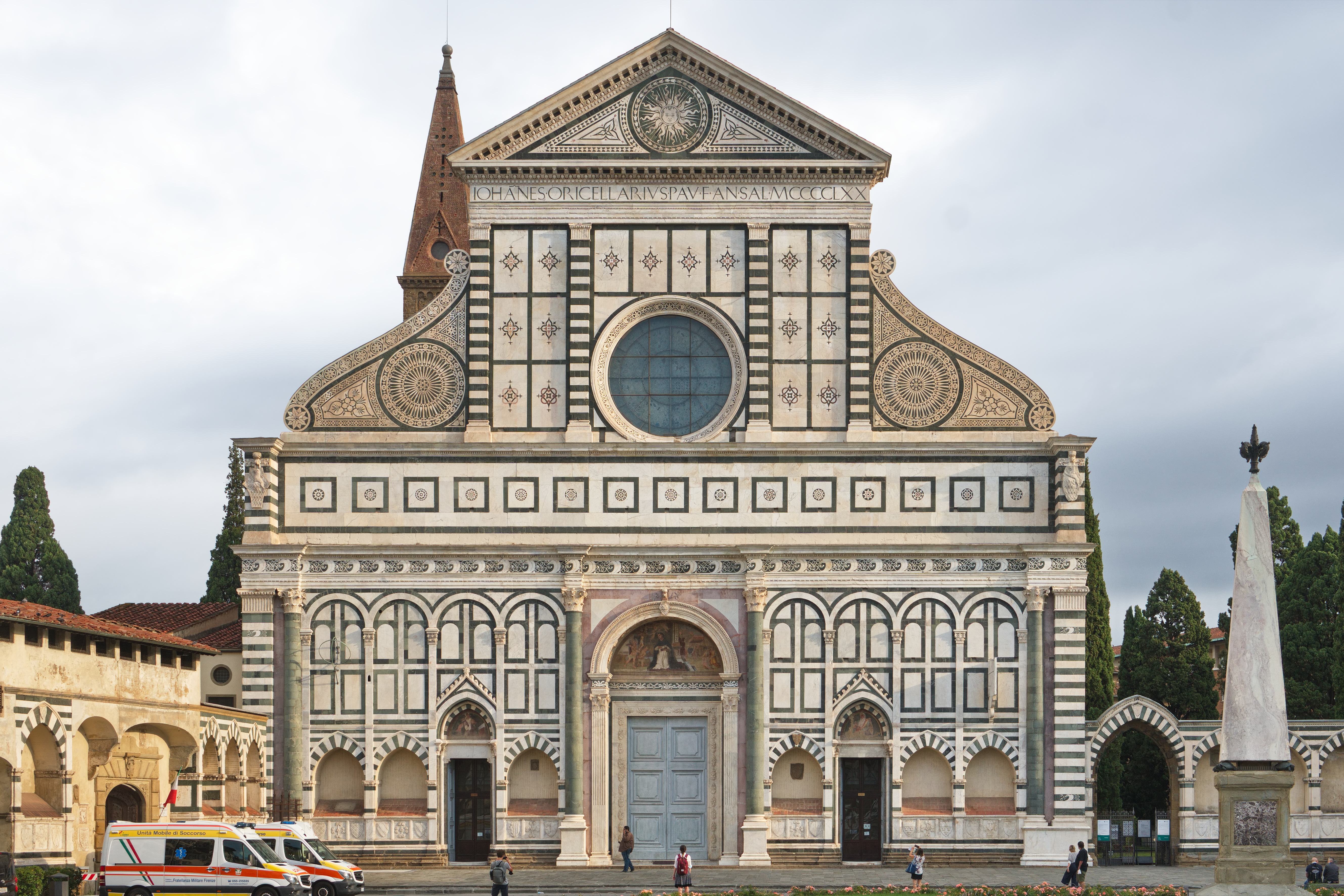
Overview
About This Work
Santa Maria Novella Façade is an architectural work by the Renaissance master Leon Battista Alberti (1404–1472), designed and constructed between 1456 and 1470 on the church of Santa Maria Novella in Florence. The work is revolutionary in multiple respects. It is the only large-scale church façade completed in Florence during the Renaissance—a fact that itself demonstrates its exceptional status in the architectural history of the period. The church building itself had been under construction since approximately 1276, having accumulated a lower façade section in the Tuscan Romanesque style (begun 1350), complete with six embedded tomb niches (avelli), three Gothic portals, and an existing rose window. Alberti's commission from the wealthy wool merchant Giovanni Rucellai required him to complete the façade while preserving all existing elements—a daunting constraint that inspired Alberti's most profound artistic solution. What makes the Santa Maria Novella façade extraordinary is not merely its beauty (though it is undeniably beautiful), but rather the sophisticated proportional system underlying its design. The entire façade fits within a single square (width equals height), subdivided according to Pythagorean ratios (1:1, 1:2, 1:3, 2:3, 3:4, etc.)—mathematical relationships derived from the principles of musical harmony. Alberti believed, following Neoplatonic philosophy, that the same numerical ratios that govern musical consonance also govern visual beauty. Every element of the façade—from the overall composition to the smallest decorative detail—is governed by these mathematical relationships. The façade thus represents a synthesis of Tuscan Romanesque tradition (in its bichrome marble patterning) with newly recovered classical principles (in its proportional system and architectural orders). It demonstrates how Renaissance architects could revive classical ideals while accommodating medieval traditions, creating harmony between old and new through the power of proportion and geometry.