History of (tagg)Art...
HomeNatureIdentityRenaissanceBaroque

Nature

  • All Nature artworks
  • Landscape or Seascape in 2D
  • Animals in 2D or 3D
  • The Elements (Fire, Water, Wind or Earth) in 2D or 3D
  • +3 more topics

Identity

  • All Identity artworks
  • The Divine in 2D or 3D Works
  • Portraits in 2D Works
  • Portraits in 3D Works
  • +3 more topics

Renaissance

  • All Renaissance artworks
  • Religious Painting
  • Religious Sculpture
  • Mythological in 2D or 3D
  • +3 more topics

Baroque

  • All Baroque artworks
  • Religious Painting
  • Religious Sculpture
  • Mythological Painting
  • +6 more topics

About

A comprehensive study resource for Pearson Edexcel History of Art A-Level.

NatureIdentityRenaissanceBaroque

History of (tagg)Art... - A-Level Study Resource

Pearson Edexcel Specification

Admin
  1. Home
  2. Renaissance
  3. Pope Julius II

Pope Julius II

Raphael, 1511-12
RenaissancePortraits in 2D or 3DRome
Pope Julius II by Raphael
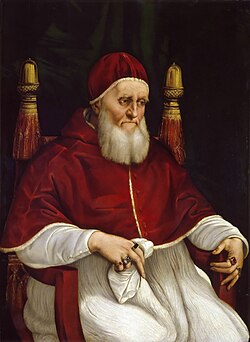
Portrait of Pope Julius II by Raphael, 1511-12, oil on poplar panel, National Gallery, London

Overview

About This Work

Portrait of Pope Julius II is an oil painting on poplar wood panel by Raphael (Raffaello Sanzio da Urbino, 1483–1520), executed between June 1511 and March 1512. Now housed in the National Gallery in London (confirmed as the original in 1970 through scientific analysis), the work measures 108.7 × 81 centimetres. The painting depicts Pope Julius II (Giuliano della Rovere, 1443–1513), one of the most powerful and controversial pontiffs in history, shown as an aged, careworn man seated in contemplative repose. His full white beard, grown as a sign of mourning for the loss of Bologna to French forces, frames a face lined with the burdens of age and leadership. His downturned gaze is directed inward rather than outward toward the viewer, creating an impression of introspection and melancholy utterly unprecedented in papal portraiture. The work introduces revolutionary psychological depth into religious and political portraiture, revealing human vulnerability behind absolute authority. It established a model for ecclesiastical portraiture that would dominate for approximately two centuries.

Visual Analysis

Composition

The most striking feature is the face of Julius II—a visage of extraordinary psychological complexity. The Pope is 68 years old, his face lined and weathered, cheeks drooping with age, eyes deep-set beneath bushy eyebrows. His prominent nose dominates the face. These are not idealized features; they are unflinching, physiognomically accurate rendering of an elderly man. The Pope's gaze is cast downward and inward, not toward the viewer. His mouth is closed, lips slightly parted, creating an impression of contemplation and almost melancholic resignation. This is utterly unprecedented in papal portraiture—previous popes had been depicted facing the viewer frontally or kneeling in profile, expressions serene and dignified. Raphael's Julius II appears vulnerable—tired, meditative, burdened by office. The three-quarter pose creates psychological distance between Pope and viewer. We observe him, yet he is not addressing us. He exists in his own interior world—a daring compositional decision suggesting the Pope's power derives from internal spiritual authority rather than interaction with the viewer.

Colour & Light

The background is a deep, muted green—almost black. This dark, minimalist background creates dramatic isolation of the figure. There is no setting, no architectural context, no landscape. Julius exists in a void of green shadow, with only his red robes and white beard providing luminosity against the darkness. The effect is claustrophobic and introspective. Within this green background, faintly visible are the papal insignia—crossed keys and tiara—woven into a decorative pattern. The pattern is so subtle it is barely noticeable, suggesting authority is present yet transcended by individual humanity. X-ray analysis in 1970 revealed Raphael originally painted this pattern in gold, then covered it—evidence of the painting's originality. The controlled lighting emphasizes Julius's face and hands. Light appears to come from the left, creating subtle modeling through chiaroscuro. The face is darker and more weathered than the hands, which appear luminous and pale—almost translucent with age. This contrast reinforces psychological content: the face shows marks of lived experience; the hands suggest physical fragility and mortality.

Materials & Technique

Despite emotional and physical vulnerability, Julius is dressed in sumptuous papal vestments asserting unquestionable authority: a white alb (undergarment), crisp and pure; a deep red mozzetta (short cape) lined and edged with ermine fur—the white fur with characteristic black spots; a red camauro (shoulder cape); and a red velvet papal cap. Red signifies papal authority, the blood of martyrs, and divine grace. The ermine represents sacred authority and nobility. Raphael renders these materials with such delicate softness that they do not overwhelm the fragile figure. The materials almost swallow the man—he is consumed by his office, protected yet isolated by elaborate garments. The contrast between splendor of vestments and vulnerability of the aging figure creates poignant psychological tension. The Pope's hands are rendered with extraordinary psychological sensitivity. His right hand holds a ceremonial cloth—not wielding a staff or blessing the viewer, but simply holding cloth, suggesting vulnerability, even physical weakness. His left hand grasps the armrest with visible tension—aged, spotted, almost skeletal—gripping as if clinging for support. This is not the gesture of an imperious ruler; it is an aging man holding on for stability.

Historical Context

Context

Pope Julius II (Giuliano della Rovere, 1443–1513) was one of the most extraordinary figures in papal history. Elected Pope in 1503 at age 60, he chose his name to emulate Julius Caesar—a remarkable assertion equating papal and imperial authority. Known as Il Papa Terribile ("the Terrible Pope"), he personally led military campaigns, recovering papal lands through conquest, defeating Venice in 1509, and forming the Holy League to expel French forces from Italy. Yet Julius was also one of history's greatest art patrons. He commissioned Michelangelo's Sistine Chapel ceiling (1508–1512), Raphael's Vatican apartments decoration, and the rebuilding of St. Peter's Basilica. His use of art as propaganda was calculated and sophisticated. In 1510, Julius suffered profound military defeat—Bologna was lost to the French. At this moment of humiliation, Julius grew his white beard as a sign of mourning and mortification, vowing not to shave until Bologna was recovered. This vow was fulfilled in 1512, but the beard remains visible in this portrait. The crisis also triggered serious illness. Raphael captured Julius at a moment of vulnerability—not a triumphant pope in fullness of power, but a wounded, aging leader confronting mortality.

Key Themes

Revolutionary Psychological Portraiture

The fundamental innovation is the introduction of unprecedented psychological depth into religious portraiture. Rather than depicting the Pope as a figure of undeniable authority and serene dignity, Raphael reveals the human being behind the office—tired, vulnerable, contemplative, aware of mortality. This was influenced by Leonardo da Vinci's pioneering portraiture revealing psychological interiority. Raphael adapted Leonardo's techniques—subtle use of light and shadow (sfumato-like effects) to suggest emotional states—yet transformed them with his own characteristic softness and balance. What makes the portrait so profound is its fundamental paradox: it presents a figure of immense authority who is simultaneously vulnerable and fragile. The red robes, papal insignia, golden della Rovere acorns, ceremonial chair—all assert power and divine authority. Yet the expression, the gaze, the hand grasping the armrest, the trembling cloth—all suggest a tired, aging man struggling to maintain composure. This is not propaganda of conventional sort. It does not show the Pope in triumph. Yet it is profoundly propagandistic—it asserts authority through revealing humanity and vulnerability, suggesting the Pope's power derives from inner spiritual force that transcends physical age and weakness.

Exam Focus Points

Critical Perspectives

Key examination points include: 1) Revolutionary psychological portraiture—why depicting a pope in vulnerable, introspective state was unprecedented; 2) The three-quarter pose and downward gaze—how averted gaze creates emotional distance and suggests internal authority; 3) The Bologna crisis and the beard—historical significance of the white beard as mourning symbol; 4) The hands—psychological vulnerability shown through the handkerchief and the tense grip on the armrest; 5) Vestments and insignia—how materials assert authority while figure suggests vulnerability; 6) The della Rovere acorns—heraldic significance on the chair posts; 7) Color and light—role of deep green background and controlled lighting; 8) Leonardo's influence—comparison to Mona Lisa in psychological depth; 9) Scientific attribution—the 1970 breakthrough confirming the National Gallery version as original through X-ray analysis revealing the overpainted gold pattern.

On this page

OverviewVisual AnalysisHistorical ContextKey ThemesExam Focus Points