Palazzo Medici
Michelozzo, 1444-84
Overview
About This Work
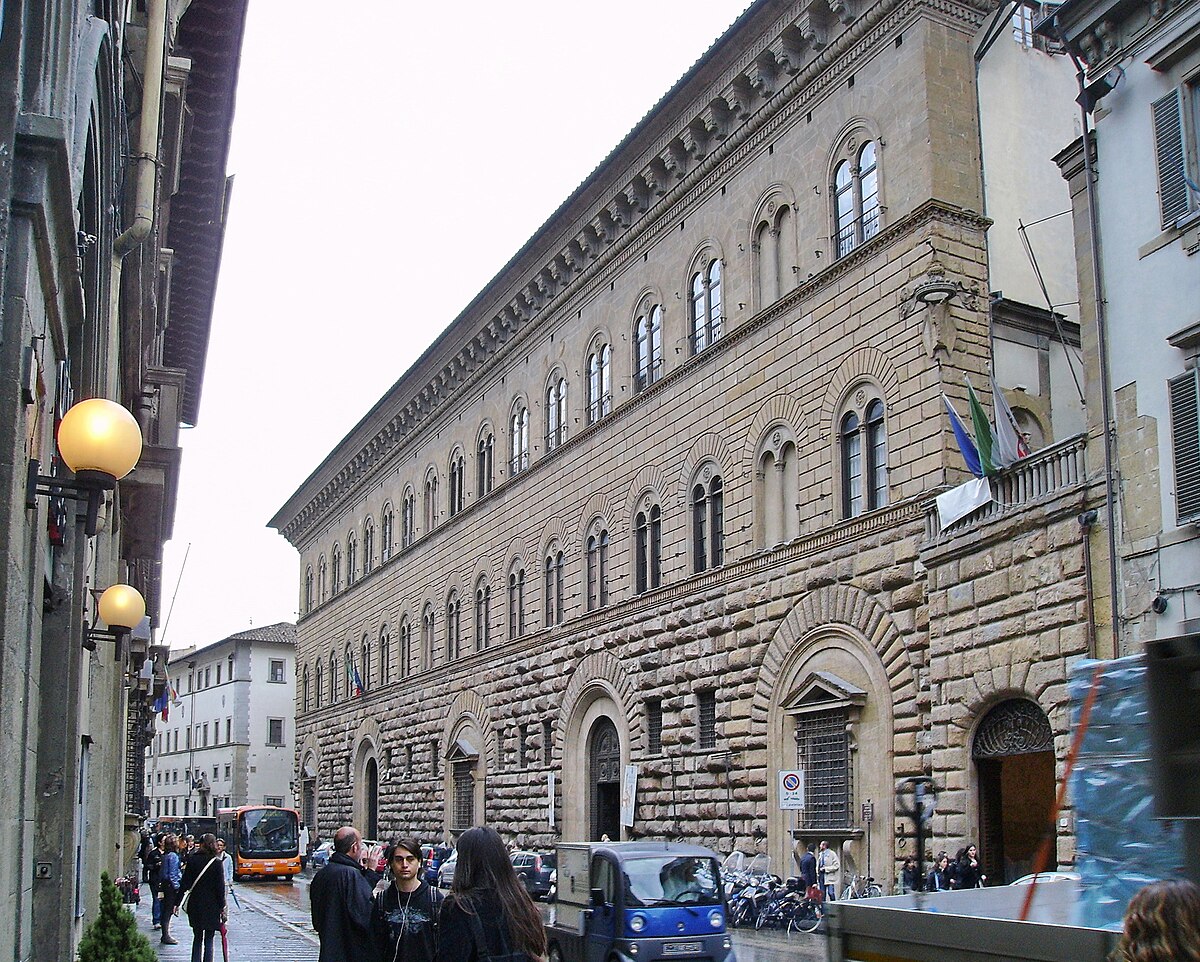
Palazzo Medici (also called Palazzo Medici-Riccardi after its acquisition by the Riccardi family in 1659) is a Renaissance palace in Florence designed by architect Michelozzo di Bartolomeo and commissioned by Cosimo de' Medici the Elder in 1444. Construction began immediately and continued through approximately 1460, with final details completed by 1484. The palace stands as a turning point in the history of civic architecture: it is the first monumental Renaissance palace built in Florence and became "the prototype of the Tuscan Renaissance palazzo," establishing conventions that would be followed by all subsequent Renaissance palace design. The palazzo represents a brilliant political and architectural compromise. When Cosimo commissioned the work, he rejected designs by Filippo Brunelleschi—the greatest architect of the age—because Brunelleschi's proposals were "too bombastic and pretentious" and might "arouse the envy of fellow citizens." Instead, Cosimo chose Michelozzo's more refined and restrained design, which successfully displayed Medici wealth and power while maintaining the appearance of republican modesty and civic responsibility. The result is a building of extraordinary visual sophistication: a three-story facade organized through graduated stonework (rough rustication at the base ascending to smooth ashlar above), crowned by a revolutionary classical cornice, surrounding a colonnaded courtyard organized according to Renaissance principles of proportion and mathematical harmony. The Palazzo Medici demonstrates Renaissance synthesis of medieval and classical traditions. The rusticated ground story recalls medieval fortress palaces, conveying strength and impregnability. The refined upper stories, with their classical moldings and proportioned windows, express cultivation and learning. The crowning cornice—a ten-foot-high classical entablature removed from its traditional context and adapted to contemporary use—expresses mastery of classical vocabulary and its modern application. Internally, the colonnaded courtyard with Corinthian columns and Donatello's bronze David expresses classical ideals of beauty and proportion while serving practical functions as the palace's spatial and organizational heart.