History of (tagg)Art...
HomeNatureIdentityRenaissanceBaroque

Nature

  • All Nature artworks
  • Landscape or Seascape in 2D
  • Animals in 2D or 3D
  • The Elements (Fire, Water, Wind or Earth) in 2D or 3D
  • +3 more topics

Identity

  • All Identity artworks
  • The Divine in 2D or 3D Works
  • Portraits in 2D Works
  • Portraits in 3D Works
  • +3 more topics

Renaissance

  • All Renaissance artworks
  • Religious Painting
  • Religious Sculpture
  • Mythological in 2D or 3D
  • +3 more topics

Baroque

  • All Baroque artworks
  • Religious Painting
  • Religious Sculpture
  • Mythological Painting
  • +6 more topics

About

A comprehensive study resource for Pearson Edexcel History of Art A-Level.

NatureIdentityRenaissanceBaroque

History of (tagg)Art... - A-Level Study Resource

Pearson Edexcel Specification

Admin
  1. Home
  2. Renaissance
  3. Sir John Hawkwood Memorial

Sir John Hawkwood Memorial

Paolo Uccello, 1436
RenaissancePortraits in 2D or 3DFlorence
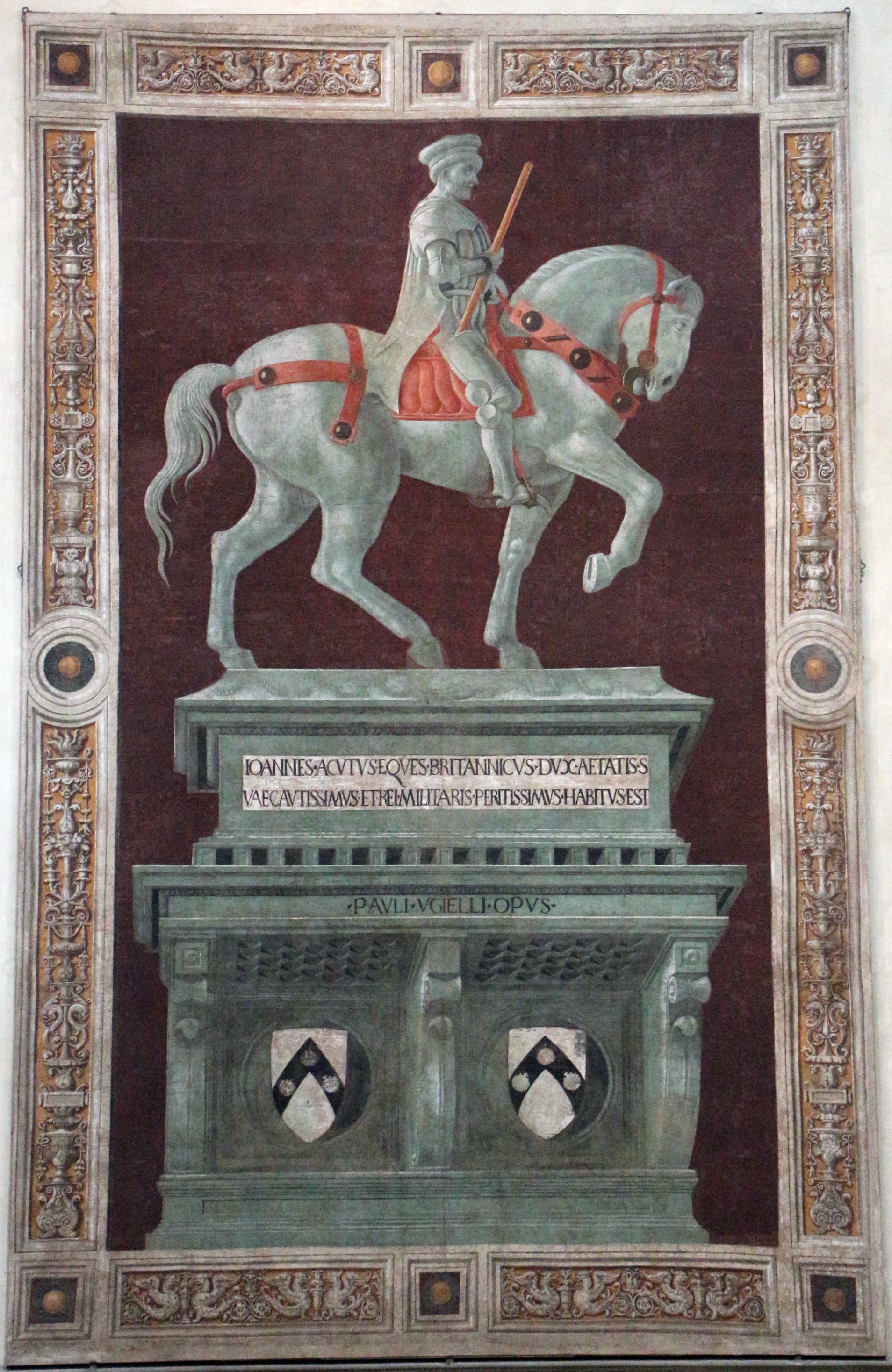
Sir John Hawkwood Memorial by Paolo Uccello
Funerary Monument to Sir John Hawkwood, Paolo Uccello, 1436, fresco transferred to canvas, Florence Cathedral

Overview

About This Work

Funerary Monument to Sir John Hawkwood (Italian: Monumento a Giovanni Acuto) is a monumental fresco by the Florentine master Paolo Uccello (1397–1475), commissioned in 1436 and painted on the interior north wall of Florence Cathedral (Santa Maria del Fiore). The work measures approximately 8.5 metres tall by 5.3 metres wide—a scale befitting its prominent cathedral location. The fresco depicts an illusionistic equestrian monument in trompe-l'oeil style, created entirely in shades of green earth (terra verde) and monochromatic tones to simulate stone sculpture. It commemorates Sir John Hawkwood (Giovanni Acuto), an English mercenary who had commanded Florentine military forces and died in 1394. The work is historically significant as the oldest authenticated surviving work by Paolo Uccello, establishing his reputation as a master of linear perspective. It represents an innovative solution to military commemoration—painting an equestrian monument rather than sculpting one, achieving impressive visual effect at lower cost.

Visual Analysis

Composition

The fresco is organized into two distinct but integrated registers: a lower architectural plinth and an upper equestrian figure. This two-part structure imitates the traditional monument type—a funerary chest surmounted by a rider on horseback, suggesting the contrast between earthly death (the sarcophagus) and immortal fame (the eternally mounted warrior). The lower register depicts an elaborate funerary chest or sarcophagus shown in foreshortening—viewed from below the spectator's eye level. The plinth is decorated with heraldic shields bearing Hawkwood's coats of arms, and a Latin inscription. Above the sarcophagus stands Sir John Hawkwood mounted on a white horse, depicted in profile facing left. The figure wears armor rendered in pale green tones, yet notably wears a commander's cap rather than a helmet. In his raised hand, Hawkwood carries a marshal's baton—the symbol of military authority—while his sword remains significantly sheathed.

Colour & Light

The entire fresco is painted in terra verde (green earth pigment) on a red background. This monochromatic approach simulates the appearance of stone sculpture. The viewer's initial impression is of an actual relief sculpture or carved monument integrated into the cathedral wall. The monochromatic effect is enhanced through masterful chiaroscuro—the modeling of form through light and shadow. The light appears to come from the left, consistent with the cathedral's natural lighting. Strong shadows create depth and volumetric form. This is trompe-l'oeil (literally "trick of the eye")—an illusionistic technique designed to deceive the viewer into perceiving a two-dimensional surface as three-dimensional form.

Materials & Technique

The horse is rendered with extraordinary anatomical precision and sculptural quality. Every muscle is carefully modeled through subtle gradations of light and shadow that create the impression of three-dimensional form carved in stone. Yet there is a peculiarity: both of the horse's right legs are raised simultaneously—anatomically impossible. Giorgio Vasari criticized this as a serious artistic error, but scholars now understand this is not a mistake but a consequence of Uccello's complex perspective construction. Unlike Alberti's theoretical system with a single vanishing point, Uccello employs two different vanishing points. The sarcophagus is constructed to be viewed from below, while the horse and rider follow a different spatial logic at approximately eye level.

Historical Context

Context

Sir John Hawkwood (c. 1320–1394), known in Italy as Giovanni Acuto, was an English soldier of fortune of remarkable prominence. Born in Sible Hedingham, Essex, he distinguished himself during the Hundred Years' War before achieving fame serving Italian city-states as a mercenary commander (condottiero). Hawkwood served multiple Italian powers: the Papacy, Milan, Padua, and Florence. His greatest victory was the Battle of Castagnaro (1387). He commanded Florentine military forces from 1377 until his death in 1394. The Opera del Duomo commissioned the fresco in 1436. When Uccello completed the initial version, the patrons were dissatisfied and ordered him to repaint it. The final accepted version remains in the cathedral today.

Key Themes

Perspective as Geometric Abstraction

The most significant aspect of the Hawkwood fresco is what it reveals about Uccello's philosophy of perspective. Unlike Alberti's theoretical system, which aimed at producing a transparent optical window into space, Uccello's perspective is deliberately complex, even contradictory. The multiple vanishing points, the horse's impossible anatomy, the spatial tension between the sarcophagus (viewed from below) and the rider (viewed at eye level)—these are not failures of technique but deliberate choices. Uccello was less interested in creating perfect optical illusion than in exploring perspective as a geometric system for organizing pictorial space. Art historian Robert Paoletti writes that Uccello's fresco is "more a portrayal of the idea of a warrior than of a warrior in flesh and blood."

Exam Focus Points

Critical Perspectives

Commission and Patronage: Why did the Opera del Duomo commission a painted monument rather than a sculptural one? What does the choice of Uccello reveal about Florence's artistic ambitions? The Condottiero System: Explain Hawkwood's career as an English mercenary in Italy. What was the condottiero system and why was it essential to Italian warfare? Trompe-l'Oeil Illusion: Explain the technique of creating an illusionistic monument in paint. How does monochromatic terra verde enhance the illusion? The Horse and Anatomical Anomaly: Explain the unusual positioning of both right legs raised. Why did Vasari criticize this? Why is it actually justified within Uccello's perspective system? Revolutionary Perspective Construction: Explain the use of two different vanishing points. How does the sarcophagus perspective differ from the rider's perspective?

On this page

OverviewVisual AnalysisHistorical ContextKey ThemesExam Focus Points