History of (tagg)Art...
HomeNatureIdentityRenaissanceBaroque

Nature

  • All Nature artworks
  • Landscape or Seascape in 2D
  • Animals in 2D or 3D
  • The Elements (Fire, Water, Wind or Earth) in 2D or 3D
  • +3 more topics

Identity

  • All Identity artworks
  • The Divine in 2D or 3D Works
  • Portraits in 2D Works
  • Portraits in 3D Works
  • +3 more topics

Renaissance

  • All Renaissance artworks
  • Religious Painting
  • Religious Sculpture
  • Mythological in 2D or 3D
  • +3 more topics

Baroque

  • All Baroque artworks
  • Religious Painting
  • Religious Sculpture
  • Mythological Painting
  • +6 more topics

About

A comprehensive study resource for Pearson Edexcel History of Art A-Level.

NatureIdentityRenaissanceBaroque

History of (tagg)Art... - A-Level Study Resource

Pearson Edexcel Specification

Admin
  1. Home
  2. Renaissance
  3. Tempietto

Tempietto

Bramante, 1502
RenaissanceReligious ArchitectureRome
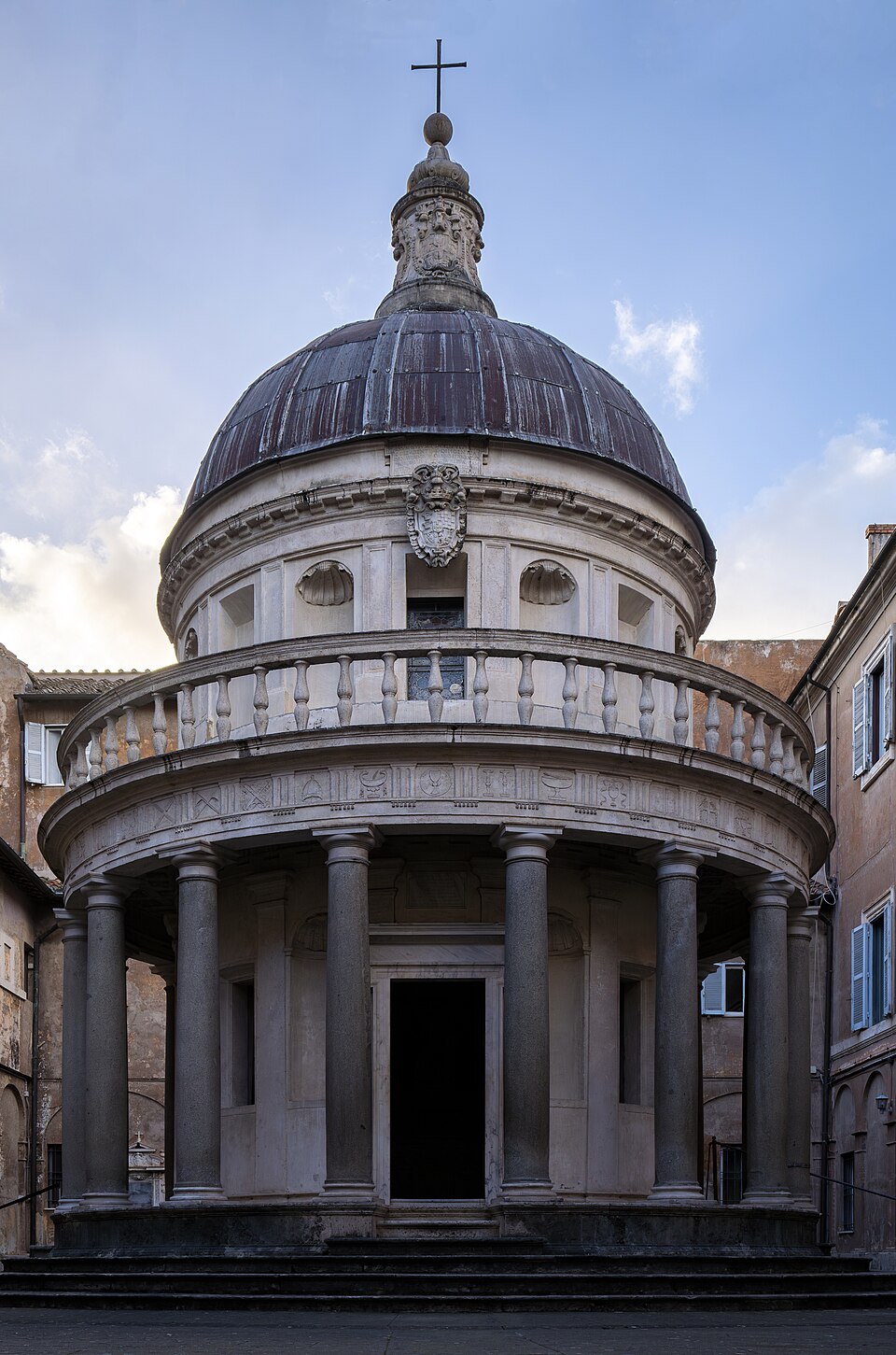
Tempietto by Bramante
Tempietto by Donato Bramante, 1502–1510. San Pietro in Montorio, Rome.

Overview

About This Work

Tempietto (Italian diminutive of "temple," literally "little temple"; its full title is Tempietto di San Pietro in Montorio) is a small circular chapel designed by the Renaissance master Donato Bramante (1444–1514) and erected between 1502 and 1510 in the courtyard of the church of San Pietro in Montorio on the Janiculum Hill in Rome. The work was commissioned by Ferdinand II of Aragon and Isabella I of Castile, the Catholic Monarchs of Spain, to commemorate the traditional site of Saint Peter's crucifixion. The building stands as one of the supreme masterpieces of Renaissance architecture and represents a turning point in European architectural history: it was the first Renaissance building to successfully revive the classical peripteral temple form (a temple surrounded by a colonnade) since classical antiquity—a hiatus of over 1,000 years. It was also the first Renaissance structure to employ the Doric order correctly, including properly proportioned triglyphs and metopes, demonstrating Bramante's profound study of the ancient architect Vitruvius and the Roman ruins surrounding him in Rome. The Tempietto exemplifies the High Renaissance synthesis of classical revival and Christian meaning. Although superficially it appears to be an ancient Roman temple, internally it functions as a martyrium (a memorial structure marking a sacred martyrdom site) and houses both an upper chapel for prayer and a lower crypt marking the actual spot where Peter was believed to have been executed. The building's perfectly centralized plan, with sixteen columns arranged in a circle radiating outward from the sacred center, embodies Renaissance Neoplatonic philosophy—the belief that mathematical proportion and geometric perfection reflect divine order. Despite its tiny interior (only about 14.5 feet in diameter), the Tempietto exerted enormous influence on subsequent Renaissance and Baroque architecture, establishing principles that would govern church design for centuries. It stands as a supreme demonstration of how great architecture can be achieved not through size or complexity, but through perfection of proportion and clarity of geometric vision.

Visual Analysis

Composition

The Tempietto's most distinctive feature is its perfectly centralized, circular plan. When viewed from above, the building consists of two concentric circles: an inner solid cylinder (the cella, or sacred inner chamber) surrounded by an outer ring of sixteen columns (the peristyle). This arrangement creates a radial geometry in which all architectural elements organize themselves around a single central point—the traditional site of Saint Peter's martyrdom. This circular plan is fundamentally different from the Latin cross basilica plan that dominated medieval Christian architecture. A basilica is directional—it has a clear front (the altar) toward which the viewer processes, and a back. By contrast, the circular plan of the Tempietto is non-directional: it is equally accessible from all sides, with no privileged "front" elevation. This geometric choice expresses profound theological meaning: the sacred center is not at the end of a processional pathway but at the very heart of the building, accessible from all directions. The viewer can circumambulate (walk around) the building, approaching the sacred interior from any angle. The building is surrounded by sixteen columns arranged in perfect circle. These columns are rendered in the Doric order (called Tuscan order in Renaissance terminology), the simplest and most masculine of the classical orders. The columns themselves are remarkably eclectic: the gray-granite shafts were salvaged from ancient Roman buildings (a common Renaissance practice of reusing classical materials), while the capitals and bases are newly carved white marble from the Renaissance period. This mingling of ancient and modern materials is symbolically significant: it suggests the continuity between classical Rome and Renaissance Rome, between pagan classical civilization and Christian civilization. The Doric order was traditionally associated with temples to gods of strength (Mars, Hercules); by extension, it was deemed appropriate for Saint Peter, the "rock" upon which the church was built, symbolizing strength and durability. The number of columns—sixteen—carries symbolic weight. When halved, sixteen becomes eight, a number that in Christian symbolism represents salvation, regeneration, and resurrection. The sixteen columns thus subtly encode Christian meaning within classical form.

Colour & Light

The color scheme demonstrates Renaissance appreciation for contrasts and textures: Gray-granite column shafts (salvaged from ancient Rome) create dark, dramatic vertical accents. White marble capitals, bases, and entablature provide sharp, crisp detailing. Cream-colored travertine walls of the cella and dome create warm, unified surfaces. The interplay of light and shadow across the grooved Doric columns creates visual vibration and emphasizes the building's classical ancestry. In Mediterranean sunlight, the deep shadows of the colonnade frame the pristine white entablature and travertine interior, creating a composition of remarkable visual beauty. Above the columns rises the classical entablature—the horizontal band of moldings that crowns the columns in classical architecture. The entablature consists of (from bottom to top): a plain architrave (undecorated horizontal beam), a frieze with alternating triglyphs and metopes (vertical grooved blocks and square panels between them), a cornice with dentil molding (small rectangular blocks creating visual articulation), and a small balustrade with square balusters (rail with small posts) running around the upper edge. This entablature is historically significant because it represents the first correct application of the Doric entablature in Renaissance architecture. The metopes (the square panels in the frieze) are decorated with papal symbols—references to Christian prayer and the authority of Saint Peter and the papacy. Thus the frieze, while classically correct in form, carries Christian content. Above the cella rises the drum—a cylindrical wall decorated with smaller pilasters and rectangular windows. The drum is crowned by a perfect hemispherical dome covered in lead. The proportions are mathematically precise: the height of the drum equals the height of the dome, creating perfect visual balance. A small lantern with a cross crowns the dome's apex, directing the eye heavenward. The dome represents the vault of heaven. Inside, the dome surface is decorated with painted gold stars on a blue sky—a reference to the Christian heaven. When standing inside the Tempietto, gazing upward into the dome, one experiences the impression of looking into the celestial sphere itself, a profound spiritual effect.

Materials & Technique

The entire structure rests on a rusticated base—large blocks of rough-faced stone typical of Renaissance fortress architecture. Above the base is a stepped platform (stylobate) that elevates the building slightly above the courtyard floor. This platform is approached by steps that invite ascent, creating a ritualistic progression from the secular courtyard into the sacred interior. The rustication (rough-faced blocks) expresses structural solidity and permanence, recalling Roman imperial architecture. The contrast between the crude rustication below and the refined colonnade above creates visual drama and visual hierarchy—the classically refined structure rises from a sturdy, elemental base. Rising above the entablature is the cella, the inner cylindrical chamber. The outer wall of the cella is articulated by sixteen pilasters (flattened columns) that correspond to the sixteen columns of the peristyle below. These pilasters narrow slightly as they ascend—a subtle tapering that creates visual refinement and suggests the building rises toward heaven. Between the pilasters are alternating deep and shallow niches. These niches would traditionally contain statuary, creating visual variety on the otherwise cylindrical surface. Small rectangular windows at multiple levels provide interior illumination, ensuring even light throughout the interior space. The materials demonstrate Renaissance synthesis of old and new: reused ancient Roman granite for the column shafts combined with new Renaissance marble for the capitals and bases, travertine for the walls and dome structure, and lead covering for the dome exterior. This combination of salvaged and new materials symbolizes the continuity between classical Rome and Renaissance Rome.

Historical Context

Context

The Tempietto was commissioned by Ferdinand II of Aragon and Isabella I of Castile, the Catholic Monarchs of Spain who had sponsored Columbus's voyage to the Americas in 1492 and had recently completed the Spanish Reconquista (reconquest of Spain from Muslim rule). They were at the height of their political and military power, and sought to demonstrate their piety and cultural patronage in papal Rome by funding the construction of a magnificent memorial to Saint Peter on the supposed site of his martyrdom. According to tradition, Saint Peter was crucified in Rome under the Emperor Nero and buried on this location—the future site of Saint Peter's Basilica and Vatican. The San Pietro in Montorio (Church of Saint Peter on the Janiculum Hill) was built to commemorate this martyrdom, and the church was consecrated in 1500 under Pope Alexander VI. The Tempietto was added in 1502 to provide a more prominent, classically refined memorial to the martyrdom site. Bramante had moved to Rome around 1499, having previously worked on architectural projects in Milan. Rome proved transformative for his artistic development. The city was surrounded by the remains of classical Roman architecture—temples, arches, aqueducts, the Pantheon, the Temple of Vesta at Tivoli, and countless other buildings offering lessons in classical proportion and form. Bramante studied these ruins intensively. He consulted Vitruvius's De architectura—the only surviving treatise on Roman architecture, which had been printed in multiple editions since 1486. This text provided theoretical justification and practical guidance for reviving classical forms. Bramante's access to both material ruins and theoretical texts made Rome the ideal environment for his studies. The Tempietto was Bramante's first major independent work in Rome, designed before his larger, more famous commission: the rebuilding of Saint Peter's Basilica itself (begun 1506, for which Bramante was named chief architect). The Tempietto represents Bramante's emerging mastery of classical architecture and his philosophical conviction that Renaissance architecture could revive classical ideals after a thousand-year gap. According to documentation by the Renaissance architect and theorist Sebastiano Serlio, Bramante originally designed the Tempietto to stand within a circular courtyard with a circular colonnade. This unbuilt design is of profound significance because it would have created a "building within building" experience—the circular colonnade of the courtyard would mirror and echo the circular colonnade of the Tempietto itself, creating concentric circles of increasing scale. The courtyard was never built (a rectangular courtyard was constructed instead, compromising the original vision). Yet Bramante's unbuilt design demonstrates that he conceived the Tempietto not as an isolated monument but as the center of a carefully orchestrated spatial experience.

Key Themes

Connection to Renaissance

Exam Focus Points

Critical Perspectives

The Martyrium Function and Patronage: Why was the Tempietto built and on what site? (Commemorate Saint Peter's crucifixion). Who commissioned it and why? (Ferdinand and Isabella, Spanish Catholic Monarchs). Meaning of martyrium: structure marking site of martyrdom. The Peripteral Temple Form: Explain peripteral temple plan: cella surrounded by peristyle. Why is this form historically significant? (First Renaissance peripteral; first since antiquity). Classical precedents: Temple of Vesta, Pantheon, Greek temples. How did Bramante synthesize classical temple form with Christian martyrium? The Centralized, Circular Plan: Non-directional geometry: accessible from all angles. Contrast to medieval basilica plan (processional, directional). Sacred center rather than end-point of procession. Concentric circles radiating from martyrdom site. The Sixteen-Column Peristyle: Perfect circle of Doric columns. Symbolic number: 16 halved = 8 (salvation, resurrection, regeneration). Gray-granite shafts (salvaged Roman material) + white marble capitals (Renaissance). Mingling of ancient and modern materials. The Doric Order: Correct Application: First Renaissance building to employ Doric order correctly. Proper proportions per Vitruvius. Correct triglyphs and metopes in frieze. Doric suited to Saint Peter's strength (masculine order). Demonstrates Bramante's classical scholarship. Mathematical Proportions: Peristyle width equals cella height (1:1 ratio). Drum and dome equal height (1:1). Interior diameter ~14.5 feet; height ~29 feet (1:2). Height-to-width ratios of 3:5. Vitruvian proportions; mathematical harmony reflecting divine order. Neoplatonic Philosophy: Circle as perfect, eternal form. Geometric perfection as expression of divine order. Mathematics as path to understanding cosmic harmony. Renaissance belief in proportional beauty. The Unbuilt Circular Courtyard: Bramante originally designed circular courtyard surrounding Tempietto. Documented by Sebastiano Serlio. Concentric circles of increasing scale. Never executed; rectangular courtyard built instead. Demonstrates Bramante's larger spatial vision. Small Scale, Great Impact: Interior diameter only ~14.5 feet (very small). Yet historically and artistically seminal. Demonstrates that greatness comes from proportion and clarity, not size. Monument to be viewed primarily from outside.

On this page

OverviewVisual AnalysisHistorical ContextKey ThemesExam Focus Points